Advances in Engineering Advances in Engineering features breaking research judged by Advances in Engineering advisory team to be of key importance in the Engineering field. Papers are selected from over 10,000 published each week from most peer reviewed journals.

Significance
Shale reservoirs comprise of pore systems whose porosity and pore size distribution are used to characterize the pore structure. Despite the efforts to determine the influence of pore structure on the performance of the shale reservoirs, reliable shale reservoir evaluation has remained a challenge due to wide pore size distribution and heterogeneity of the fine-grained strata. On the other hand, the evolution of organic matter hosted porosity has not been effectively understood. However, incorporating the effects of various geological factors in controlling the generation and modification of organic matter hosted pores, a deep understanding of the porosity and storage capacity evolution by thermal maturation is highly recommended.
To this note, West Virginia University-based research team: Dr. Liaosha Song (currently an assistant professor at California State University Bakersfield), Keithan Martin (PhD candidate), Professor Timothy Carr and Dr. Payam Kavousi investigated the porosity and storage capacity of middle Devonian shale. Specifically, they studied the effect of presence of the organic matter on the most critical reservoir parameter: porosity and pore structure. Their work is currently published in the research journal, Fuel.
Briefly, the authors started their work by measuring the specific surface area, porosity, pore size and pore volume for four different wells in West Virginia and Pennsylvania: CS1, SW1, G55, and A1 wells. This was done using subcritical nitrogen adsorption and helium porosimetry technique. Next, samples were collected from the four wells and used to analyze the evolution of porosity with an increase in the thermal maturity that covered a wide range of hydrocarbon generation sequence from the wet gas zone to post mature zone.
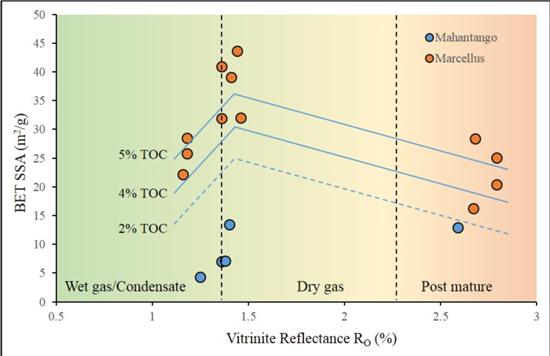
The shale samples had a total organic carbon content ranging from 0.41-7.88wt%. From the analysis, the research team noticed that the porosity and pore structure were highly affected by the total organic carbon of the samples. For instance, an increase in the total organic carbon level resulted in a corresponding decrease in the average and median pore sizes. Additionally, the presence of organic matter in shale increased the specific surface area and pore volume thus enhancing the storage capacity. This represented both the free-gas storage capacity and the sorption storage capacity. Furthermore, carbonate and quartz showed no correlations with the pore volume, porosity, and specific surface area.
To actualize their study, they investigated the relationship between the geological factors like mineralogy and thermal maturity, porosity and pore structure. The complex relationship observed, however, raised the question on the accessibility of the pore space within the clay minerals which proved difficult. It was worth noting that thermal maturation was the main reason for altering the development of organic pores. For example, the highest specific surface area and pore volume were observed in samples in the dry gas zone as compared to those in the post-mature zone for similar total organic carbon level. The study by Dr. Liaosha Song and colleagues is hoped to improve the performance of shale reservoirs.




Reference
Song, L., Martin, K., Carr, T., & Ghahfarokhi, P. (2019). Porosity and storage capacity of Middle Devonian shale: A function of thermal maturity, total organic carbon, and clay content. Fuel, 241, 1036-1044.
Go To Fuel