Advances in Engineering Advances in Engineering features breaking research judged by Advances in Engineering advisory team to be of key importance in the Engineering field. Papers are selected from over 10,000 published each week from most peer reviewed journals.

Significance
The mechanical properties of rocks are highly sensitive to changes in temperatures. The extent of high-temperature effects varies depending on the types of rocks, their diversity and physical properties. However, a consistent and convincing explanation of the high-temperature effect is still lacking. The recent introduction of a thermal damage factor has attracted significant attention of researchers as a promising tool for predicting the high-temperature effect on the mechanical properties of rocks.
Recently, Jian Yang (graduate student) and Zhiwei Wang (PhD student), cooperator Dr. Weiqiang Zhang and led by Professor Li-Yun Fu from China University of Petroleum (East China) presented a comprehensive investigation of the thermal damage factor of limestone rock. The main focus areas included the effective porosity and peak compressive strength. The work is currently published in the journal, International Journal of Rock Mechanics and Mining Sciences.
Being a sedimentary rock, limestone is distributed over a variety of sources that probably have different chemical compositions and physical microstructures. Up to now, most studies on limestone contributes to their thermal effects on their physical and mechanical properties with limited studies on thermal damage factor at high temperatures. Briefly, the authors commenced their research work by collecting ten groups of limestone rock samples. Next, an experiment was conducted to investigate the high-temperature effect on the limestone rock samples at ten different temperatures for each sample.
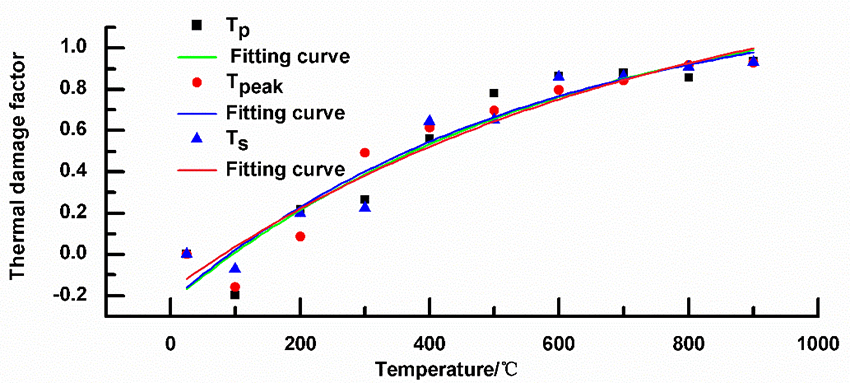
The thermal damage factors were determined by correlating the P-wave velocities with the changes in the effective solid matrix and the peak compressive strength provided in the experimental data. The variations in the mechanical properties of the limestone i.e. P-wave velocity, effective solid matrix, and peak compressive strength were used to investigate the thermal damage mechanism.
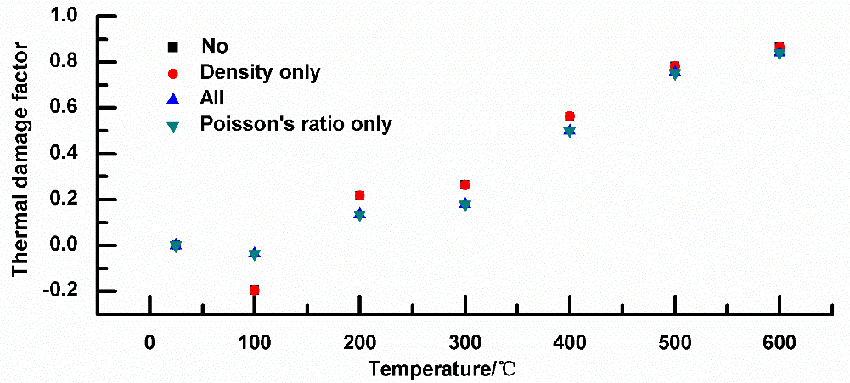
The authors observed that unlike the rate of change in the P-wave velocity, peak compressive strength and rate of change in the effective solid matrix were better parameters for expressing thermal damage factor. This was well captured in the cross-plot of P-wave velocities with peak compressive strength and effective solid matrices at different temperatures. Additionally, the high-temperature effect on the elastic modulus of limestone followed a quadratic thermoelastic prediction. For example, a fitting correlation coefficient of up to 0.98 was obtained compared to that in the experimental data. The thermal damage factor could be reduced by ignoring the effects of Poisson’s ratio and densities that helped in simplifying the P-wave velocity ratios before and after high-temperature treatments. All the limestone properties exhibited a similar exponential trend with temperature increase and correlation coefficients.
In summary, the study provided insights into the characteristics of thermal damage factors about the mechanical properties of limestones exposed to high temperatures. Considering the influence of high temperature on the mechanical properties of limestone and rocks in general, it was noted that an increase in temperature may result in the gradual accumulation of the thermal damage factor. This knowledge will be useful in high-temperature rock mechanics that is a key area in numerous engineering applications.




Reference
Yang, J., Fu, L., Zhang, W., & Wang, Z. (2019). Mechanical property and thermal damage factor of limestone at high temperature. International Journal of Rock Mechanics and Mining Sciences, 117, 11-19.
Go To International Journal of Rock Mechanics and Mining Sciences