Advances in Engineering Advances in Engineering features breaking research judged by Advances in Engineering advisory team to be of key importance in the Engineering field. Papers are selected from over 10,000 published each week from most peer reviewed journals.

Significance
Concrete is the most used construction material globally. Despite its remarkable physical and mechanical properties, they exhibit poor fire-resistance performance. This is a serious challenge as far as fire safety is concerned in the building and construction industry especially considering the high distribution density and rapid increase in the number of tall buildings. When concrete is subjected to high temperatures, they undergo complex physical and chemical transformations that result in thermal damage in form of distributed cracks. Therefore, characterization of progressive thermal cracking induced by thermal treatments in concrete using nondestructive evaluation methods is very critical.
In a recently published literature, various ultrasonic based nondestructive evaluation techniques have been developed owing to their highly sensitive response to structural defects. For instance, nonlinear ultrasonic second harmonic generation techniques have been effectively used in evaluating the damage to different materials. However, they involve the use of contact type transducers coupled to the structural surfaces that affects their ability to perform multiple measurements.
To this effect, Chenglong Yang (PhD candidate) and Dr. Jun Chen from Beihang University investigated the thermal damage in concrete materials based on a fully noncontact nonlinear ultrasonic second harmonic generation technique. Fundamentally, air-coupled transducers were used instead of traditional contact transducers to improve the measurement reliability by preventing the side effects of the coupling condition. The sensitivity of the nonlinear ultrasonic measurements was validated by comparing the results obtained by the noncontact second harmonic generation and that of phase velocity. The work is published in the journal, Cement and Concrete Research.
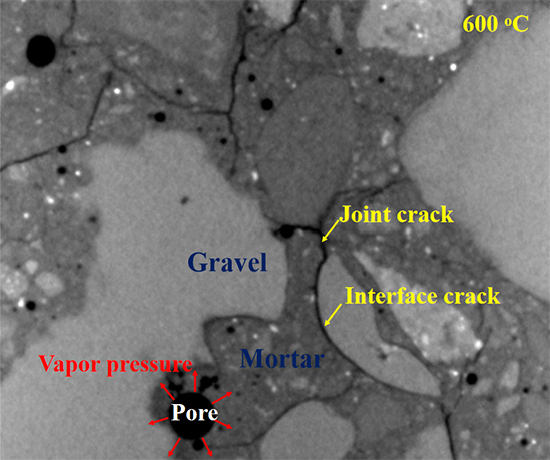
The research team technically improved the experimental measurements of the existing half noncontact system to develop a full noncontact system with enhanced sensitivity and measurement reliability. Additionally, they focused on establishing a direct correlation between the microscopic material evidence and nonlinear ultrasonic measures to determine the structural damage, unlike previous works that depended on external physical parameters as structural damage indicators. Furthermore, the accumulated microscopic cracks during thermal damage were both analytically and experimentally quantified using elastic wave velocity inversion and X-ray computed tomography methods respectively.
In addition to the higher sensitivity to the damage growth, the obtained nonlinear parameter also exhibited excellent correlation with the microscopic crack density as compared to the traditional macroscopic ultrasound parameters. For instance, crack density proportionally increased with the increase in the propagation distance of the ultrasonic waves. Also, the thermal damage in different dimensions quantified by the two-dimensional and three-dimensional reconstructed images were consistent to each other. On the other hand, the variation parameter patterns responsible for material crack and porosity could be explained by the physical and chemical mechanisms taking place during the thermal treatment of concrete.
Based on the experimental findings by Dr. Jun Chen and Chenglong Yang, the non-contact second harmonic generation technique proved an effective tool for assessing globally distributed thermal damage in concrete material with high sensitivity and reliability based on the nondestructive measurements approach. Besides, the non-contact feature proved more suitable for large scale inspection due to the coupling between the transducers and the sample which minimizes the measurement errors and improves measurement flexibility. The study will, therefore, advance the design of high integrity building materials with low thermal damage.

Reference
Yang, C., & Chen, J. (2019). Fully noncontact nonlinear ultrasonic characterization of thermal damage in concrete and correlation with microscopic evidence of material cracking. Cement and Concrete Research, 123, 105797.
Go To Cement and Concrete Research