Advances in Engineering Advances in Engineering features breaking research judged by Advances in Engineering advisory team to be of key importance in the Engineering field. Papers are selected from over 10,000 published each week from most peer reviewed journals.

Significance
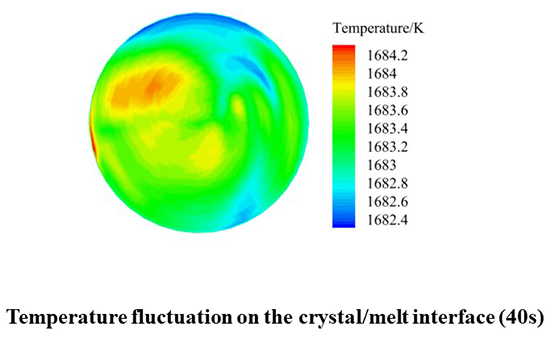
The Czochralski crystal growth is a promising method for growth of high-quality bulk monocrystalline silicon desirable for electronic applications. This method offers a unique crystal growth environment influenced by many forces in the melt. These forces interact in the melt to cause turbulence of the melt flow due to the crucible size increment. Consequently, the strong melt flow oscillations result in unstable temperature on the crystal/melt interface which influence the variation of the crystal growth in one way or the other. Thus, it is very vital to understand the characteristic of the temperature fluctuation on the crystal/melt interface as well as the influence mechanism of melt flow. However, present research works have majored on the temperature fluctuation in the melt with limited reports on the crystal/melt interface which associated with impurity and micro defects formation in the crystal.
To this note, Dr. Junling Ding and Professor Lijun Liu from Xi’an Jiaotong University investigated the temperature fluctuation on the crystal/melt interface during Czochralski crystal growth. The large eddy simulation method was utilized to study the unstable melt flow in large crucible. The main objective was to analyze the effects of crystal and crucible rotation on melt flow and temperature fluctuation on the crystal/melt interface. Importantly, the influence mechanism of melt flow instability on temperature fluctuation was clarified. Their work is currently published in the International Journal of Heat and Mass Transfer.
Briefly, a numerical model was presented to simultaneously calculate the fluctuating temperature on the crystal/melt interface and unstable melt flow in crucible, considering the relationship between the growth rate and kinetic undercooling. The finite volume method on non-orthogonal curvilinear grids was used to solve the large eddy simulation governing equations.
The authors observed that as the crystal counter-rotated with crucible, the temperature fluctuations in the melt and that on the crystal/melt interface were more intense compared to the co-rotation. For instance, the temperature fluctuation on the crystal/melt interface was reported to be 0.4K and 0.7K for co-rotation and counter-rotation, respectively. For counter-rotation, the frequency characteristics of the temperature fluctuations on the interface and that in the melt were observed to be identical. However, this consistency was not obvious for co-rotation. Interestingly, the temperature variation on the interface lagged behind that in the melt for counter-rotation. The same situation happened in the central region when crystal underwent co-rotation with crucible. However, the situation was exactly opposite in the region close to the fringe of crystal when crystal co-rotated with crucible. This phenomenon was clarified by analyzing the local convective heat transport in the melt. On the other hand, it was worth noting that the heat transfer was dominated by the axial local heat flux in the central melt region close to the crystal for both counter-rotation and co-rotation with the former of larger local heat flux.
In summary, Dr. Junling Ding and Professor Lijun Liu explored the influence mechanism of melt flow instability on the temperature fluctuation on the crystal/melt interface. The characteristics of the heat transfer in the melt region close to the crystal for both co-rotation and counter-rotation were evident. This work presents useful insights that will pave the way for the advancement of crystal growth.



Reference
Ding, J.L., & Liu, L.J. (2019). The influence mechanism of melt flow instability on the temperature fluctuation on the crystal/melt interface during Czochralski silicon crystal growth. International Journal of Heat and Mass Transfer, 142, 118463.