Advances in Engineering Advances in Engineering features breaking research judged by Advances in Engineering advisory team to be of key importance in the Engineering field. Papers are selected from over 10,000 published each week from most peer reviewed journals.

Significance
Solar energy is an imperative source of clean and renewable energy and a promising strategy for mitigating global warming and over-reliance on fossil fuels. Dish systems comprising of the solar tracker, power conversion devices and paraboloid reflector are very common in solar energy harvesting. However, the traditional versions of dish systems are costly, heavy and structurally complex-a major challenge in developing dish systems with high conversion efficiencies.
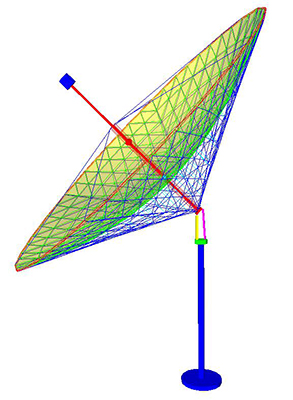
Central pedestal and carousel tracking styles are mainly used in solar trackers with heavy receivers while polar tracking is common in lightweight receivers. For large-scale manufacturing and commercialization, the structural design of the solar tracker and the dish reflector system are vital considerations. Even though the structural design of the reflector depends on the tracking style of the solar tracker, the reflector must maintain desirable surface accuracy and structural integrity at different orientations when subjected to gravitation loads and wind. Research shows that ultralight structures such as the mesh reflector antenna (enabling adjustment of the structural parameters) can substantially reduce the high cost and complexity of the solar trackers.
In recent research: Tao Zheng, Xi Rui, Xiang Ji and Kui Niu and led by Professor Fei Zheng from Xidian University developed a novel ultralight dish system to address the weaknesses of the existing dish systems. It consisted of a three-extensible-rod solar tracker, a cable mesh reflector-based antenna and an ultralight thermoelectric conversion device. These three components are further investigated in this paper. The research is published in the journal Solar Energy.
A 3-RPS solar tracker was designed for the proposed dish system. Sun-tracking control strategy of heavy variation was specifically adopted to reduce the required number of extensions in the rod from tree to two. This resulted in a decrease in total energy consumption. For effective rotation capabilities and fabrication ease, a spherical joint of the solar tracker was prioritized over a compound joint comprising of hook and rotary joints. Then, the proposed dish system was subjected to wind and gravitational loads under various orientations to determine its structural parameters through analysis and optimization. Finally, sun-tracking experiments for 3-RPS solar tracker was carried out successfully, and its sun-tracking accuracy obtained was ±0.7°.
Results show that the system performed satisfactory well when subjected to winds and gravitational loads. Due to its ultralight weight and simplicity, the manufacturing process of the proposed dish system was less complex and costly. This will enhance its rapid fabrication, commercialization, and transport to various sites such as urban centers and remote regions. In particular, the proposed dish system exhibited satisfactory advantages as compared to the existing reflectors. Just to mention but a few: the mass cable reflector saved more metal materials thus reducing its development cost and the ultralight reflector simplified the whole structural outlook of the proposed dish system.
Overall, the research insights highlight the need for ultralight dish systems based on the three-extensible-rod solar tracker for reduced development, operation, and maintenance costs and transport efficiency. For instance, the reflectors with smaller diameters can be folded to occupy a small space for easy transportation. It also emphasized on the need for further research on the optimization of the cable mash reflector in terms of wind resistance and concentration effects. This, according to Professor Fei Zheng, is the right direction for societal transitions to renewable energy resources for the sake of the planet and future generations.





Reference
Zheng, T., Zheng, F., Rui, X., Ji, X., & Niu, K. (2019). A novel ultralight dish system based on a three-extensible-rod solar tracker. Solar Energy, 193, 335-359.