Advances in Engineering Advances in Engineering features breaking research judged by Advances in Engineering advisory team to be of key importance in the Engineering field. Papers are selected from over 10,000 published each week from most peer reviewed journals.

Significance
In some extensive engineering systems, self-excited stick-slip oscillations are induced by dry friction. This friction is also widely known for the destructive response of rotor/stator rubbing especially when the clearances between the rotor and stator have to be kept smaller to maximize the machine efficiency. Consequently, self-excited dry friction backward whirl has been experimentally observed to occur when the friction coefficient at the contact points exceeds a certain critical value. Due to its destructive effects, the dry friction backward whirl boundaries have been investigated for various rotor/stator rubbing models to determine its intrinsic characteristics influencing the existence of the response. Numerical simulations and analytical estimates have been used to investigate the transition between the stick-slip and pure stick motions. Nonetheless, these methods have not provided enough detection of dry friction backward whirl in different systems. For instance, the response of the dry friction backward whirl is not taken into account or cannot be correctly captured when the non-smooth effects are neglected.
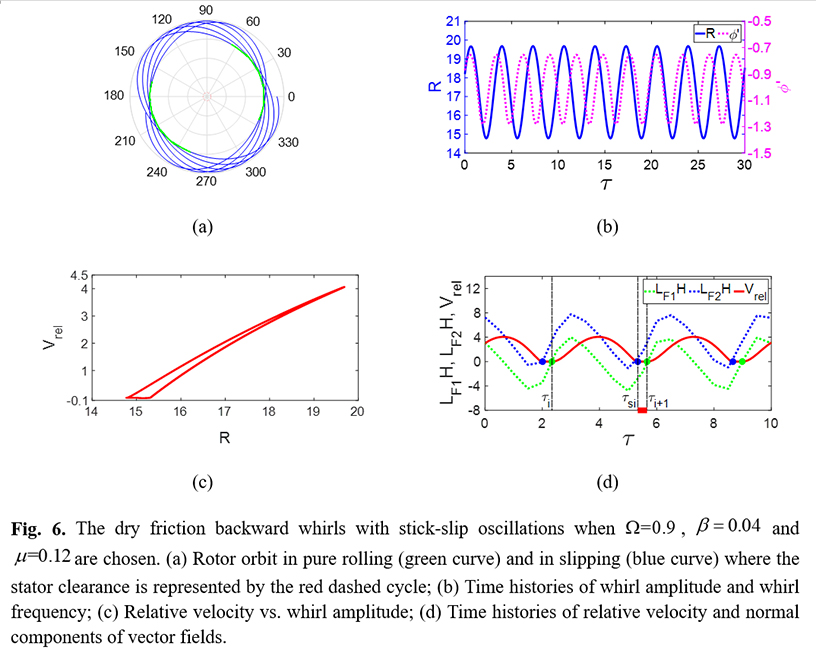
In a recent study published in the journal- Mechanical Systems and Signal Processing, Shunzeng Wang (graduate student), Professor Ling Hong and Professor Jun Jiang from the Xi’an Jiaotong University investigated the intrinsic characteristics of the stick-slip oscillations exhibited in the response self-excited dry friction backward whirl, particularly, taking into consideration the sliding bifurcations. A four-dimensional piecewise smooth rotor/stator rubbing system was investigated. This system had a switching manifold defined by zero relative velocity on the rubbing point, which helped in the identification of the different sliding regions of the switching manifold surface based on the characteristics of the two discontinuous vector fields near it.
Results showed accurate detection of the sliding regions with the help of event-driven algorithms for the Filippov system approach. Practically, three different sliding regions were identified on the curved hypersurface of the switching manifold based on the derived conditions of the sliding regions and their boundaries. This confirmed the validity of the results. Pure rolling, whose ratio varied depending on the system parameters, was observed to exist in the one-period oscillation of dry friction backward whirl. This explained the underlying difficulty in experimental detection of existing pure rolling in cases comprising of both pure rolling and slipping in one period of oscillation.
By exploring the influence of the system parameters on the stick-slip transition of the dry friction backward whirl, the authors noted the interplay between the different parameters as revealed in the experimental observations. For example, increasing the rotor radius at contact for a given friction coefficient and increasing the friction coefficient at a given rotor radius exhibited the same effects. Besides, it was worth noting that for all the system parameters at their existence boundaries, dry friction backward whirl oscillated in a pure rolling manner and can serve as a given condition to predict the existence boundary in the rotor/stator rubbing models.
In a nutshell, the Xi’an Jiaotong University scientists studied the characteristics of stick-slip oscillations in dry friction backward whirl of piecewise smooth rotor/stator rubbing systems focusing mostly on sliding bifurcations. Filippov systems-based algorithms were used to accurately detect sliding regions. Furthermore, by analyzing the characters of the sliding motion at the existing boundary of the dry friction backward whirl, a summary of analytical relations was derived and observed to agree well with that in the literature. The study by Professor Jun Jiang and his colleagues will provide more insights into the detailed response features in self-excited dry friction backward whirl of rotor/stator rubbing systems.



Reference
Wang, S., Hong, L., & Jiang, J. (2020). Characteristics of stick-slip oscillations in dry friction backward whirl of piecewise smooth rotor/stator rubbing systems. Mechanical Systems and Signal Processing, 135, 106387.