Advances in Engineering Advances in Engineering features breaking research judged by Advances in Engineering advisory team to be of key importance in the Engineering field. Papers are selected from over 10,000 published each week from most peer reviewed journals.

Significance
Cement has facilitated the development of infrastructures bearing human civilization and social progress. Cement possess remarkable binding properties that have this far promoted its widespread use over a variety of civil structures. However, cement-based materials also face many problems, such as environmental pollution, limited functional properties and brittleness. These shortfalls, if weighed against the benefits ripped from cement, global researchers have opted to develop multifunctional cement-based materials with the aim being to make the cement-based materials smart, environmentally friendly and comfortable. These endeavors have yielded considerable results: for instance, self-sensing cement-based materials, self-healing cement-based materials, self-adjusting cement-based materials, and electromagnetic shielding cement-based materials – among others. The latter property has specifically garnered much interest. Recent deployment of nanotechnology in this field has further changed the vision of researchers regarding cement-based materials and brought new impetus into the development of multifunction cement-based materials. Researchers have found that carbon nanotubes (CNTs) can not only enhance the mechanical properties of cement-based materials but also endow them with multifunctional properties.
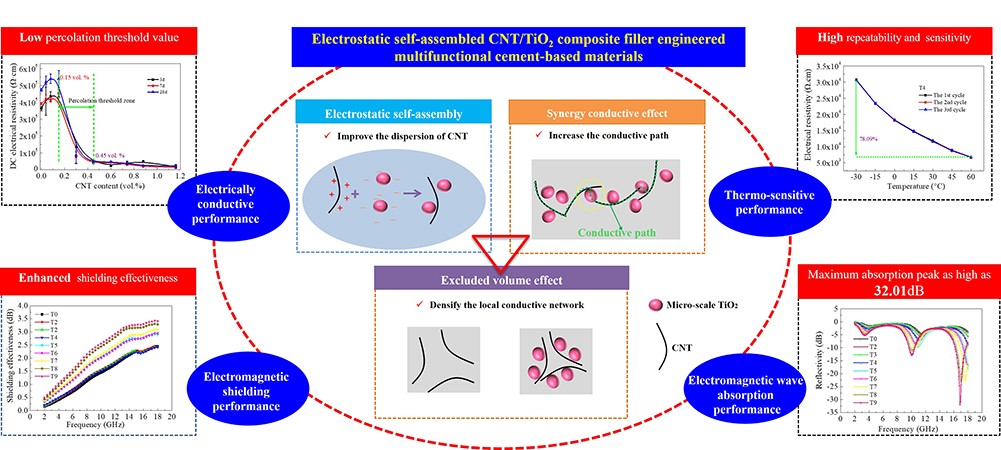
A thorough look at previous research reveals that CNTs can enhance the electrical conductivity and electromagnetic properties of cement-based materials, which is mainly related to the dispersion state of CNTs, the compaction degree of the matrix, and the type and content of CNTs. Effective and simple dispersion methods of CNTs are the critical issue for the engineering application of CNT filled cement-based materials. The electrostatic self-assembled method has been used to effectively disperse CNTs in a cement matrix. Micro-scale TiO2 is a semiconductor and dielectric absorber, which shows the potential of being a micro-scale secondary phase to disperse CNT based on excluded volume effect. Therefore, the electrostatic self-assembled filler containing CNT and micro-scale TiO2 is an excellent candidate for developing multifunctional cement-based materials due to their good conductive property, dispersion, and low water absorption property. In this view, Dalian University of Technology researchers: Dr. Linwei Li, Dr. Yanlei Wang and led by Professor Baoguo Han in collaboration with Dr. Liqing Zhang at the East China Jiaotong University and Dr. Xun Yu at the New York Institute of Technology developed a new fabrication for multifunctional cement-based materials with a CNT/TiO2 composite filler and explore their electrical properties, thermal-resistance effect, electromagnetic shielding and absorption properties. Their work is currently published in the research journal, Construction and Building Materials.
In their approach, CNT/TiO2 composite filler engineered multifunctional cement-based materials were fabricated by using traditional preparation method and their electrical properties, thermal-resistance effects, electromagnetic shielding and absorption properties were studied.
The authors observed that CNT/TiO2 modified cement-based materials showed percolation characteristics through direct current, alternating current resistivity methods and percolation theory, with percolation threshold zone ranging from 0.15 vol% to 0.45 vol%. The composites with wide electrically conductive range have the potential to use in self-sensing, self-heating, static-electrically conductive system and so on. Further, it was noted that the resistivity of the CNT/TiO2 modified cement-based materials decreased with increasing temperature, which has potential application to monitor the real time temperature in smart infrastructures. With increasing CNT/TiO2, the rate of decrease of the electrical resistivity of the composites changed sharply during the percolation threshold zone for increasing temperature from -30 °C to 60 °C. What’s more, the electromagnetic shielding effectiveness of CNT/TiO2 modified cement-based materials was up to 1.30 times greater than that of the control cement-based materials. When the CNT content was 1.16 vol%, the reflectivity of the cement-based composite reached -32.01 dB at a frequency of 16.88 GHz. The composites show the potential to be used in electromagnetic protection. Cement-based materials with low CNT content can show excellent multifunction properties due to electrostatic self-assembled method, excluded volume effect and synergy conductive effect of CNT and TiO2.
In summary, the study used an electrostatic self-assembled method and micro-scale TiO2 to disperse CNT and fabricate multifunctional cement-based materials using traditional preparation method, which advances the large-scale applications of nano filler engineered multifunctional cement-based materials.


Reference
Liqing Zhang, Linwei Li, Yanlei Wang, Xun Yu, Baoguo Han. Multifunctional cement-based materials modified with electrostatic self-assembled CNT/TiO2 composite filler. Construction and Building Materials, volume 238 (2020) 117787.