Advances in Engineering Advances in Engineering features breaking research judged by Advances in Engineering advisory team to be of key importance in the Engineering field. Papers are selected from over 10,000 published each week from most peer reviewed journals.

Significance
Constitutive models describe how different materials respond to different loadings and play essential roles in numerous engineering applications. Within the context of continuous hysteretic models, most of the traditional approaches present several drawbacks, including the need to fix the values of some parameters to improve their accuracy, which limits their computational accuracy and applications.
Recently, a new class of uniaxial constitutive models. Compared to most of the traditional models, including the popular Bouc-Wen, these new models exhibit several advantages making their application more convenient since its constitute parameters represent its physical parameters and can be obtained directly from the experiment. For instance, they are less complicated, fast, and do not require any differential equations. Despite the significant efforts devoted towards the development of effective constitutive models, most approaches are based on mechanical considerations and fitting of experimental curves that lacks the desired accuracy to measure and determine the degree of the errors, despite being effective for determining the parameters.
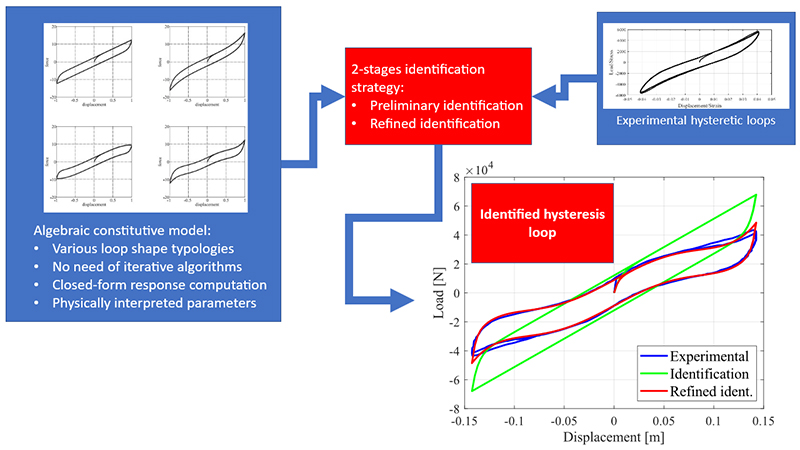
In an effort to address the above problem, a team of researchers at the University of Naples Federico II: Dr. Salvatore Sessa, Professor Luciano Rosati, Dr. Massimo Paradiso, and Dr. Nicolò Vaiana presented an inverse strategy for identifying the constitutive parameters of phenomenological hysteretic constitutive models. In their approach, two optimization procedures performed sequentially were employed to minimize the least square residual between the experimental curve and numeric response. Moreover, the first trial of the identifying parameters was determined iteratively to ensure convergence to the global minimum. Their work is currently published in the journal, Mechanical Systems and Signal Processing.
This strategy was particularly used to identify the parameters of a hysteretic phenomenological model. Results showed that the proposed strategy is robust and highly convenient for parameter identification of differential models. Unlike analogous strategies, the proposed strategy exhibits several advantages: does not assume approximations, does not require limitation of any parameter values, and does not require any particular expertise. The authors observed that it was easy and straightforward to compute the suitable first trials, considered an essential step of the procedure, taking advantage of the fact that the parameter corresponds to the physical quantity characterized by the experiment. The feasibility of the proposed strategy was validated in numerical applications to identify the mechanical parameters of two theoretical and four experimental responses, and the results proved to be robust and effective.
In summary, the study presented an inverse strategy for the identification of constitutive parameters characterizing materials modeled by the phenomenological constitutive model. Despite being developed for the algebraic model, the procedure is versatile and can be extended to other constitutive models of the same family. Moreover, the effectiveness and efficiency of the algorithm were successfully tested through numerical applications. In a statement to Advances in Engineering, Dr. Salvatore Sessa, first author said the study findings will advance future research and development of constitutive models for various engineering applications.




Reference
Sessa, S., Vaiana, N., Paradiso, M., & Rosati, L. (2020). An inverse identification strategy for the mechanical parameters of a phenomenological hysteretic constitutive model. Mechanical Systems and Signal Processing, 139, 106622.