 Advances in Engineering Advances in Engineering features breaking research judged by Advances in Engineering advisory team to be of key importance in the Engineering field. Papers are selected from over 10,000 published each week from most peer reviewed journals.

Significance
Railway transport offers a safe and economical means of moving people or goods to various destinations. Electric railway systems are seen as part of a future where systems run on clean and renewable energy resources. As such, upgrading and construction of new and effective well-interconnected rail-track systems is on the rise globally. From a mechanical perspective, the wheelset subsystem of a railway vehicle is fundamentally controlled by axles/loading transferred to the railway track. These sub systems are designed against fatigue limits according to relevant standards. As with most engineering systems, the design is usually based on an expected service life. The system is subject to various in-service damage, that at some point can lead to premature failure. This can have serious implications on cost, operation or in the worst case, can be fatal. With recent technological advances, railway systems designers complement contemporary techniques with a touch of modernism; either empirically or numerically by using modelling. Modeling, for instance, has been employed during design to assess various aspects of the systems. In addition, field inspection techniques, such as: non-destructive testing, have been well advanced and reported noteworthy results; nonetheless, some fatigue-induced failures of axles are still observed.
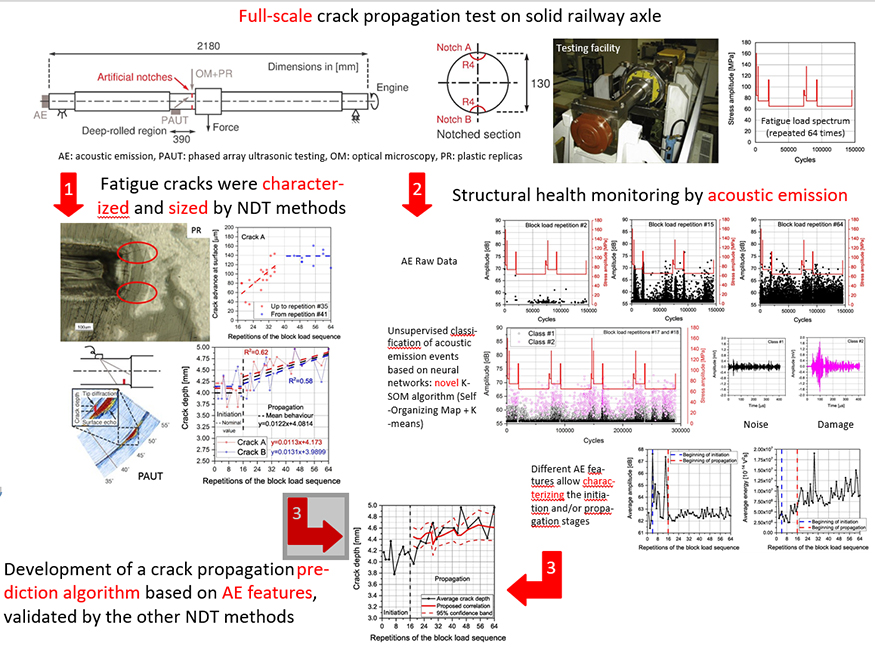
In essence, the in-service safety of railway axles is a very important engineering challenge, as it has a large impact not only from the economic point of view of the railway operator, but it has cascading effects on an economy. It is therefore vital that the structural integrity of such components is known, during their lifecycle, with the highest possible accuracy via precise modelling, reliable inspections and, more recently but still at research level, effective condition monitoring. In light of this, researchers Professor Michele Carboni from Politecnico di Milano and Dr. Davide Crivelli, proposed to apply structural health monitoring by Acoustic Emission to the special case of a deep-rolled solid axle subjected to a variable amplitude full-scale crack propagation test. Their work is currently published in the research journal, International Journal of Fatigue.
In their approach, a fatigue crack propagation test was carried out in the lab subjecting the axle to many repetitions of a block load sequence defined from real service measurements. Acoustic emission data was continuously recorded during the test, whilst crack size was periodically measured by conventional non-destructive techniques. Eventually, a first-approximation correlation was highlighted between Acoustic Emission data, post-processed by a machine-learning algorithm, and crack propagation ones.
Carboni and Crivelli reported that the physical nature of the collected data was clearer after the application of unsupervised classification, excluding effectively signals due to background noise. Consequently, the possibility to clearly identify and separate the initiation and propagation stages of damage development was observed, providing an important advantage when compared with the conventional application of non-destructive testing. Simply put, acoustic emission detected damage before traditional non-destructive testing.
In summary, the objective of the study was to highlight the feasibility of using acoustic emission for the real-time structural health monitoring of in-service railway axles with initiating and developing damage. Remarkably, by focusing on the propagation stage, an empirical and reasonable relationship, linking suitable acoustic emission features to the measured crack size, was found. In a statement to Advances in Engineering, Professor Michele Carboni mentioned that their work showed that there certainly exists a scope for using acoustic emission to reduce the frequency and the cost of periodic nondestructive testing inspections, and of maintenance as a whole, of railway axles.


Reference
Michele Carboni, Davide Crivelli. An acoustic emission based structural health monitoring approach to damage development in solid railway axles. International Journal of Fatigue: volume 139 (2020) 105753.