Advances in Engineering Advances in Engineering features breaking research judged by Advances in Engineering advisory team to be of key importance in the Engineering field. Papers are selected from over 10,000 published each week from most peer reviewed journals.

Significance
Wind load is a crucial structural design consideration, especially for tall buildings. The wind load and its potential impact is primarily dependent on the speed of the wind at the site. Currently, design codes representing the respective wind speeds of a particular region, commonly known as basic wind speed, are widely used to determine the wind load. Basic wind speed is based on decades of recorded wind speed data. In most design codes, including ISO 4354 and ASCE 7 – 16, it is the speed set at ten meters above the ground in flat and open terrain and the definition of flat terrain is similar for these design codes. For practical application purposes, the basic wind speed is often generalized by the specific terrain conditions.
It is recommendable to consider the terrain effects such as topography, surface roughness and height for accurate calculation of basic wind speed from the available wind data. Although equations within most design codes attempt to consider the effects of topography and surfaces roughness, it is difficult to apply them in real conditions due to the complexity of the terrain. Besides, different terrain categories are determined based on engineering judgment that may lead to errors. These limitations make an accurate quantitative evaluation of wind speeds a big challenge.
Due to the rapid changes in terrains and global climates, updating the available basic wind speeds is necessary. Recently, machine learning has emerged as a promising technique for addressing various issues within the wind engineering field, including predicting wind speeds. However, this approach only uses numerical data and does not consider the effects of the terrain. In addition, the machine learning approach is only applicable to regions where data exists. Addressing these limitations will make machine learning a valuable tool in wind engineering.
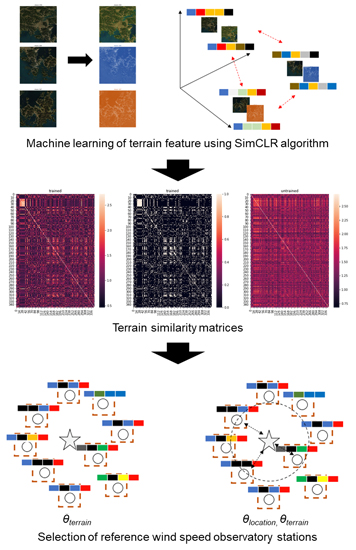
On this account, Mr. Donghyeok Lee (PhD Student) and Mr. Seung Yong Jeong (PhD Candidate) led by Professor Thomas Kang from Seoul National University proposed a new machine learning procedure for accurately predicting the basic wind speeds based on the terrain features from satellite imageries. Their main objective was to improve the accuracy of existing basic wind speeds by overcoming the limitation of engineering judgment. Baseline experiments, based on three methods: Select-One, K-NN and Each-One, involving wind speed data observed in 318 stations in Korea, were performed for comparison. The effects of the three main parameters: terrain similarity, number of selected weather stations and distance from the stations, were evaluated. Their work is currently published in the research journal, Building and Environment.
The research team showed that using the machine learning approach allowed quantitative terrain evaluation and subsequent prediction of the basic wind speeds. K-NN based on both terrain similarity and distance showed better performance than either K-NN basic wind speeds based only on terrain similarity or based only on distance. Compared with baseline experiments, where the effects of topography and surface roughness were based on engineering judgment, the presented machine learning approach provides the best performance than all the K-NN methods. This was attributed to its ability to accurately capture terrain features that are difficult to recognize by human judgment or conventional methods for determining basic winds speeds.
In a nutshell, Professor Thomas Kang and his research group developed a machine learning-based method for determining the basic wind speed considering the effects of terrain features from satellite imagery. By overcoming the shortcomings of the conventional methods, it proved to be an appropriate method for accounting for the different terrain effects. In a statement to Advances in engineering, Professor Thomas Kang stated that the machine learning approach is more accurate and would lead to accurate determination of basic wind speeds for effective structural design.



Reference
Lee, D., Jeong, S., Y. & Kang, T. H.-K (2022). Consideration of terrain features from satellite imagery in machine learning of basic wind speed. Building and Environment, 213, 108866.