 Advances in Engineering Advances in Engineering features breaking research judged by Advances in Engineering advisory team to be of key importance in the Engineering field. Papers are selected from over 10,000 published each week from most peer reviewed journals.

Significance
Quantum entanglement is a critical paradigmatic quantum-mechanical resource and an essential ingredient in the quantum-information field. As multiple degrees of freedom, hyperentanglement can increase the channel capacity by encoding more bits qubits per transmitted photon. Thus, it is a promising candidate in many quantum-information applications. In photonic systems, it is possible to encode quantum entanglement in various degrees of freedom. Among these degrees of freedom of photons, time energy and polarization in fiber-based quantum applications involving long-distance. Therefore, hyperentanglement in these two degrees of freedom is promising for long-distance quantum-information applications.
Constructing large-scale practical quantum networks requires compact hyperentangled sources to provide adequate photon pairs in the communication band. Specifically, fiber-based entangled sources, such as time-energy and polarization entangle sources, are compatible with integrated optics and have been achieved through four-wave mixing in silicon microring cavities. However, the silicon microring cavity often cannot generate photon pairs covering all the communication band wavelengths because the cavity mode has a large free spectral range. Additionally, the cooling requirements of the dispersion fiber make the system more complicated. These limitations can be overcome by adopting photonic integrated circuits like efficient waveguide structures.
While waveguide-based spontaneous parametric down-conversion (SPDC) is beneficial in constructing hyperentangled sources in the two above degrees of freedom, high-fidelity quantum operations are also fundamental in most quantum-information applications. They include precise manipulation of polarization entanglement useful in encoding quantum information. Although significant progress has been made in realizing single-photon polarization manipulation, the rapid manipulation of polarized entangle state remains largely underexplored.
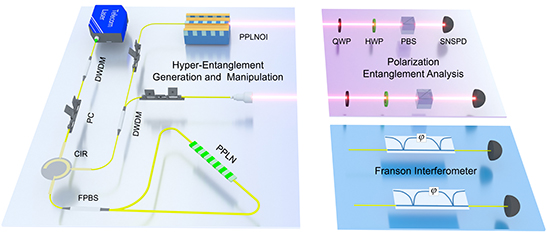
Herein, a team of researchers from Shanghai Jiao Tong University: PhD candidate Yiwen Huang, Dr. Juan Feng, Professor Yuanhua Li, Dr. Zhantong Qi, Dr. Chuangyi Lu, Professor Yuanlin Zheng and distinguished Professor Xianfeng Chen investigated the generation and manipulation of high-performance hyperentanglement in time-energy and polarization degrees of freedom. Briefly, the hyperentangled photon pairs were generated by a combination of SPDC and cascaded second-harmonic generation processes in a highly-efficiency periodically poled lithium niobate (PPLN) waveguide. Their work is currently published in the journal, Physical Review Applied.
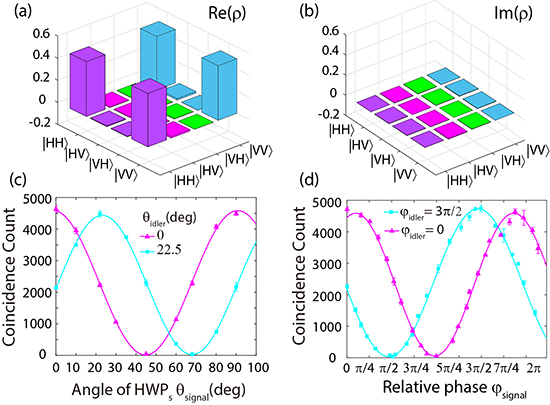
The research team showed that the entangle source could achieve a maximum Clauser-Horne-Shimony-Holt Bell inequality value of S = 2.76 ± 0.03. It was characterized by extremely high interference visibility exceeding 98% for polarization entanglement and Franson-type two-photon interference visibility fringes of about 98.5% for the time-energy entanglement. Leveraging the advantages of transverse electro-optic effect, fast-speed response, low drive voltage and integration, the manipulation of the polarization entanglement state was successfully implemented on PPLN-on-insulator chip. The PPLN-on-insulator chip allowed fast switching of the entangled states to each other.
Even after the entanglement manipulation, a higher polarization entanglement visibility exceeding 97% was obtained while maintaining the quantum characteristics of time-energy degrees of freedom. The fiber-based scheme and high-performance system could significantly minimize the complexity of the quantum system. Moreover, it could serve as a quantum source required in the construction of large-scale fiber quantum networks.
In summary, the authors reported the successful implementation of efficient and precise manipulation of hyperentanglement in time-energy and polarization degrees of freedom. By using the PPLN-on-insulator platform, it was possible to effectively control the polarization state by switching one maximally entangled state to another while preserving the time-energy entanglement during the manipulation. In a joint statement to Advances in Engineering, the authors said their proposed new system is a promising candidate for numerous applications in quantum information, such as teleportation and superdense coding.



Reference
Huang, Y., Feng, J., Li, Y., Qi, Z., Lu, C., Zheng, Y., & Chen, X. (2022). High-Performance Hyperentanglement Generation and Manipulation Based on Lithium Niobate Waveguides. Physical Review Applied, 17(5).