Advances in Engineering Advances in Engineering features breaking research judged by Advances in Engineering advisory team to be of key importance in the Engineering field. Papers are selected from over 10,000 published each week from most peer reviewed journals.

Significance
Graphene is a two-dimensional material that consists of a single layer of carbon atoms arranged in a honeycomb lattice. Graphene has many remarkable properties, such as high electrical and thermal conductivity, high mechanical strength and stiffness, high specific surface area and biocompatibility. These properties make graphene a promising material for various applications in electronics, composites, energy storage and conversion, environmental treatment, thermal management and biomedicine. However, graphene also has some limitations, such as the tendency to aggregate or restack due to the strong van der Waals forces between graphene sheets, which can reduce its effective surface area and impair its performance. Moreover, graphene is difficult to process into three-dimensional structures that can meet the requirements of complex applications. One way to overcome these challenges is to fabricate graphene foams (GrFs), which is a three-dimensional material composed of interconnected graphene sheets, which form a porous network. The unique structure of graphene foam gives it a high surface area, excellent electrical conductivity, and mechanical strength. Graphene foam’s high surface area and electrical conductivity make it an excellent material for use in supercapacitors and batteries. It also has high thermal conductivity makes it useful for dissipating heat in electronics and other applications. It can be used as a support material for catalysts, increasing their efficiency and stability. Graphene foam’s porous structure makes it useful for filtering water and removing pollutants. It can be used as a sensor for detecting gases, chemicals, and other substances. Graphene foam’s lightweight and strength make it useful in aerospace applications, such as in lightweight composites for aircraft and spacecraft. GrFs can retain most of the advantages of graphene while avoiding its drawbacks. GrFs have low density, high porosity, high surface area and excellent mechanical, thermal and electrical properties. However, the mechanical properties of GrFs are usually low due to the weak interactions between graphene sheets. To improve the mechanical response of GrFs, one strategy is to bond them with short crosslinkers (e.g. C–C bond) or long carbon nanotubes (CNTs), which can enhance the load transfer and prevent the sliding and rotation of graphene sheets. CNTs are another type of 2D carbon nanomaterials that have a tubular structure with a high aspect ratio. CNTs have similar or even superior properties to graphene in terms of electrical and thermal conductivity, mechanical strength and stiffness. CNTs can act as reinforcing fibers or bridges between graphene sheets and improve the mechanical performance of GrFs.
A recent study published in the peer-reviewed Journal, Physical Chemistry Chemical Physics, Dr. Shuai Wang, Tian Yang, Chao Wang and led by Professor Lihong Liang from Beijing University of Chemical Technology explored the mechanical response and microscopic deformation mechanism of GrFs bonded by both short crosslinkers and long CNTs (named CNT bonded GrF, CbGrF) under tension and compression. They also investigated the effect of the properties of graphene sheets and CNTs on the mechanical properties of CbGrF.
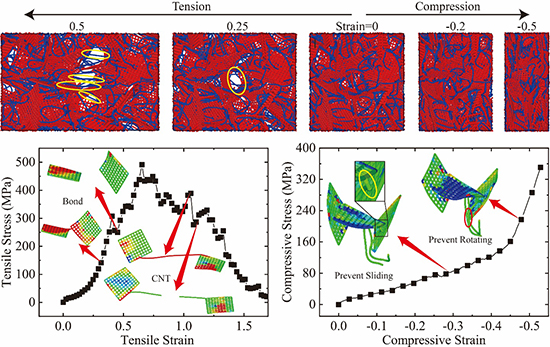
The authors conducted an investigation on three different types of graphene-based fibers (GrFs) and their mechanical properties under tension and compression. The three types of GrFs were pure GrF (PGrF), GrF bonded by short crosslinkers (SbGrF), and CbGrF. They used a coarse-grained molecular dynamics method to simulate the behavior of the GrFs with different parameters of graphene sheets and CNTs. They calculated the stress-strain curves, Young’s moduli, strengths, and toughness of the GrFs. Under tension, the authors found that CbGrF had a higher tensile modulus and tensile strength than PGrF and SbGrF. They also found that CbGrF had a higher tensile toughness than PGrF and SbGrF due to the long CNTs that acted as reinforcing fibers and prevented the complete fracture of graphene sheets. The deformation of GrFs under tension was mainly dominated by the bond breaking of short crosslinkers and long CNTs, followed by the wrinkling of graphene sheets. Under compression, the authors found that CbGrF had a higher compressive modulus than PGrF and SbGrF due to the long CNTs that prevented the sliding and rotation of graphene sheets. The deformation of GrFs under compression was mainly dominated by the wrinkling, sliding, and rotation of graphene sheets, as well as the buckling of CNTs. The authors investigated the effect of the thickness, bending stiffness, and stretching stiffness of CNTs on the mechanical properties of CbGrF. They found that the mechanical properties of CbGrF were highly dependent on the thickness of graphene sheets. As the thickness increased from 1 to 9 layers, both tensile and compressive moduli increased by more than 300%. This was due to the increased number of bonds between graphene sheets and CNTs, as well as the increased bending stiffness of graphene sheets. The bending stiffness of CNTs had a modest effect on the mechanical properties, while the stretching stiffness of CNTs had almost no effect.
In summary, Professor Lihong Liang and co-workers provided a comprehensive understanding of the tunability of GrFs using both short and long crosslinkers and reveals the microscopic deformation mechanism of CbGrF under tension and compression. These results should be instrumental for designing and fabricating advanced GrF-based composites with enhanced mechanical performance.


Reference
Wang S, Yang T, Wang C, Liang L. The mechanical response and microscopic deformation mechanism of graphene foams tuned by long carbon nanotubes and short crosslinkers. Physical Chemistry Chemical Physics. 2023;25(1):192-202.