Advances in Engineering Advances in Engineering features breaking research judged by Advances in Engineering advisory team to be of key importance in the Engineering field. Papers are selected from over 10,000 published each week from most peer reviewed journals.

Significance
Triboelectric nanogenerators (TENGs) have emerged as a class of devices capable of converting mechanical energy into electrical energy by utilizing the triboelectric effect. This effect occurs when two materials come into contact and then separate, resulting in the acquisition of an electrical charge. This charge separation phenomenon can be harnessed to generate electricity. Researchers have been exploring ways to improve the performance of TENGs through surface morphology engineering and chemical surface modification techniques.
Surface morphology engineering involves employing nanostructuring techniques to create micro/nano-level patterns on the triboelectric layers. These patterns significantly increase the effective contact area between triboelectric surfaces, leading to improved charge transfer and enhanced energy production. By increasing the contact area, the efficiency of charge collection is boosted, thereby increasing the overall output of the TENGs. On the other hand, chemical surface modification techniques focus on introducing functional groups or self-assembled monolayers to the surfaces of triboelectric materials. This modification enhances charge transfer efficiency and further improves energy production. Functionalization techniques involve introducing specific functional groups to the surface, which facilitate better charge transfer between the triboelectric layers.
Both surface morphology engineering and chemical surface modification techniques have proven beneficial for TENGs. By increasing the effective contact area between triboelectric surfaces and improving charge transfer, these methods enhance the overall performance of the devices while maintaining a straightforward configuration. The successful implementation of these techniques has the potential to increase the efficiency and output of TENGs, paving the way for their utilization in various energy harvesting systems.
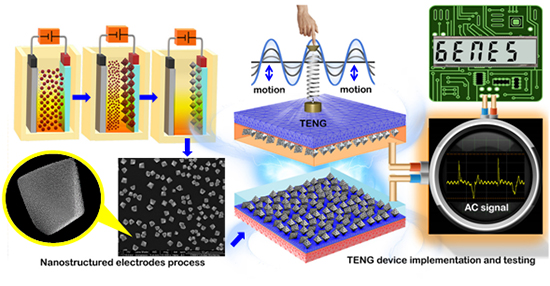
In a new study published in the peer-reviewed Journal of Energy Chemistry by researchers from the Centro de Investigación en Materiales Avanzados S.C. in Mexico: Dr. M. Edith Navarro-Segura, Dr. Margarita Sánchez-Domínguez, Ana Arizmendi-Morquecho and Dr. Jaime Alvarez-Quintana introduced a novel design for nanostructured triboelectric nanogenerators using Ag octahedral-based electrodes. The researchers focused on improving charge collection and overall device performance. In this research, instead to increase the effective contact area between triboelectric surfaces as former works, nanostructured electrodes were designed to increase the contact surface area between the electrode/dielectric interfaces, resulting in a higher number of intrinsic interface states and enhanced charge transfer capabilities.
The proposed device in the study consisted of two triboelectric plates with flexible polyethylene terephthalate/indium tin oxide substrates shaped like arches. One plate was coated with a layer of acetate, while the other had a layer of Polytetrafluoroethylene. These materials exhibited negative and positive static cling, respectively. When a contact-separation action occurred between the two surfaces, electrons were exchanged, leading to one surface becoming negatively charged and the other positively charged. The transferred charge was then collected by charge-collecting layers for external load utilization.
To fabricate the contact layers for the triboelectric nanogenerator device, the research team utilized spin-coating techniques with Polytetrafluoroethylene and acetate solutions. They adorned the contact layers with Ag octahedral nano-assemblies synthesized electrochemically using mesquite gum as a reducing agent. Various characterization techniques such as field emission scanning electron microscopy, Grazing incidence X-ray diffraction, transmission electron microscopy, and X-ray photoelectron spectroscopy were employed to analyze the morphology, structure, composition, and elemental analysis of the contact layers decorated with Ag octahedral nano-assemblies.
The performance of the TENGs was evaluated by measuring their electrical output characteristics using digital oscilloscopes, while mechanical vibrations were applied using a custom laboratory system. These measurements provided insights into the performance of the TENG device and the efficacy of the nanostructured contacts in enhancing charge collection and transfer capabilities.
The researchers compared the electrical output performance of the TENGs under various conditions. They observed that as the excitation frequency increased, the TENGs’ output voltage also increased, showing an asymptotic trend with a significant rise from 1 Hz to 9 Hz and a slight increase beyond 9 Hz. Irrespective of the frequency, TENGs with nanostructured contacts exhibited higher output voltages compared to those with non-nanostructured contacts. Further analysis of the TENGs’ performance was conducted by examining the output voltage, current, and power at different load resistances. The output power demonstrated a Gaussian distribution with a peak at a specific load resistance. TENGs with nanostructured contacts showed enhanced output performance. The effects of frequency on the output voltage and power of TENGs were investigated, revealing that higher frequencies led to increased open circuit voltage and maximum power. The study successfully demonstrated the ability of TENGs to power low-power electronic devices, highlighting their potential as power supply devices.
In conclusion, the authors successfully showcased the utilization of nanostructured Ag octahedral-based electrodes to enhance the electrical output performance of TENGs. By increasing the contact surface area between the electrode/dielectric interfaces through nanostructuring, the number of intrinsic interface states and charge transfer capabilities were significantly improved. The TENGs with nanostructured contacts outperformed devices with non-nanostructured contacts in terms of output voltage, current, and power. The excitation frequency and load resistance played crucial roles in determining the output characteristics of the TENGs. The research laid a promising foundation for the advancement of TENG technology and its potential implementation in energy harvesting systems.




Reference
M. Edith Navarro-Segura, Margarita Sánchez-Domínguez, Ana Arizmendi-Morquecho, J. Alvarez-Quintana. Triboelectric nanogenerator based on electrodeposited Ag octahedral nano-assemblies. Journal of Energy Chemistry, Volume 83, 2023, Pages 478-495.