Advances in Engineering Advances in Engineering features breaking research judged by Advances in Engineering advisory team to be of key importance in the Engineering field. Papers are selected from over 10,000 published each week from most peer reviewed journals.

Significance
The construction of tall buildings stands as a testament to human innovation and architectural prowess. These towering structures redefine skylines and serve as icons of urban development. However, the design and construction of tall buildings are not merely exercises in aesthetics; they represent complex engineering challenges that demand structural efficiency, sustainability, and safety. A recent study published in the Computer-Aided Journal of Civil and Infrastructure Engineering by Italian engineers from the University of Pisa offers an innovative approach to tall building design – Vorogrid. This methodology introduces an alternative family of polygonal patterns that not only enhance aesthetics but also provide load-bearing capacity akin to traditional tube structures.
The design of tall buildings is a multi-dimensional process, with considerations ranging from the building’s visual impact on the urban landscape to structural stability in the face of external forces like wind and seismic activity. These structures often employ tube systems as a popular structural solution, where external surfaces play a crucial role. Beyond aesthetics, these surfaces serve as load-bearing members, ensuring the flow of forces throughout the building.
As the height of these structures increases, so does the complexity of design and the demands on efficiency and sustainability. The need to address lateral loads, such as wind and seismic forces, adds another layer of intricacy. Engineers and architects have explored various structural systems to meet these challenges, including tube structures, outriggers, bundled towers, and megaframes. One particular derivation of the tube structure is the diagrid system, which utilizes a grid of diamond cells in place of the tube’s surface. These cells distribute axial forces efficiently and have become a standard structural scheme for tall buildings.
The Vorogrid methodology, introduced in this study, is a revolutionary approach to tall building design that aims to create alternative polygonal patterns mimicking traditional tube structures while offering an organic and aesthetically pleasing appearance. Traditional Voronoi tessellations, derived from hexagonal honeycomb systems, have been used in various fields, including computer graphics and finite element analysis. However, Vorogrid takes Voronoi patterns to a new level by altering the density of the seeds to create denser regions where higher mesh stiffness is desired. This approach allows for better structural performance and increased design control.
The authors proposed the Vorogrid methodology which consists of several key steps:
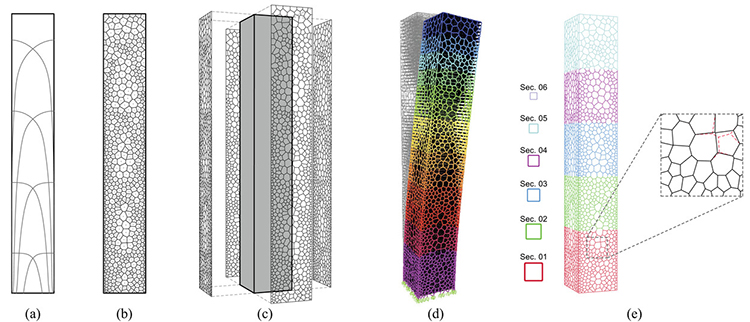
- Selection of Plausible Static Schemes: Engineers identify structural schemes based on their experience or numerical calculations. These schemes highlight curves and surfaces on the building’s exterior, which become candidate paths for the Voronoi tessellation.
- Variable Density Voronoi Tessellation: A Voronoi tessellation is generated with seeds attracted to the highlighted paths or areas, creating denser regions where higher mesh stiffness is desired. The distribution of seeds is not regular, and the distance metric varies along the surface.
- Stiffness-Based Preliminary Design: The cross-sections of the grid elements are initialized according to a stiffness-based procedure to convert Voronoi edges into beams. This step provides a starting point for structural simulations.
- Structural Analysis and Optimization: A structural model is created, and finite element analyses are performed to evaluate the behavior of the Vorogrid under vertical and lateral loads. Geometric and structural optimization are employed to enhance the grid’s quality.
- Final Cross-Section Selection: The cross-sections of grid members are chosen based on the optimization results, assigning commercial section properties to clusters of Vorogrid beams.
The authors’ 3D structural analyses and compares six Vorogrid case studies with traditional structural solutions like diagrids and hexagrids. It’s worth noting that Vorogrids exhibit high bending stiffness, and their structural response varies depending on the specific pattern used.
In terms of interstory drift and overall structural performance, diagrids still outperform Vorogrids and hexagrids. However, Vorogrids demonstrate a unique ability to mimic certain mechanical features of the structural schemes they imitate, such as excellent rigidity for frame-inspired grids and distinct interior force distribution for outrigger-inspired grids.
One notable challenge in Vorogrid design is that it tends to be bending-dominated, while traditional tube structures like diagrids excel in axial stress distribution. Vorogrids, therefore, require a strength-based approach, emphasizing the importance of a core or high-strength materials to meet safety standards.
In practical applications, the feasibility of Vorogrids must consider fabrication and construction. While traditional modular systems like diagrids and hexagrids benefit from prefabrication and cost-effectiveness, Vorogrids introduce geometric complexity and custom elements, making digital fabrication a more suitable approach.
The Vorogrid approach streamlines fabrication by adopting a single cross-section for all members within a cluster and using three-way nodes for production efficiency. Additionally, the symmetry of tall buildings can be leveraged to achieve more symmetric Voronoi mesh patterns, further enhancing prefabrication and structural symmetry.
The Vorogrid methodology represents a new approach to tall building design, offering a new paradigm that balances aesthetics with structural efficiency. By introducing alternative polygonal patterns that mimic traditional tube structures, Vorogrids provide a visually pleasing yet robust structural solution for modern tall buildings.
While Vorogrids may not outperform traditional solutions like diagrids in terms of stiffness and strength, their unique ability to replicate certain mechanical features of the structural schemes they imitate makes them a valuable addition to the architect’s toolbox. Additionally, Vorogrids open up new possibilities for structural design, paving the way for innovative and visually striking tall buildings that push the boundaries of architectural and engineering creativity.
In conclusion, the Vorogrid methodology exemplifies the spirit of innovation in civil and infrastructure engineering, demonstrating that tall buildings can be both functional and works of art that inspire and captivate. It represents a significant step forward in the pursuit of sustainable, aesthetically pleasing, and structurally sound tall buildings that define our modern urban landscapes.


Reference
Francesco Laccone, Domenico Gaudioso, Luigi Malomo, Paolo Cignoni, Maurizio Froli. Vorogrid: A static-aware variable-density Voronoi mesh to design the tube structure tessellation of tall buildings. Computer-Aided Journal of Civil and Infrastructure Engineering, Volume 38, Issue 6, 2023, Pages 683-701.
Go to Computer-Aided Journal of Civil and Infrastructure Engineering.