 Advances in Engineering Advances in Engineering features breaking research judged by Advances in Engineering advisory team to be of key importance in the Engineering field. Papers are selected from over 10,000 published each week from most peer reviewed journals.

Significance
Unwanted vibration is a significant challenge in engineering, from aircraft fuselages and car suspensions to long-span bridges and metrology tools, low-frequency vibration is especially difficult because it erodes structural margins, corrupts measurements, and makes systems feel unsafe even when nothing is actually failing. The workhorse solution, the linear isolator, has an old and stubborn flaw. If we soften it enough to push down the natural frequency, we also sap its ability to carry static loads. That stiffness–support trade-off has shaped design practice for decades and, frankly, kept performance below what modern applications demand. Quasi-zero stiffness (QZS) designs sidestep much of this bind. By arranging elements so the net stiffness around equilibrium is near zero, they admit very low natural frequencies while still carrying significant weight. The idea is elegant and has seen numerous embodiments, yet one practical issue continues to undercut predictions: damping. Most analyses treat damping as linear and viscous. Real materials—especially polymers and elastomers—do not oblige. Their dissipation is frequency- and history-dependent, with relaxation behaviors that classical dashpots simply do not capture. Thermoplastic polyurethane (TPU) is a good example. It’s attractive for isolators because it’s elastic, durable, and easy to manufacture, but its loss mechanisms are distinctly viscoelastic. Fractional-derivative models, which interpolate between purely elastic and purely viscous responses, have repeatedly shown they can reproduce these behaviors with far fewer ad hoc parameters. Even so, QZS literature has been slow to incorporate fractional damping in a rigorous, experimentally grounded way.
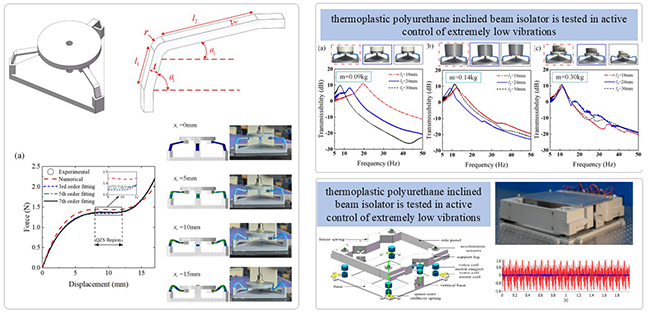
To this account, new research paper published in Mechanical Systems and Signal Processing and conducted in Dr. Yuan-Suo Zhang, Dr. Feng Hou, Professor Ze-Qi Lu, Dr. Hu Ding, and Dr. Li-Qun Chen from the Shanghai University, the researchers developed a compact vibration isolator made from thermoplastic polyurethane inclined beams that naturally exhibits quasi-zero stiffness and fractional derivative damping. By combining analytical modeling with experiments, they created a system capable of achieving very low natural frequencies while maintaining load-bearing capacity. Their prototype demonstrated that fractional damping, inherent in TPU, effectively reduces resonance peaks and improves stability compared to traditional linear damping models. This innovation offers a simpler and more practical pathway to high-performance low-frequency vibration isolation.
The team 3D-printed inclined-beam isolators in TPU, using additive manufacturing to precisely control beam length, angle, and spacing. That geometric tuning drives the quasi-zero-stiffness behavior, while the polymer provides the viscoelastic energy loss. In slow compression tests, they recorded full force–displacement curves, including the snap-through region where the effective stiffness turns negative. Lower-order curve fits missed key features. Only a seventh-order polynomial captured the measured softening and hardening sequence and the width of the negative-stiffness window, giving a reliable nonlinear stiffness law for modeling.
They studied damping separately and instead of assuming a standard viscous term, the authors ran single-tone excitation tests at controlled amplitudes and frequencies. With force and motion measured simultaneously, the elastic part predicted by the seventh-order stiffness was removed from the total response to isolate the dissipative component. Those residuals matched a fractional-derivative damping model with an order around 0.32. That value is informative: TPU behaves between an ideal elastic solid and a purely viscous fluid, with clear frequency-dependent memory effects. A single viscous constant simply cannot describe it. Afterward, the researchers validated the dynamics where frequency sweeps produced transmissibility curves for direct comparison with models. Linear-damping models consistently overstated resonance peaks and predicted the wrong high-frequency roll-off. The combined quasi-zero-stiffness plus fractional-damping model reproduced the experiments far better: lower and broader resonance, the correct slope beyond resonance, and amplitude-dependent features such as jump phenomena and hysteresis at higher drive levels. Finally, the authors showed that in geometric parametric tests—varying beam length, inclination, and span—how each knob shifts the QZS plateau and the isolation bandwidth. Longer beams or shallower angles lowered the natural frequency but narrowed the stable region; span changes traded load capacity against isolation depth.
In conclusion, what makes the study by Shanghai University researchers stand out is how cleanly it stitches together theory and the stubborn realities of polymer behavior. For years we have leaned on linear viscous damping because it made the math tidy, then wondered why the prototype on the bench did not behave like the model. The authors confront that mismatch head-on. By acknowledging that materials like thermoplastic polyurethane dissipate energy with memory and frequency dependence, and by framing that behavior with fractional damping, they close the gap between prediction and practice. The result is better fit to data; and excellent modeling approach that we can trust when the device is bolted into a real system. There is a second, practical payoff. Many attempts to add nonlinearity and damping to quasi-zero-stiffness isolators have piled on hardware—auxiliary springs, magnets, nested linkages. These can work, but complexity brings cost and new failure modes. Here, the TPU beams do double duty: geometry delivers the QZS response, and the polymer’s inherent viscoelasticity supplies the right kind of damping. That combination points toward isolators that are compact, manufacturable, and stable without elaborate tuning. It is exactly the sort of simplification that moves an idea from a lab demo to something you can specify in a vehicle, an aircraft bay, or a building.
Additionally, the reported research work also gives fractional calculus a very concrete footing. Rather than treating it as elegant mathematics kept at arm’s length from hardware, the authors identify the fractional parameters directly from experiment, then show how those numbers explain details that linear models miss—lower and broader resonance peaks, realistic roll-off at higher frequencies, and amplitude-dependent features. That kind of evidence will resonate beyond vibration isolation, inviting similar treatments in structural dynamics, biomechanics, and acoustic devices where dissipation governs performance. Finally, the parametric work is genuinely useful. By sweeping beam length and angle, the authors successfully mapped how geometry shifts the natural frequency and shapes the isolation bandwidth. That gives future designers a tuning chart rather than a set of hunches. When the job is protecting a satellite during launch or keeping a surgical robot steady near an MRI, that predictability is not a luxury—it is the difference between acceptable and exceptional performance.

Reference
Yuan-Suo Zhang, Feng Hou, Ze-Qi Lu, Hu Ding, Li-Qun Chen, Analytical and experimental study of thermoplastic polyurethane inclined beam isolator with quasi-zero stiffness and fractional derivative damping, Mechanical Systems and Signal Processing, Volume 224, 2025, 111962,