Advances in Engineering Advances in Engineering features breaking research judged by Advances in Engineering advisory team to be of key importance in the Engineering field. Papers are selected from over 10,000 published each week from most peer reviewed journals.

Significance
Rural housing in western China’s solar-rich regions sits at an odd intersection of opportunity and neglect. On paper, areas like the Qinghai–Tibet Plateau should be perfect models for renewable living; the solar radiation there is extraordinary, often surpassing 6300 MJ m⁻² each year, however, when one looks closely, most homes still depend on inefficient heating and are built with almost no consideration for orientation, insulation, or daylight. They leak energy through thin walls, sit awkwardly against the sun, and remain uncomfortable for much of the year. What’s striking is how little of this abundant solar potential has been translated into design knowledge. For families living in these high-altitude settlements, poor construction it is both environmental issue as well as daily burden of cost and discomfort. Efforts to improve these dwellings have made progress, but most still examine one variable at a time: a new wall material here, a better window there. Rarely do they explore how these factors interact. Early-stage design choices—form, layout, and envelope—govern a building’s entire performance, however, traditional simulation tools make exploring multiple options painfully slow. They also tend to oversimplify the messy trade-offs between energy, cost, carbon, and comfort. The result is a gap that’s both technical and conceptual: we still lack a coherent, data-driven framework capable of handling these interdependencies in a way that respects the climatic and cultural context of rural China. That gap is precisely what this study sets out to address. To this account, new research paper published in Energy and Buildings and led by Professor Yan Liu, and Dr. Mei Dou from the Xi’an University of Architecture and Technology together with Dr. Chenyou Luo and Dr. Huizhi Zhong from the China Southwest Architectural Design and Research Institute Corp. Ltd. The researchers developed a hybrid optimization framework that integrates XGBoost-based surrogate modeling with the NSGA-II metaheuristic algorithm to identify climate-responsive designs for rural housing in solar-rich regions.
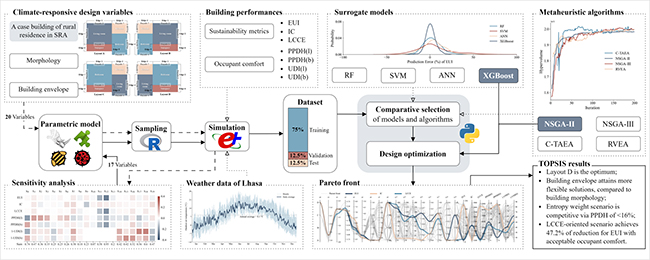
The team developed a computational framework combining parametric modeling, surrogate learning, and evolutionary optimization. The case study house—a single-story rural residence in Lhasa—was modeled in Grasshopper and Rhino to allow automated manipulation of twenty design variables, encompassing both morphological parameters (e.g., building layout, height, sunspace depth) and envelope features (e.g., wall type, insulation thickness, glazing properties). The simulation data were derived through orthogonal-array Latin hypercube sampling (OALHS), ensuring representative coverage of design permutations while maintaining orthogonality. A total of 4,096 design samples were generated, capturing variations across energy, thermal, lighting, and cost domains. To determine which parameters most strongly affected performance, the researchers applied Morris sensitivity analysis. This step revealed that envelope-related variables—particularly insulation thickness and window configuration—exerted the greatest influence on energy and comfort indices, whereas orientation and wall thickness were less critical. Variables with minimal impact were fixed to enhance computational stability and reduce dimensionality. The refined dataset was then divided for training, validation, and testing of four surrogate models: Random Forest (RF), Support Vector Machine (SVM), Artificial Neural Network (ANN), and Extreme Gradient Boosting (XGBoost). Among these, XGBoost consistently demonstrated superior predictive accuracy (R² > 0.9, NRMSE < 0.1) across all objectives, outperforming ANN and SVM in both convergence speed and generalization. For optimization, the authors benchmarked four metaheuristic algorithms—NSGA-II, NSGA-III, C-TAEA, and RVEA— under identical parameters. NSGA-II emerged as the most stable and effective, offering smooth convergence and high diversity in Pareto fronts. When applied to the Lhasa prototype, the XGBoost–NSGA-II combination revealed that building envelope optimization contributed more significantly to performance gains than morphological changes. The results showed that a design with layout D (living room west-facing, bedroom east-facing with optional sunspace) achieved superior energy and comfort outcomes. Compared to the base case, the authors found the optimized design reduced EUI by 47.2% and life-cycle carbon emissions by 38.1%, while maintaining acceptable levels of daylight availability and significantly improving thermal comfort (PPDH reduced by 10.7–27.4%). The trade-offs were particularly visible between daylight and energy use—enhancing insulation or reducing window area improved efficiency but diminished daylight uniformity. By using entropy-weighted TOPSIS analysis, the researchers identified balanced solutions where envelope tuning achieved sustainability gains without compromising livability, underscoring the nuanced interplay between passive solar design and data-driven control.
In conclusion, the research team successfully developed dual-model system that efficiently predicts and optimizes five competing objectives—energy, carbon, cost, thermal comfort, and daylight—using a data-driven yet architecturally interpretable process. This new approach yielded a reproducible workflow capable of generating balanced, human-centered, and low-carbon building solutions adaptable to other regions with abundant solar resources. We believe what stands out most from this work in addition to its technical precision the quiet shift it represents in how rural architecture can be approached. The idea of using surrogate learning together with metaheuristic optimization sounds, at first, like a purely computational exercise. However, its real value lies in how it changes the rhythm of design thinking. Rather than working through endless trial and error, architects can now explore thousands of options in the time it once took to test a single one. That speed matters, but so does the depth—it allows trade-offs among cost, carbon, comfort, and daylight to be seen together, not as separate targets. In a field where these priorities often compete, that integration feels transformative. From a sustainability perspective, the study shows that efficiency in places such as Lhasa does not depend on expensive equipment or futuristic materials. Instead, performance improvements of more than forty percent were achieved through careful adjustment of insulation, glazing quality, and spatial proportion. These are design choices that fit within the realities of rural construction, which makes the findings immediately useful. It is also telling that the best configurations echo long-standing vernacular instincts—compact forms, sun-facing rooms, and simple thermal envelopes—now refined by computational logic rather than replaced by it. In a nutshell, the new work ultimately provides a transferable methodological framework for optimizing low-carbon residential buildings in solar-rich regions, offering scientific guidance for architects, engineers, and policymakers committed to achieving energy-efficient and climate-adaptive rural housing.



Reference
Chenyou Luo, Chi Feng, Huizhi Zhong, Yan Liu, Mei Dou, Design optimization of climate-responsive rural residences in solar rich areas considering sustainability and occupant comfort, Energy and Buildings, Volume 336, 2025, 115546,