Advances in Engineering Advances in Engineering features breaking research judged by Advances in Engineering advisory team to be of key importance in the Engineering field. Papers are selected from over 10,000 published each week from most peer reviewed journals.

Significance
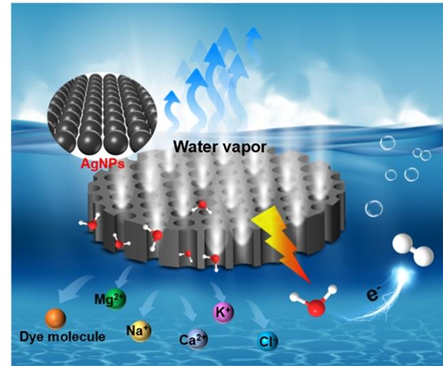
The team began their fabrication process with the preparation of a PMMA solution in dichloromethane containing a surfactant, didodecyldimethylammonium bromide (DDABr). When this solution was drop-cast onto glass substrates under controlled humidity, condensation droplets from ambient air templated a regular honeycomb network as the solvent evaporated. The resulting film exhibited low-tortuosity vertical channels and uniform pores, forming an ideal scaffold for nanoparticle loading. Monodisperse AgNPs, approximately 25 nm in diameter, were synthesized separately through a polyol reduction of silver nitrate in ethylene glycol. Poly(vinyl alcohol) was used as both a stabilizer and antioxidant, ensuring long-term nanoparticle stability. The AgNP dispersion was then spin-coated onto the PMMA membrane to yield the final PMMA/AgNP composite layer. The authors performed scanning electron microscopy which showed successful formation of uniformly distributed silver nanoparticles embedded within the polymer matrix, while atomic force microscopy confirmed a modest reduction in surface roughness due to nanoparticle infiltration. X-ray diffraction patterns exhibited sharp reflections indexed to metallic silver, and verified the crystalline state of the nanoparticles. Moreover, conducting mercury intrusion porosimetry demonstrated that, although average pore diameters decreased from 2.1 µm to 0.7 µm after AgNP modification, the overall porosity rose to about 63%, reflecting the optimized hierarchical pore structure. Furthermore, mechanical testing showed that AgNP incorporation had negligible influence on tensile strength or flexibility, on the other hand thermogravimetric analysis indicated improved thermal stability. Additionally, the team conducted optical characterization which highlighted the strong broadband absorption of the PMMA/AgNP film (> 87% across 250–2500 nm) enhanced by multiple internal reflections within the porous matrix. The authors Under simulated sunlight (1 kW m⁻²), infrared thermography recorded a rapid surface temperature rise from 22 °C to 46 °C within five minutes, outperforming pristine PMMA. During interfacial evaporation tests, the composite achieved an evaporation rate of 1.76 kg m⁻² h⁻¹ and a photothermal conversion efficiency approaching 96%. Even in brine concentrations up to 15% NaCl, performance remained nearly unchanged, demonstrating excellent salt tolerance through ion-gradient-driven back-diffusion. Moreover, the evaporator retained over 90% of its efficiency after ten operational cycles. Beyond desalination, the film displayed remarkable photocatalytic behavior. In a three-electrode setup using a Na₂SO₄ electrolyte, illumination increased the photocurrent by 26% compared with dark conditions, confirming plasmon-enhanced charge generation. Hydrogen evolution rates reached 48.4 mmol m⁻² h⁻¹, supported by electrochemical impedance measurements showing significantly reduced charge-transfer resistance. The system thus transformed absorbed solar energy into both thermal and chemical outputs with impressive stability.
In conclusion, the work of Professor An Li and colleagues developed novel frameworks that can elucidate the dual functions of their PMMA/AgNPs platform (efficient solar evaporation and simultaneous hydrogen production) and the merged these models within a single, scalable material system managed to link desalination and renewable energy conversion. This is an important advancement in the design of multifunctional solar evaporators that unite desalination and hydrogen production and the team achieved a level of material integration rarely seen in interfacial evaporation research by combining the breath figure method with plasmonic nanostructures. The BF approach, which relies solely on humidity-induced self-assembly, eliminates the need for complex template removal or chemical etching, providing an environmentally benign and scalable fabrication pathway. This simplicity could make the technique attractive for large-area membrane manufacturing, especially in regions with limited infrastructure or resources. The PMMA/AgNPs evaporator is novel because it absorbs sunlight across nearly the full spectrum and converts it into heat with remarkable efficiency, but still maintains strong capillary water flow through its porous network. The structure itself is key—its vertical pores help draw water continuously while the surrounding polymer matrix traps heat just long enough to sustain rapid evaporation. Balancing these two behaviors is not trivial, but the authors’ results are impressive: superb evaporation rate and thermal efficiency, and no significant salt crystallization even after extended operation. The film also withstood repeated cycling in brine without visible degradation, which says a lot about its mechanical integrity and chemical stability under stress. What makes this material especially interesting is that its plasmonic layer drive evaporation and also supports hydrogen generation. The same localized surface plasmon resonance that heats the interface promotes charge separation for photoelectrochemical water splitting. In practical terms, that means the new device can desalinate during the day while simultaneously producing hydrogen, effectively recycling sunlight into both clean water and stored chemical energy.

REFERENCE
Cai, Ruiyun & Jiang, Jian & Jiao, Rui & Sun, Hanxue & Zhu, Zhaoqi & Li, Jiyan & Li, An. (2025). Nanosilver-Coated Organic Porous Films Prepared by the Breath Figure Method for Efficient Solar-Driven Interfacial Evaporation and Hydrogen Production. Industrial & Engineering Chemistry Research. 64. 10.1021/acs.iecr.5c01701.
Industrial & Engineering Chemistry Research.