Advances in Engineering Advances in Engineering features breaking research judged by Advances in Engineering advisory team to be of key importance in the Engineering field. Papers are selected from over 10,000 published each week from most peer reviewed journals.

Significance
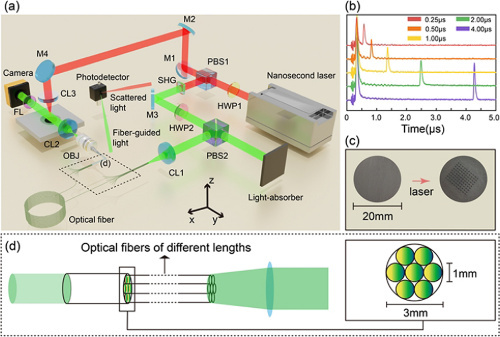
The research team constructed a laser–fiber shadowgraphy system using a 1064 nm Nd:YAG pulsed laser split into excitation and illumination pathways. The excitation beam impinged perpendicularly on compressed coal sheets—each 2.5 mm thick and 20 mm in diameter—composed of fine coal particles pressed at 10 tons of pressure. Meanwhile, the illumination beam, frequency-doubled to 532 nm, was routed through optical fibers ranging from 30 m to 800 m in length. Each fiber introduced a calibrated delay, allowing sequential shadowgrams of the same plasma event to be captured across intervals spanning 0.15 to 4.00 microseconds. The synchronized detection used a CMOS camera equipped with a 532 nm passband filter, which ensured suppression of broadband plasma emission and minimizing image saturation. The authors found the shadowgrams provided high-resolution visualization of shockwave dynamics. At 0.25 µs, for instance, arcuate wavefronts with radii near 0.5 mm emerged, propagating at approximately 1550 m/s—confirming the supersonic character of LIP-induced shockwaves. When they increased the excitation energy from 22 mJ to 400 mJ elevated the initial velocity to around 3580 m/s before it gradually decayed toward the acoustic limit of air. Moreover, the shockwave propagation behavior, when fitted to the Dewey explosion model (R = A + Bt + C ln(1 + t) + D(ln(1 + t))¹ᐟ²), demonstrated remarkable correspondence with theoretical blast dynamics, which reinforced the analogy between micro-scale LIP events and macro-scale explosions. They also evaluated the method’s analytical potential, and to do this shadowgrams from 29 distinct coal types were acquired, each represented by 90 laser-excited regions. The convolutional neural network, trained with 73 images per class and tested on 17 unseen samples, achieved an exceptional classification accuracy of 98.38%. Five-fold cross-validation confirmed the robustness of this approach, yielding an average accuracy of 97.53%. Visual inspection revealed that shadowgram brightness correlated inversely with volatile matter content, suggesting that optical intensity inherently reflects compositional attributes. The authors also tested predictive capacity, shadowgrams from three representative coal samples—spanning low, intermediate, and high volatility—were analyzed to estimate ash content, volatile matter, and fixed carbon. The model achieved root mean square errors of prediction (RMSEP) of 1.75%, 1.04%, and 2.74%, respectively.
In conclusion, the new work by by Professor Honglian Guo and colleagues developed innovative models that achieved 98.38% accuracy across 29 coal types and predicted key composition metrics with minimal error. The innovation lies in combining optical fiber–controlled temporal imaging with deep learning analytics, offering a new route for rapid, non-destructive analysis of complex materials. Additionally, the successful deployment of a fiber-based shadowgraphy platform effectively democratizes access to time-resolved plasma imaging by replacing bulky high-speed cameras with a compact, modular system that preserves spatial fidelity. The innovative use of varying fiber lengths as temporal gates exemplifies an elegant solution to the trade-off between resolution and frame rate, enabling simultaneous multi-timepoint imaging of shockwave dynamics within a single laser pulse. Moreover, the new study pioneers a methodological framework for material identification where each shadowgram encodes image as well as provide multidimensional signature of density, volatility, and composition by coupling high-resolution physical imaging with deep learning. We believe such data-driven optical analytics could transform in-situ monitoring of energetic materials, reduce dependency on costly chemical assays, and accelerate the transition toward smart, automated energy systems. In practical terms, the demonstrated 98% classification accuracy means that power plants, mining facilities, and material sorting operations could one day implement non-contact, instantaneous coal identification pipelines, reducing inefficiencies and lowering environmental impact. Furthermore, the CNN’s ability to discern coal types from intensity variations highlights how artificial intelligence can show latent correlations between optical patterns and chemical composition and relationships that elude traditional spectroscopic intuition. In a nutshell, the new model’s capacity to predict ash and carbon content with sub-3% RMSEP highlights its quantitative credibility, while its limitations for minor constituents point toward future refinements in dataset diversity and hybrid architectures combining spectral and spatial inputs.