Advances in Engineering Advances in Engineering features breaking research judged by Advances in Engineering advisory team to be of key importance in the Engineering field. Papers are selected from over 10,000 published each week from most peer reviewed journals.

Significance
Prestressed concrete (PC) continuous girder bridges constitute a foundational element of modern highway infrastructure, because of their favorable balance of structural efficiency, construction economy, and long-term service performance. Their widespread adoption reflects material advantages such as high flexural stiffness and crack control as well as the suitability of prestressing technology for medium- to long-span applications under repetitive traffic demands. However, as transportation networks expand and freight intensity continues to rise, many existing PC bridges are now operating under loading conditions that differ substantially from those assumed at the design stage. A major challenge in the long-term assessment of such bridges lies in the progressive degradation of structural reliability because unlike instantaneous failure modes, reliability deterioration unfolds gradually and driven by the combined influence of increasing vehicle loads, environmental exposure, and time-dependent material behavior. Scientists have long recognized concrete shrinkage and creep as primary contributors to excessive deflection, redistribution of internal forces, and prestress loss during service life. Traditional analyses, however, have tended to focus on shrinkage and static creep induced by sustained self-weight and simplified traffic representations, often neglecting the effects of stress fluctuations generated by real traffic flow.
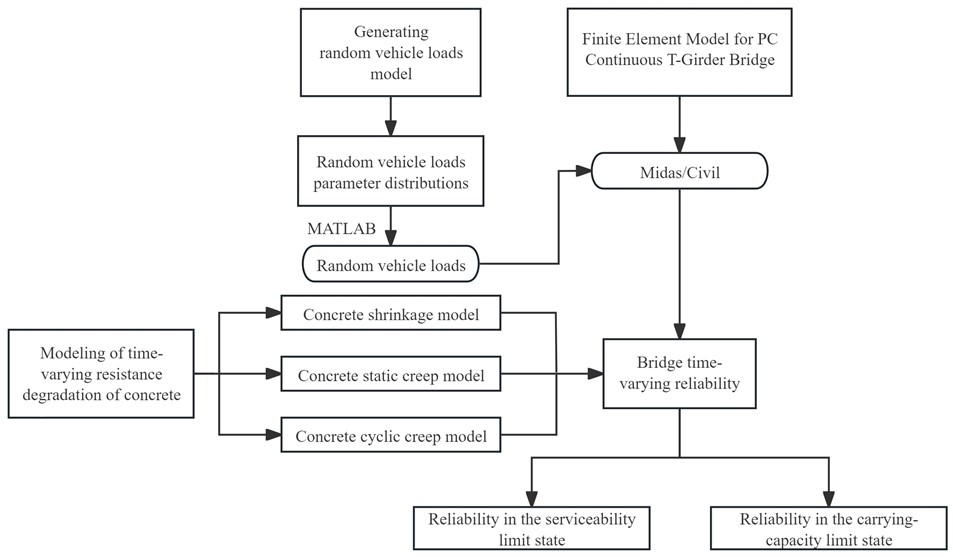
In practice, vehicle loads act neither as static nor stationary processes. The passage of vehicles produces cyclic stress variations within the girder cross-section, particularly in bridges subjected to high proportions of heavy trucks. These stress cycles promote the gradual development of microcracking in concrete, giving rise to cyclic creep—a phenomenon distinct from conventional static creep in both mechanism and long-term consequences. While cyclic creep may appear negligible under light traffic, its cumulative effect becomes increasingly relevant for long-span PC bridges operating under dense or evolving traffic conditions. Another limitation of existing reliability frameworks lies in their treatment of traffic loading. Many approaches idealize vehicle loads as stationary stochastic processes, despite clear evidence that traffic volume, vehicle weight distribution, and axle configurations evolve over time. The growing availability of weigh-in-motion (WIM) monitoring systems offers a means to overcome this simplification by providing direct, long-term measurements of random vehicle load characteristics. Yet the integration of such data into time-varying reliability analyses that also account for cyclic creep remains limited. To this end, new research paper published in Advances in Bridge Engineering and conducted by Dr. Qifan Zhao, Dr. Yuefei Liu & led by Professor Xueping Fan from the Ministry of Education of China School of Civil Engineering and Mechanics at Lanzhou University, the researchers developed an integrated time-varying reliability framework for prestressed concrete continuous girder bridges that combines monitored random vehicle load information with advanced concrete shrinkage, static creep, and cyclic creep models. They coupled Monte Carlo–based traffic simulation with incremental constitutive laws and finite element analysis to track reliability degradation over the bridge service life and the new approach links traffic evolution to cyclic creep accumulation and reliability loss, and enabled more realistic prediction of both ultimate and service-ability limit states.
The research team characterized real traffic conditions using data obtained from a weigh-in-motion monitoring system installed on a prestressed concrete continuous T-girder bridge. Vehicle records were statistically processed to identify representative vehicle classes, axle configurations, speed distributions, and time headway characteristics. These parameters formed the basis for a Monte Carlo simulation scheme, implemented in MATLAB, to generate random vehicle flows that realistically reproduce observed traffic variability over extended service periods. Rather than treating traffic as a stationary input, the simulated vehicle flows preserved distinctions between peak and off-peak traffic states, allowing differences in loading frequency and intensity to emerge naturally. The resulting random vehicle load histories were then translated into time-dependent stress responses within the bridge structure through numerical analysis. The authors constructed a finite element model of a three-span prestressed concrete continuous girder bridge using commercial structural software, incorporating detailed geometric, material, and prestressing information consistent with design practice. They also combined the CEB-FIP shrinkage and static creep models with a cyclic creep formulation grounded in fatigue mechanics to represent time-dependent concrete behavior. They implemented static creep using a Kelvin chain representation derived from a continuous retardation spectrum, which enabled incremental time-step analysis. They also modeled cyclic creep as an accumulation of strain increments driven by stress amplitude and the number of vehicle-induced load cycles within each time interval. This formulation allowed cyclic creep to respond directly to changes in traffic density and vehicle weight. Indeed, the integration of these constitutive models within the finite element framework enabled the calculation of evolving internal forces, deflections, and sectional capacities under random traffic loading. The team performed reliability analyses afterward for both ultimate limit states, governed by flexural capacity, and serviceability limit states, governed by mid-span deflection and they included structural resistance degradation and annual growth in vehicle load effects. The authors found distinct reliability trajectories depending on traffic conditions and limit states. For ultimate limit states, the increase in vehicle load over time emerged as the dominant factor driving reliability reduction, with cyclic creep exerting a secondary but non-negligible influence. In contrast, serviceability reliability proved highly sensitive to cyclic creep, particularly after several decades of service, when accumulated deformation effects became pronounced. Comparisons between simulated and measured reliability indices based on monitored traffic data showed close agreement, with relative errors remaining within acceptable bounds, supporting the validity of the proposed framework.
In conclusion, the work of Professor Xueping Fan and colleagues is substantive advance over traditional reliability models that treat traffic and time-dependent material effects in isolation and by incorporating random vehicle load information derived from WIM data, the study moves beyond idealized traffic models and addresses a key source of uncertainty in long-term bridge assessment. The shift reflects a broader transition toward data-informed infrastructure management. Equally important is the treatment of concrete cyclic creep as a reliability-relevant mechanism and while cyclic creep has been acknowledged in experimental and analytical studies, it is often omitted from routine reliability evaluations due to modeling complexity. The present framework demonstrates that such omission can lead to a systematic overestimation of long-term serviceability performance, especially for bridges subjected to dense or growing traffic flows. Cyclic creep may become the controlling factor in serviceability deterioration over extended service lives, even when ultimate strength remains adequate.
From an engineering perspective, the results have direct implications for maintenance planning and life-cycle decision-making. Reliability indices derived from time-varying analyses provide a quantitative basis for identifying critical periods during which intervention may be required. The observed divergence between reliability trajectories with and without cyclic creep highlights the risk of deferred maintenance strategies that rely on simplified creep models. In this sense, the study supports a more cautious and anticipatory approach to bridge management. The new proposed framework also offers a flexible platform for future extensions and as monitoring technologies continue to improve, richer traffic datasets including vehicle platooning effects or changes in freight policy can be readily incorporated. Similarly, the probabilistic treatment of material properties and environmental conditions opens pathways for site-specific reliability assessments rather than generalized code-based evaluations.



Reference
Zhao, Qifan & Liu, Yuefei & Fan, Xueping. (2025). Monitoring random vehicle load information-based time-varying reliability analysis of PC bridge considering concrete cyclic creep effects. Advances in Bridge Engineering. 6. 10.1186/s43251-025-00187-z.