Advances in Engineering Advances in Engineering features breaking research judged by Advances in Engineering advisory team to be of key importance in the Engineering field. Papers are selected from over 10,000 published each week from most peer reviewed journals.

Significance
Crossed-beam energy transfer (CBET) has been used as a tuning mechanism in indirect-drive laser fusion, allowing energy to be redistributed between beams with slightly different frequencies in order to improve symmetry. In direct-drive configurations, however, CBET is detrimental. At a mechanistic level, two intersecting laser beams exchange energy through a resonant three-wave interaction mediated by an ion-acoustic wave. However, the dynamic details of this interaction in realistic plasmas—particularly in direct-drive laser fusion—remain unclear. Here, CBET is primarily confined to the region near the critical density surface, where strong laser refraction and reflection dominate. Laser trajectories bend, interference patterns form and dissolve, and small changes in plasma conditions can noticeably alter the coupling strength. Capturing this behavior in a way that remains stable and predictive places heavy demands on numerical models, especially when CBET must be embedded within radiation-hydrodynamics simulations that already strain computational resources. Over time, two broad modeling strategies have taken shape. Ray-based models, which describe laser beams as bundles of geometric rays, are attractive because they are fast and integrate naturally with large-scale fusion codes. Their weakness becomes apparent precisely where CBET is most active. Caustics, phase singularities, and unresolved interference force the introduction of empirical limiters and calibration factors, reducing confidence in quantitative predictions. Wave-based models avoid many of these issues by resolving the electromagnetic field directly, but the price is steep. Resolving optical wavelengths over millimeter-scale plasmas and nanosecond time windows quickly becomes impractical, even on modern computing platforms. To this end, new research paper published in Physics of Plasmas and conducted by Doctoral student Xiaobao Jia; Dr. Qing Jia; Dr. Jianyuan Xiao; and Professor Jian Zheng from the University of Science and Technology of China, the researchers developed a Hamiltonian reformulation of crossed-beam energy transfer that recasts laser–plasma coupling as a structure-preserving dynamical system. On this basis, they introduced an explicit symplectic numerical algorithm implemented in the BEAM code, achieving wave-level accuracy at dramatically reduced computational cost. They further derived a physically transparent CBET gain formula directly from the Hamiltonian, enabling reliable prediction of energy transfer without empirical tuning.
The research team reformulated the coupled laser–plasma interaction equations governing CBET. Starting from the wave equation for electromagnetic propagation in a plasma and a fluid description of the ion-acoustic response, the system is reduced to two coupled Schrödinger-type equations for the laser envelopes, linked through the ion density perturbation. Rather than treating this coupling as a purely numerical construct, the authors explicitly decompose the complex field variables into real and imaginary components and demonstrate that the resulting evolution equations satisfy canonical Hamiltonian form. This identification is nontrivial: it reveals that the total energy of the interacting laser–ion-acoustic system is conserved in the absence of damping and provides a natural foundation for symplectic time integration. Afterward, the authors implemented symplectic algorithm through Hamiltonian splitting, in which the full Hamiltonian is decomposed into analytically solvable sub-Hamiltonians. Each sub-step advances the system exactly over a finite time increment, and their composition yields a globally stable, structure-preserving scheme. This algorithm is implemented in the BEAM code, with fluid equations for the ion-acoustic wave solved on a coarser time scale and electromagnetic propagation handled with absorbing boundary layers to suppress artificial reflections.
The authors tested the performance of their approach against particle-in-cell simulations across three increasingly demanding scenarios, as is shown in the figure below. In the first, laser reflection near a turning point in a strongly refracting plasma is simulated. The wave-based BEAM results reproduce interference patterns, refraction, and reflection observed in fully kinetic simulations with striking fidelity, despite orders-of-magnitude lower computational cost. In the second case, two intersecting Gaussian beams undergo CBET in a uniform plasma. The spatial redistribution of intensity and the temporal growth of energy transfer agree closely with particle-in-cell results, while BEAM completes the simulation in minutes rather than hundreds of CPU hours. Finally, the model is tested in the strong-coupling regime of Brillouin amplification, where a short probe pulse extracts energy from a long pump pulse. The simulated pulse compression, amplification factors, and pump depletion dynamics quantitatively match established kinetic benchmarks.
Beyond constructing the numerical scheme and developing simulation tools for CBET, the team also found the Hamiltonian formulation to yield an analytical CBET gain expression. They derived a gain formula that remains accurate across a broad range of intensities by relating the energy stored in the ion-acoustic wave to the depletion and amplification of the interacting beams, the predicted gain closely tracks full wave simulations, which provided a compact and physically grounded estimator for CBET strength.
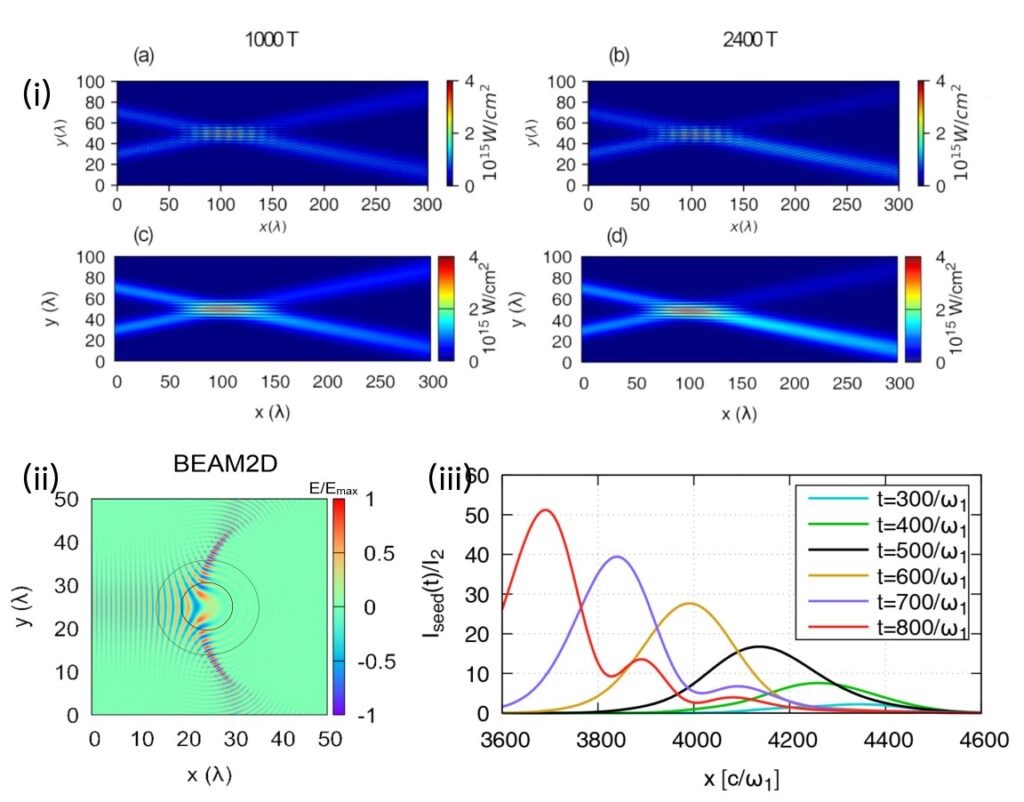
Figure: Three benchmark cases for the BEAM code: (i) crossed-beam energy transfer, comparing BEAM2D simulations (a-b) with PIC simulations (c-d); (ii) laser refraction and reflection at the turning surface; and (iii) Brillouin amplification of a short laser pulse.
In conclusion, the new work of Professor Jian Zheng and colleagues unified wave-based accuracy and computational efficiency in a way that has eluded previous approaches. The implications for inertial confinement fusion are substantial and CBET remains one of the dominant uncertainties in direct-drive implosion modeling, where even modest errors in energy redistribution can lead to large deviations in symmetry and yield. The BEAM framework provides a tool that can be deployed at scales relevant to experiments without resorting to empirical correction factors. Its efficiency makes it suitable for parametric studies, design optimization, and integration into larger simulation pipelines where kinetic models are simply infeasible. Moreover, the analytical CBET gain formula derived from the Hamiltonian formalism and this expression provides a rare bridge between first-principles theory and operational modeling. Rather than calibrating ray-based codes against experiments or kinetic simulations in an ad hoc manner, modelers can use the Hamiltonian gain as a physically motivated benchmark. This has direct relevance for facilities seeking to control or mitigate CBET through beam geometry, frequency detuning, or plasma flow tailoring. Furthermore, the work illustrates the power of structure-preserving numerical methods in plasma physics. Symplectic integration is widely appreciated in celestial mechanics and accelerator physics, yet it remains underutilized in laser–plasma interaction modeling. By demonstrating its effectiveness for CBET, the authors invite similar treatments of other laser-plasma instabilities, including Raman scattering and multi-wave coupling processes, where energy conservation and phase coherence are central. Indeed, the new work of Xiaobao Jia etl al reshapes how CBET can be approached, analyzed, and ultimately controlled in fusion-relevant plasmas.
Reference
Jia, Xiaobao & Jia, Qing & Xiao, Jianyuan & Zheng, Jian. (2025). Modeling of crossed-beam energy transfer in inertial confinement fusion: Numerical simulation and theoretical analysis. Physics of Plasmas. 32. 10.1063/5.0273367.
Go to Journal of Physics of Plasmas.