Advances in Engineering Advances in Engineering features breaking research judged by Advances in Engineering advisory team to be of key importance in the Engineering field. Papers are selected from over 10,000 published each week from most peer reviewed journals.

Significance
Optical coherence tomography (OCT) is one of the most widely used imaging technologies in modern medicine and science because it offers micrometer-level resolution, non-invasive depth sectioning, and real-time imaging of tissue microstructure. Its importance and applications span clinical diagnostics, biomedical research, and industrial metrology. However, its theoretical foundation has lagged behind the pace of experimental innovation. As clinicians and researchers push OCT into regimes of higher numerical aperture, broader spectral bandwidths, and increasingly complex optical designs, they often observe image behaviours that do not sit comfortably within classical, three-dimensional approximations. The field has largely relied on simplified treatments that separate lateral and axial resolution, or that implicitly collapse spatial and temporal coordinates into a single depth variable, an approach that works only so long as the optical system operates in a regime where aberrations, dispersion, and coherence gating remain weakly coupled. Once those assumptions are relaxed—which is increasingly the norm in high-performance OCT and OCM—the existing theory struggles to explain why images distort, why coherence gates curve, or why certain spatial frequencies seem irretrievably lost.
To this end and in a new research paper published in Journal of the Optical Society of America A and conducted by Dr. Naoki Fukutake, Dr. Shuichi Makita, Dr. Yoshiaki Yasuno from the University of Tsukuba in Japan and in collaboration with Nikon Corporation, the researchers developed a unified four-dimensional (4D) image-formation theory that treats OCT as a system governed jointly by spatial and temporal coordinates. Their framework introduces 4D pupil functions and a 4D frequency-space aperture that precisely determine which object frequencies contribute to the measured image. They show that all major OCT modalities—time-domain, frequency-domain, and full-field—share the same underlying imaging equation once recast in this 4D space. This formulation explains longstanding imaging distortions and establishes conditions under which perfect refocusing and accurate resolution prediction are possible.
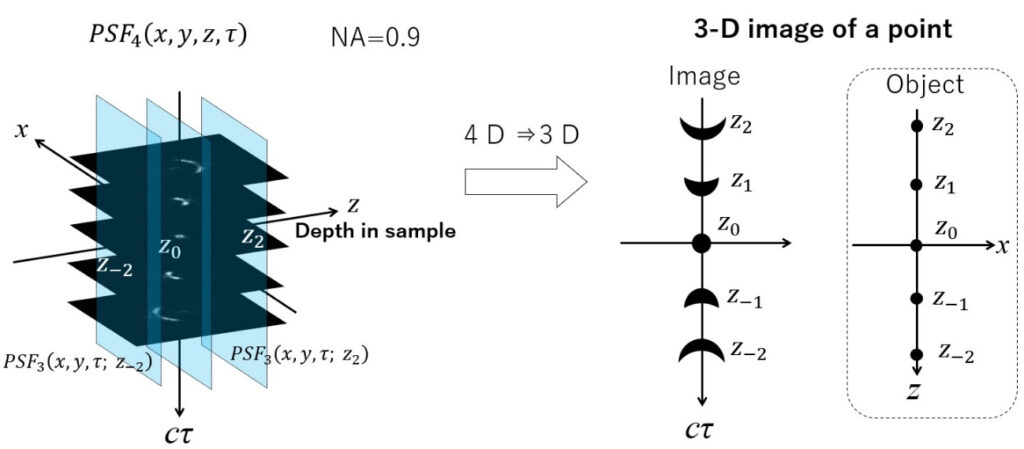
The research team performed a complete mathematical reconstruction of OCT image formation and began with the time-domain system and extended the same logic to frequency-domain and full-field implementations. Instead of treating these as distinct modalities, they derive a unified expression for the detected intensity by tracking how excitation light interacts with the object, propagates through the optical system, and interferes with the reference arm. This leads them to define a four-dimensional point-spread function PSF₄(x, τ), obtained by temporally convolving the excitation field with collection field. In practice, this PSF behaves as the spatial product of two beams—one forward-propagating and one reverse-propagating—whose overlap determines how differently the image is formed depending on the depth of object.
The authors found when they applied this framework to all three major OCT architectures the following: in time-domain systems, the depth coordinate enters explicitly through the physical delay between arms while in frequency-domain systems, the delay reappears mathematically through the Fourier transform of the spectral interferogram. Full-field OCT, despite its incoherent illumination and absence of lateral scanning, yields an equivalent formulation once the illumination coherence function is handled explicitly. According to the authors, all OCT types reduce to the same expression for PSF₄ and therefore share identical imaging properties when experimental conditions are matched.
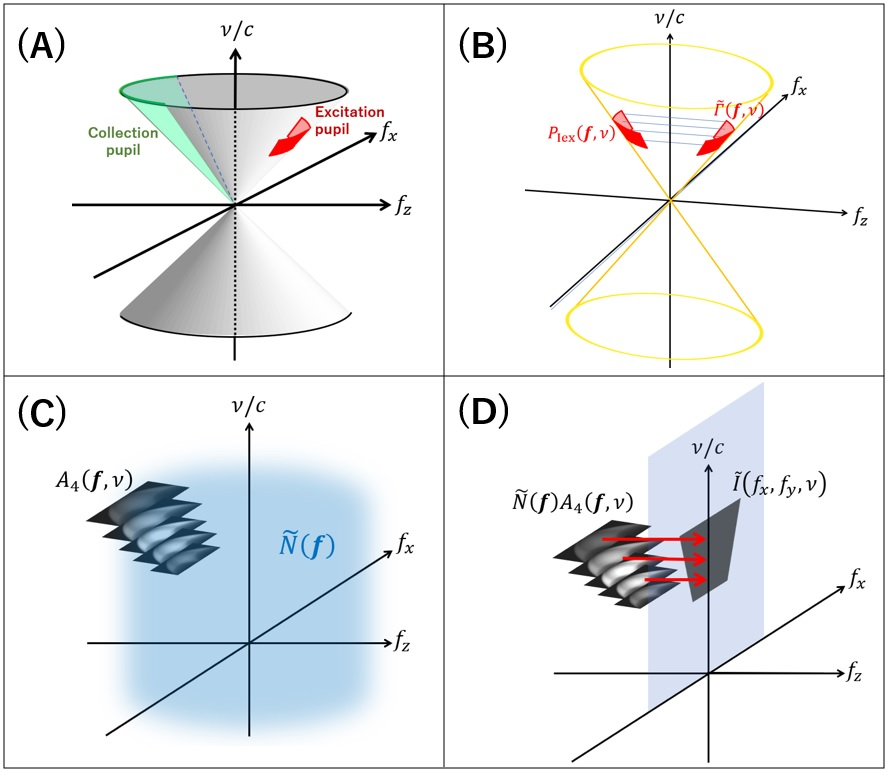
Moreover, the team performed 4D frequency space analysis, where spatial frequencies (fₓ, fᵧ, fz) are paired with optical frequency ν. By Fourier transforming PSF₄, the authors obtain a 4D aperture A₄(f, ν) that acts as a window selecting which object frequencies survive the imaging process. When the numerical aperture rises or when the spectrum broadens, this aperture thickens along fz, meaning that depth-related spatial frequencies overlap and become inseparable. This explains why refocusing fails in high-NA OCT: the instrument itself merges distinct object frequencies before detection. Conversely, when excitation NA approaches zero—as in plane-wave FF-OCT—the aperture collapses into a thin sheet, allowing perfect refocusing and recovery of object structure. Their theoretical predictions extend to aberrations and dispersion. By defining both as manifestations of 4D phase distortions within the pupil, the authors show that spatial aberrations originate from specific combinations of excitation and collection pupils, while temporal aberrations disappear only if both arms share identical dispersion. This generalization clarifies long-standing discrepancies between empirical observations and classical theory, particularly in systems operating outside the paraxial regime.
In conclusion, Dr. Naoki Fukutake and colleagues fundamentally redefined how OCT forms an image by introducing a complete, mathematically rigorous 4D imaging theory. By giving equal weight to spatial and temporal coordinates, the authors illuminate behaviours that were previously treated as experimental nuisances rather than fundamental consequences of the imaging physics. The question of resolution in OCT is often presented as deceptively simple: axial and lateral performance are treated as independent knobs, one governed by spectral bandwidth and the other by numerical aperture. What Fukutake, Makita, and Yasuno demonstrated that this tidy separation only survives in a narrow operating regime. Once the numerical aperture increases or the spectrum broadens, the imaging system begins to behave in ways that traditional theory cannot comfortably explain. Their 4D pupil formulation reveals that spatial and temporal frequencies are inherently entangled, and that this coupling quietly undermines the long-held assumption of independent resolutions. For instrument designers, acknowledging this relationship is not just an academic exercise; it prevents them from leaning on approximations that may have worked a decade ago but become unreliable in the high-performance systems now being built.
Moreover, this new framework also reframes a persistent puzzle around digital refocusing. In practice, refocusing sometimes works beautifully and sometimes stubbornly fails, even with sophisticated algorithms. The authors provide a physical explanation: refocusing does not break down because the computation is lacking, but because the 4D aperture itself blends depth-related object frequencies before detection. Once that mixing happens, the information is simply no longer recoverable. However, the same theory also points to the opposite scenario—when the excitation NA is sufficiently low, the 4D aperture collapses into a thin sheet, and refocusing becomes theoretically perfect. That observation is particularly relevant for full-field OCT, where design choices often involve awkward compromises between illumination geometry, coherence, and lateral resolution. Additionally, their treatment of aberrations follows the same unifying spirit. Spatial aberrations and chromatic dispersion, usually corrected through entirely separate procedures, become aspects of a single 4D aberration in this formulation. Thinking of them together opens a path toward optical designs that handle both simultaneously, something current systems rarely achieve. Taken together, the theory offers more than a refined mathematical model. It lays groundwork for interpreting—and possibly improving—advanced techniques such as inverse scattering reconstructions, computational OCT, and adaptive wavefront shaping. These methods have outpaced the theoretical language used to justify them, and this 4D framework brings the field much closer to understanding how OCT actually manipulates information in space and time.
Reference
Naoki Fukutake, Shuichi Makita, and Yoshiaki Yasuno, “Four-dimensional image formation theory of optical coherence tomography,” J. Opt. Soc. Am. A 42, 773-779 (2025)
Go to Journal of the Optical Society of America A