Advances in Engineering Advances in Engineering features breaking research judged by Advances in Engineering advisory team to be of key importance in the Engineering field. Papers are selected from over 10,000 published each week from most peer reviewed journals.

Significance
Scientists have made chemical systems smaller and smaller (down to the micro-scale) the level of control and precision we can now achieve in these microfluidic systems is far higher than what people thought was possible in the past. Once reactions are confined to channels only a few hundred micrometers across, even small disturbances in flow begin to matter in ways they simply do not in larger systems. A slight drift in velocity might reshape a concentration gradient, alter how long a reagent lingers in a zone of interest, or nudge a reaction along a different path altogether. For this reason, flow sensing has gradually shifted from a convenience to a necessity within microfluidic design but the tools we rely on have not evolved at the same pace. Most commercial sensors still sit outside the device, bolted onto tubing rather than integrated into the chip itself. This arrangement limits where measurements can be taken and, in many setups, consumes space that researchers would prefer to use for additional microfluidic functions.
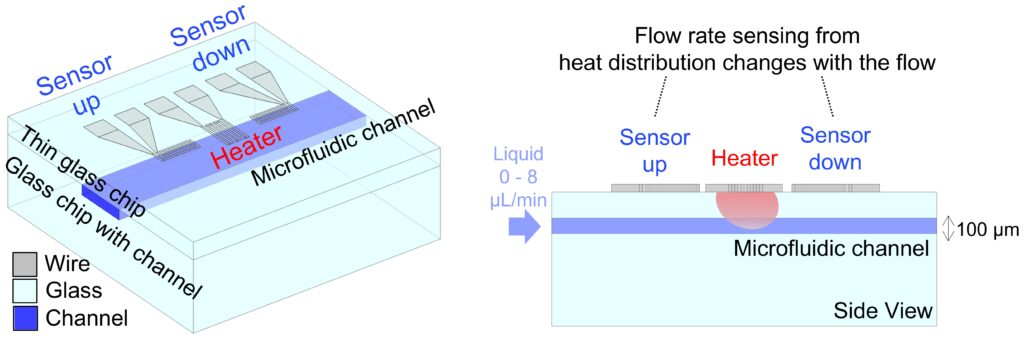
Another complication arises the moment these platforms are adapted for chemical synthesis or analytical work. The palette of usable materials narrows quickly. Many MEMS-friendly substrates—silicon, PDMS, other metals and polymers—behave nicely from a fabrication standpoint but are far less cooperative in chemically demanding environments. They may leach, swell, or participate in redox reactions after extended contact with solvents or reactive intermediates. Glass avoids most of these issues. Its chemical stability and optical clarity make it a natural choice for high-precision microfluidics. Even so, embedding MEMS sensing elements within a glass architecture is not trivial. The conductive components must remain electrically insulated from the flowing liquid, and the fabrication tolerances needed to maintain reliable flow control leave little room for error. To this end, new research paper published in Journal of Micromechanics and Microengineering and conducted by Mr. Shao-Yang Hung, Mr. Zhong-Wei Lin, Professor Hiroyuki Fujita, Professor Sheng-Shian Li, Professor Chihchen Chen, Professor Takehiko Kitamori and Professor Kyojiro Morikawa from the National Tsing Hua University, the researchers designed and fabricated a noncontact thermal MEMS flow sensor embedded directly into a glass microfluidic chip, ensuring full chemical compatibility by isolating all metallic elements behind a thin glass wall. Their system integrates a nickel heater and paired upstream–downstream sensing wires to create a calorimetric measurement scheme capable of detecting flows as low as 0–8 µl min⁻¹. They developed and validated two complementary models—one based on multiphysics thermal simulations and one based on experimental demodulated electrical signals—that jointly describe heat transport and sensitivity limits in glass-insulated microchannels.
The researchers patterned a nickel heater and two nickel sensing wires on a thin glass substrate positioned above a machined channel. The channel itself measured 550 µm in width and 100 µm in depth, dimensions chosen to maintain manageable thermal diffusion while offering compatibility with standard microfluidic operations. A second glass layer, only 170 µm thick, separated the fluid from the metal elements, forming the mechanical and electrical insulation required for chemical work. Fabrication proceeded through photolithography and lift-off, followed by the bonding of glass layers, careful CNC machining of channels and ports, and wire bonding to a flexible cable for electrical interfacing. Afterward, the authors used multiphysics modeling to anticipate how heat would propagate through the multilayer structure. They adjusted heater dimensions, sensing wire placement, and boundary conditions until the predicted thermal field could reliably distinguish upstream from downstream temperature changes. These simulations included contributions from natural convection, conduction through the glass wall, and the effects of flow velocities spanning the microliter-per-minute range. They found the selected design maintained a stable gradient at a 20 mA heating current, and allowed detectable shifts in resistance through the temperature-dependent response of nickel.
Experimentally, the team mounted the glass chip in a custom holder connected to a syringe pump. An AC-modulated signal was applied to the sensing wires and demodulated through a lock-in amplifier to extract temperature-dependent resistance changes with minimal noise. They found at low flow rates, the downstream wire consistently registered an elevated temperature while the upstream wire cooled slightly, producing a differential signal that increased monotonically with flow. The linear regime extended from 0 to 8 µl min⁻¹, a region where conventional flow sensors typically struggle. Beyond this range, the downstream signal began to plateau, a behavior the authors traced to heat loss into the channel walls and imperfect downstream heat transport. The authors also showed negligible hysteresis when flow rates were ramped up or down, suggesting that the device’s thermal response remained stable over time and did not retain a memory of previous flow conditions. Moreover, the sensitivity values were modest when calculated in terms of volumetric flow rate—an expected outcome given the small cross-section—but comparable to or better than those of earlier MEMS devices when assessed in terms of flow velocity. Moreover, the team noted that increasing heater power could enhance sensitivity, though at the cost of elevated fluid temperatures, an issue of particular importance in chemical or biological assays.
In conclusion, the new work of Professor Kyojiro Morikawa developed new models that establish a framework for future high-precision, chemically robust flow sensors suitable for advanced lab-on-chip applications. The authors resolved the chemical incompatibility of many MEMS materials by embedding the MEMS components directly into an all-glass architecture. Their strategy of isolating metallic structures behind a thin glass barrier preserves the advantages of calorimetric sensing while eliminating concerns about contamination or electrochemical interference. This is particularly relevant for applications where even trace metal ions or unintended redox reactions could distort analytical measurements or compromise product purity. The study also advances our understanding of thermal flow sensing at small scales. The linear response observed within the 0–8 µl min⁻¹ range demonstrates that calorimetric techniques remain effective when carefully adapted to the thermal properties of glass. Their findings highlight the delicate balance between heat conduction through the substrate and heat convection within the channel and that too much insulation weakens the signal; too little risks overheating the analyte. Additionally, the authors’ decision to work with a 170 µm glass separation illustrates an attempt to reconcile these competing pressures, though their own discussion points toward future opportunities in ultra-thin glass technologies. Sheets only a few micrometers thick could dramatically sharpen thermal coupling while maintaining chemical inertness, offering a pathway toward even more sensitive, lower-power sensors.
Moreover, instruments used for synthesis, catalysis screening, biological assays, or reaction monitoring increasingly rely on internal feedback to regulate conditions in real time. External flow meters are often too sluggish or too coarse for such tasks. The demonstrated ability to integrate multiple thermal sensors along a single channel—fifteen units in this device—suggests that spatially resolved flow monitoring could become routine. This would allow researchers to observe local flow disturbances, diagnose channel blockages, or quantify reaction-induced viscosity changes without modifying the chemical environment. Another significance is the reproducibility and the absence of hysteresis ensures that the device does not require recalibration between measurements which simplifies its deployment in automated systems. Its all-glass construction also aligns with the needs of optical detection methods frequently used in microfluidics, offering compatibility with fluorescence, absorbance, and imaging techniques. In sum, the new work provides a blueprint for the next generation of chemically compatible, chip-integrated flow sensors opens avenues for integrating multi-sensor arrays into increasingly complex microfluidic platforms.





Reference
Hung, Shao-Yang & Lin, Zhong-Wei & Fujita, Hiroyuki & Li, Sheng-Shian & Chen, Chihchen & Kitamori, Takehiko & Morikawa, Kyojiro. (2025). Noncontact MEMS thermal flow sensors integrated in glass microfluidic chemical chip. Journal of Micromechanics and Microengineering. 35. 065013. 10.1088/1361-6439/ade162.
Go to Journal of Micromechanics and Microengineering.