Advances in Engineering Advances in Engineering features breaking research judged by Advances in Engineering advisory team to be of key importance in the Engineering field. Papers are selected from over 10,000 published each week from most peer reviewed journals.

Significance
Passenger ships remain one of the most widely used modes of mass transportation, however, they operate in environments that are fundamentally unstable by nature. Despite decades of progress in naval architecture, safety regulations, and evacuation planning, maritime accidents continue to occur, and when they do, even small deviations from level conditions can have outsized consequences. Inclination of the vessel whether gradual or sudden can quickly transform routine movement into a physical challenge. In emergency situations, evacuation success depends less on theoretical pathway design and more on the simple, human question of how people actually move through ship corridors under stress. Walking speed, therefore, is not just a modeling parameter; it becomes a practical determinant of survival. Crucially, movement behavior observed on land offers only limited guidance. Ships impose constraints that are qualitatively different, both mechanically and perceptually. Among these constraints, inclination plays a particularly disruptive role. Heeling challenges lateral balance in ways that are difficult to compensate for instinctively, while trim reshapes the effort required to move forward or downhill. Each has been examined independently, often with tidy experimental assumptions. Real emergencies, however, are rarely tidy. Flooding, asymmetric loading, or abrupt maneuvers frequently generate combined longitudinal and transverse inclinations, forcing passengers to adapt to multiple destabilizing cues at once. Although evacuation guidelines acknowledge these effects in principle, the empirical basis for understanding combined heeling–trim conditions remain fragmented and, in some cases, contradictory. Many studies focus on single pedestrians navigating inclined surfaces, and produce valuable baseline data but overlook how evacuation actually unfolds. In reality, people move in groups and they watch one another, slow down preemptively, adjust spacing, and prioritize balance over speed. These collective behaviors are not secondary effects; they fundamentally reshape movement patterns. However, systematic experimental evidence capturing how crowd dynamics interact with inclination is still sparse. This gap is compounded by methodological inconsistency. Differences in experimental platforms, participant profiles, inclination ranges, and measurement techniques make cross-study comparisons difficult. As a result, evacuation simulations often rely on simplified speed reduction models that struggle to reflect how people truly behave when balance, gravity, and social interaction collide under inclined conditions. To this end, new research paper published in Ocean Engineering and conducted by Yong Jiang, Zihang Li, Yurou Mao, Boxuan Wang, and led by Dr. Dawei Zhang from the College of Electronic Information and Automation at Tianjin University of Science and Technology, the researchers developed a controlled experimental framework to quantify pedestrian walking speed under combined heeling and trim conditions in both individual and crowd contexts. They generated high-resolution datasets capturing average speeds, speed attenuation ratios, and instantaneous velocity evolution across realistic inclination scenarios.
The research team tried to replicate the geometric and kinematic constraints of passenger ship corridors but also allowed systematic control over inclination. They constructed a modular platform representing a ship corridor with adjustable heeling and trim angles, and enable the simulation of fifteen distinct inclination combinations within safety-relevant limits. Participants traversed the corridor under both individual and crowd walking conditions, ensuring that solitary movement and group interactions could be directly compared under identical physical settings. The authors found in individual walking trials, participants crossed the inclined corridor one at a time, allowing their natural adjustments to balance and gravity to emerge without interference from others. Under mild downhill trim, walking speeds initially increased, reflecting gravitational assistance. However, beyond a threshold, participants visibly moderated their pace to preserve stability, demonstrating that acceleration under gravity is not unbounded. Uphill trim produced a consistent reduction in speed, while increasing heeling angles introduced lateral instability that further suppressed forward motion. They also tested when the same inclination conditions in crowd walking mode, a markedly different behavioral pattern emerged. Although the overall trends with respect to trim direction were similar, average walking speeds were systematically lower than those observed in individual trials. More importantly, crowd speeds exhibited tighter distributions, indicating that pedestrians converged toward a shared pace rather than expressing individual variability. This convergence became more pronounced as heeling increased, suggesting that lateral instability heightens sensitivity to neighboring movements. Moreover, the team reported combined heeling and trim conditions revealed interactions were not evident under single-factor inclinations. In crowd mode, walking speed proved particularly sensitive to heeling when trim was present. Even modest transverse tilting caused participants to increase interpersonal spacing and reduce speed more sharply than in individual trials. Observational data indicated that pedestrians consciously moderated their steps to avoid destabilizing contacts, effectively trading speed for collective safety. The authors performed dynamic analysis of instantaneous velocities and observed across both walking modes, pedestrians typically exhibited an initial acceleration phase followed by stabilization. However, under combined inclinations, peak velocities were lower and deceleration phases more pronounced, especially during uphill trim. Crowd walking trajectories displayed smoother, more synchronized velocity profiles, reinforcing the notion that social coupling constrains individual movement choices.
In conclusion, the work of Dr. Dawei Zhang and colleagues demonstrated that crowd walking is markedly more sensitive to heeling when trim is present, a dynamic not captured by single-factor models and the results provide robust empirical inputs for improving evacuation simulations and safety assessments. This study offers a substantial advance in the empirical understanding of human evacuation dynamics aboard passenger ships. Its primary significance lies in demonstrating that combined heeling and trim conditions fundamentally alter pedestrian walking behavior, particularly when movement occurs in crowds. While previous research often treated inclination effects as additive or secondary, the present findings reveal that transverse and longitudinal tilting interact in ways that reshape both speed magnitude and variability.
One of the most consequential implications concerns evacuation modeling. Many simulation frameworks rely on speed reduction factors derived from individual walking experiments or single-inclination scenarios. The data presented here show that such approaches may underestimate evacuation time under realistic conditions, especially when crowd behavior is involved. The heightened sensitivity of crowd walking speed to heeling suggests that lateral instability exerts a disproportionate influence once social interactions constrain individual adjustment strategies. It is noteworthy to mention the authors reporting about walking speeds in crowd mode has practical implications because in emergencies, uniform pacing may reduce collisions and falls, but it simultaneously limits the ability of faster individuals to compensate for slower ones. This phenomenon implies that evacuation efficiency is bounded not by the fastest movers, but by collective balance maintenance. Designers and regulators should therefore consider whether corridor layouts, handrail placement, or surface treatments can mitigate balance demands under inclination, thereby allow safer increases in walking speed. Beyond maritime applications, the study’s findings extend to land-based evacuation scenarios involving inclined or destabilized structures, such as those affected by earthquakes or structural deformation and suggest that crowd behavior under combined inclination may follow similar principles. The new study also highlighted the value of high-resolution motion tracking and controlled inclination experiments in capturing behavioral adaptations and by integrating speed attenuation modeling with spatiotemporal velocity analysis, the researchers provide a richer representation of evacuation dynamics than static averages alone could offer. Ultimately, we believe the new study of Dr. Dawei Zhang and colleagues strengthens the empirical foundation upon which safety guidelines and evacuation simulations are built and enables more realistic assessments of evacuation performance and supports the development of safer, more resilient passenger ship designs.
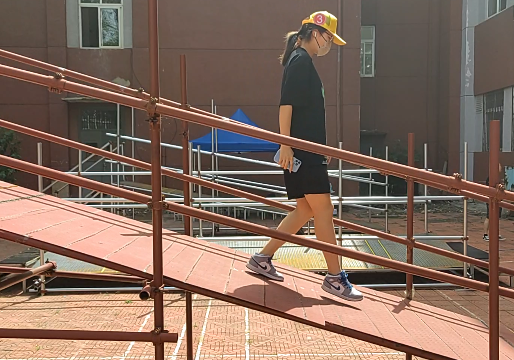
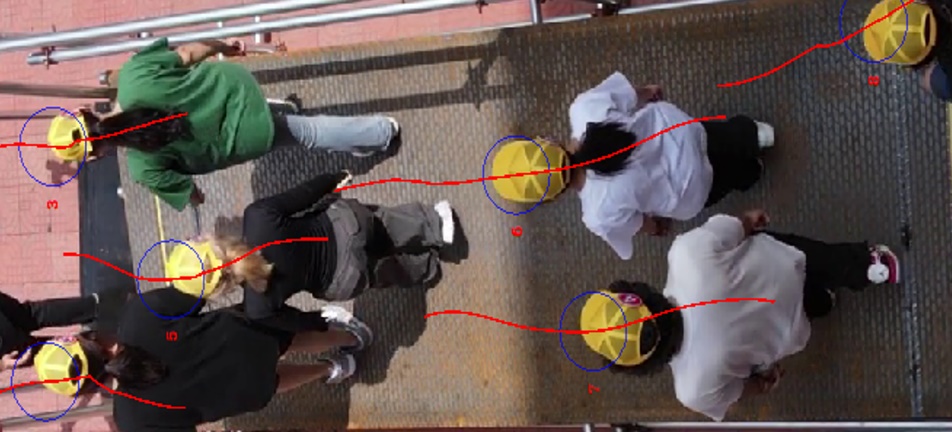
Fig. 1 Scene of evacuation experiment and track extraction
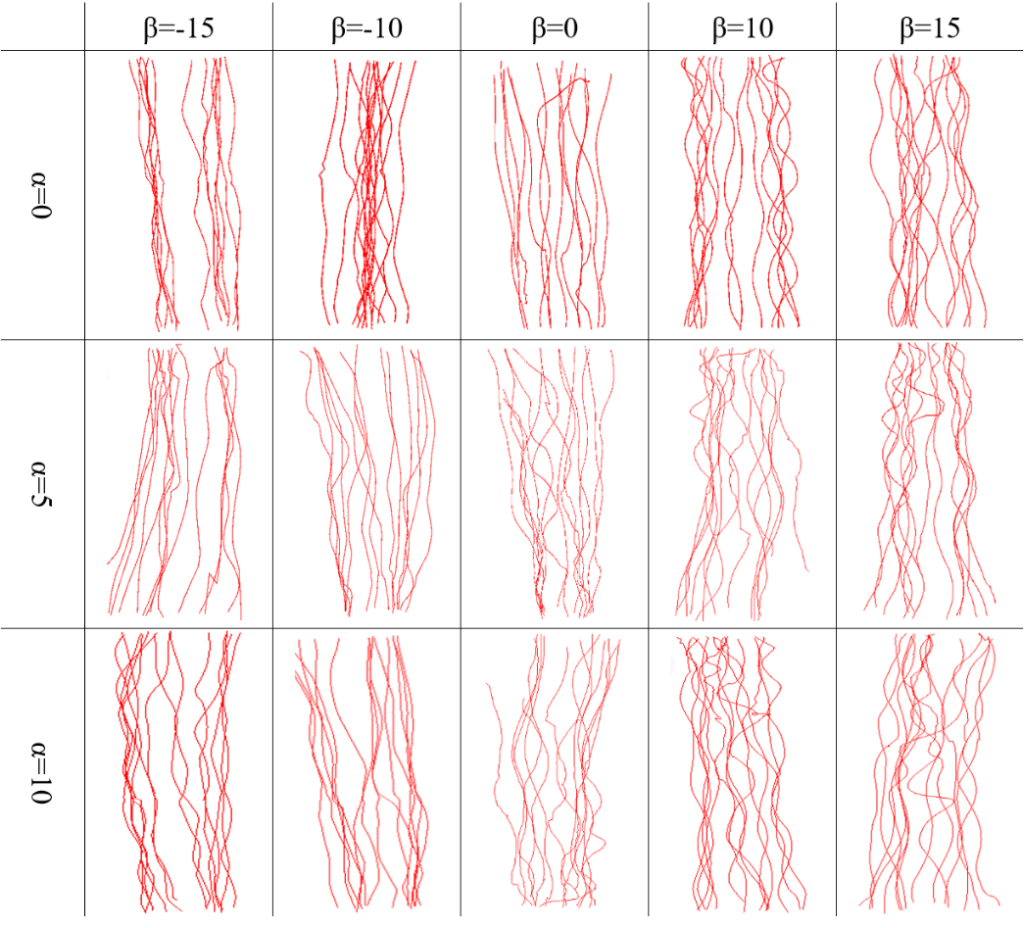
Fig. 2 Trajectory of subjects in different heeling and trim environments



Reference
Yong Jiang, Zihang Li, Yurou Mao, Boxuan Wang, Dawei Zhang, An experimental study on pedestrian walking speed considering combined effect of heeling and trim, Ocean Engineering, Volume 331, 2025, 121300,
Go to Journal of Ocean Engineering.