Advances in Engineering Advances in Engineering features breaking research judged by Advances in Engineering advisory team to be of key importance in the Engineering field. Papers are selected from over 10,000 published each week from most peer reviewed journals.

Significance
Density limits are still among the most difficult constraints in magnetically confined fusion plasmas. In both tokamaks and stellarators, pushing the average density just a bit beyond the usual operating range can cause the discharge to end abruptly. What makes this especially challenging is that the plasma does not always show a gradual loss of confinement beforehand; instead, stability can collapse over a short timescale, leaving little time to respond. Although empirical scalings (mainly the Greenwald relation) have provided a reference point but these scalings remain detached from several experimental observations that have accumulated across devices, heating schemes, and wall materials. Among the most persistent inconsistencies is the dependence of the density limit on applied heating power which is observed repeatedly but only partially rationalized within existing theoretical frameworks. Boundary cooling driven by impurity radiation has long been suspected as a controlling mechanism. Increased power input should, at least superficially, counteract such cooling but many operational datasets show that density limits rise with power only within certain regimes, flatten elsewhere, or even bifurcate into distinct operational branches and models based solely on edge power balance or turbulent transport usually reproduce selected trends, but their assumptions vary sharply from one device to another. Therefore, these approaches struggle to explain why similar power dependencies emerge in machines with very different geometries, wall compositions, and confinement characteristics. Plasma–wall interaction physics introduces a different angle on the problem. The wall does not respond passively to plasma conditions; it participates dynamically through sputtering, recycling, and impurity generation, all of which feed back into radiation and particle balance. Recent theoretical developments have formalized this interaction as a self-organizing process linking edge temperature, wall material response, and global plasma parameters. Within this view, the density limit reflects a balance condition shaped as much by material response and confinement time as by input power itself.
A recent research paper published in Plasma Physics and Controlled Fusion and conducted by Mr. Jiaxing Liu, a PhD candidate and Professor Ping Zhu from the School of Electrical and Electronic Engineering at Huazhong University of Science and Technology in collaboration with Professor Dominique Franck Escande from the Aix-Marseille Université, CNRS, the researchers presented a zero-dimensional analytical model that links density-limit scalings to plasma–wall self-organization through global power balance and impurity radiation. The new model couples heating power, sputtering-driven impurity radiation, and particle confinement into a single stability condition and unlike empirical laws, the framework predicts multiple density-limit regimes determined by material response and confinement scaling. It also extends naturally to burning-plasma conditions by incorporating fusion heating and helium radiation effects.
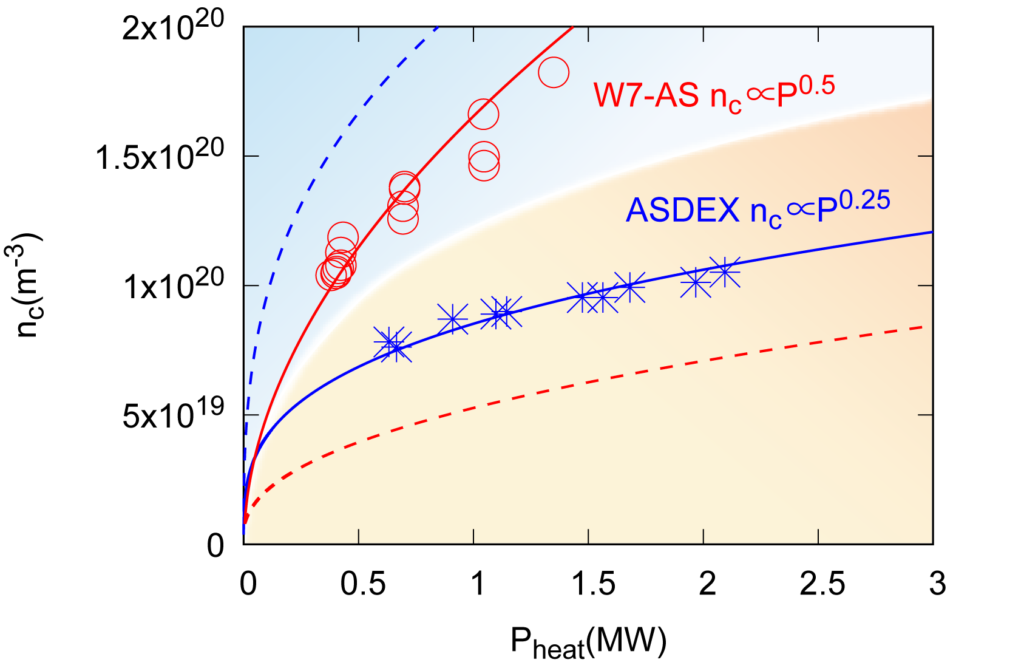
The investigators began by expressing impurity radiation at successive interaction cycles as a function of wall-deposited power, impurity transport, and sputtering yield and by embedding this relation within a global power balance, the study examined how stable fixed points emerge or disappear as heating power increases. The authors demonstrated that the density limit arises naturally from a stability condition on impurity radiation growth. When radiation responds too strongly to incremental power deposition on the wall, the system loses its steady solution. This instability defines an upper density bound that depends explicitly on both heating power and the sensitivity of sputtering yield to target temperature. The study showed that this dependence cannot be reduced to a single monotonic trend. Instead, the mathematical structure of the model admits multiple operational branches. The researchers evaluated these branches by combining material-specific sputtering physics with confinement-time scalings drawn from experimental databases and when they assumed tungsten sputtering and JET-like particle confinement, the analysis produced two distinct density-limit regimes separated by an intermediate interval where higher power reduced the allowable density. The investigators linked these regimes directly to changes in how target temperature responds to power deposition, which alters the slope of impurity yield relative to power input. The study examined how alternative confinement scalings modify this behavior. When ITER-like confinement assumptions replaced JET scalings, the authors observed a sharper rise of the upper branch with power, while the lower branch remained nearly unchanged. This outcome followed directly from how confinement time couples electron density to edge temperature, rather than from any adjustment of sputtering parameters. Plus, the researchers applied the same framework to ASDEX-Upgrade and W7-AS by adjusting only transport coefficients, wall materials, and empirically constrained confinement scalings and found the resulting power-dependent density limits aligned quantitatively with experimental trends in both devices, despite their different magnetic configurations. Additional analyses incorporated radiation from nonsputtered background impurities and heating from fusion-born alpha particles. Also, the investigators found that background impurities selectively suppress the low-temperature branch, while fusion reactions modestly relax external power requirements without altering high-temperature behavior.
In conclusion, Mr. Liu, Professor Zhu and Professor Escande provided a coherent explanation for why heating power raises density limits in some regimes, saturates in others, and occasionally produces counterintuitive behavior. Their analysis linked these trends to measurable physical quantities—sputtering yields, confinement-time scalings, and impurity transport. We believe one immediate consequence is how operational scenarios are interpreted and because density limits no longer appear as purely plasma-internal phenomena but as conditions negotiated continuously with wall materials and edge temperatures and changes in heating strategy, wall composition, or confinement scaling can alter this negotiation in predictable ways. Moreover, the presence of multiple branches suggests that operational history and access paths matter, since identical power and density values may reside on different stability branches depending on edge conditions. The new findings provide a measured tangible implication for reactor-scale plasmas. Alpha-particle heating does not remove density limits, nor does it guarantee higher operating margins. Instead, fusion heating shifts power balance in ways that depend sensitively on confinement and impurity content. Under favorable conditions, it reduces the external power needed to reach a given density, but it leaves high-temperature constraints largely intact. This bounded effect tempers optimistic assumptions while still providing a rational basis for extrapolation. Plus, the study elegantly introduces a framework capable of unifying density-limit behavior across magnetic configurations. Tokamaks and stellarators appear within the same theoretical structure once their confinement and material parameters are specified and that unity suggests that future optimization efforts may benefit more from controlling plasma–wall coupling and confinement scaling than from attempting to bypass density limits through power increases alone. Recently, this common theoretical structure proved fruitful with the increase of the density limit in the EAST tokamak by using a start-up mimicking a stellarator one [LIU, Jiaxing, ZHU, Ping, ESCANDE, Dominique Franck, et al. Accessing the density-free regime with ECRH-assisted ohmic start-up on EAST. Science Advances, 2026, vol. 12, no 1, p. eadz3040]. To sum up, Mr. Liu, Professor Zhu and Professor Escande advanced a reduced analytical model that extends plasma–wall self-organization theory to predict how heating power, impurity sputtering, and confinement scaling jointly determine density limits.


Reference
Liu, Jiaxing & Zhu, Ping & Escande, Dominique. (2025). Power dependence of the density limit due to plasma–wall interactions in a burning plasma. Plasma Physics and Controlled Fusion. 67. 10.1088/1361-6587/adf883.