Advances in Engineering Advances in Engineering features breaking research judged by Advances in Engineering advisory team to be of key importance in the Engineering field. Papers are selected from over 10,000 published each week from most peer reviewed journals.

Significance
Strain recovery becomes difficult to interpret when stress and temperature change at the same time, because the alloy is no longer moving along the simple actuation or superelastic routes that usually supply the data for constitutive calibration. High-temperature shape memory alloys, where non-proportional thermo-mechanical histories matter for practical use and where standard calibration practice still relies mainly on isobaric thermal cycling or isothermal stress cycling. Once temperature gradients, simultaneous loading, and heterogeneous local response enter the picture, a model built only from simple paths has to carry much more than a smooth macroscopic hysteresis loop; it has to represent how transformation, transformation-induced plasticity, and crystallographic slip accumulate inside a polycrystal whose grains do not all respond in the same way.
In a recent research paper published in International Journal of Plasticity, PhD candidate Adrien Cassagne, Professor Dimitris Lagoudas, and Professor Jean-Briac le Graverend from the Texas A & M University, the authors developed a crystal-plasticity mean-field framework for high-temperature shape memory alloys subjected to complex thermo-mechanical loading. The formulation combines thermo-elasticity, martensitic transformation, TRIP, and plastic or viscoplastic slip with an implicit β-transition rule that transfers macroscopic loading to grain-scale response. They also introduced a grain-size-dependent transformation-threshold law and a stress-dependent saturating transformation-strain variable tied to local von Mises stress. Using parameters calibrated from isobaric experiments, they applied the model to out-of-phase and in-phase loading paths in a Ti-rich NiTiHf polycrystal.
The authors build the constitutive framework by decomposing total strain into thermo-elastic strain, transformation strain, TRIP strain, and plastic or viscoplastic strain, then letting each inelastic part evolve from its own driving force at the grain scale. That structure matters because complex thermo-mechanical paths do not redistribute deformation through a single mechanism. A model that lumps the response too early would miss the fact that martensitic transformation changes the local state that then drives TRIP and slip. Cassagne and colleagues keep those channels separate, then couple them through dislocation-dependent transformation resistance and an irrecoverable martensite fraction. In practical terms, that means the model can let the same loading path generate recoverable strain, dislocation-assisted residual strain, and altered transformation thresholds within one common framework.
Two ingredients carry much of the paper’s original modeling work. One is the grain-size-dependent activation law for forward and reverse transformation thresholds. The other is the stress-sensitive coefficient δc that saturates the transformation-strain magnitude as a function of local von Mises stress. Those additions are not decorative. The grain-size criterion gives the model a microstructural basis for smoothing hysteresis across the aggregate, which is especially useful in a mean-field setting where each grain contributes statistically through its volume fraction. The saturation term changes the logic of how stress feeds transformation strain: instead of letting strain continue to scale too aggressively from the moment stress rises, the formulation lets the response build toward a ceiling. The paper shows why that choice is physically useful for the NiTiHf alloy under discussion, where higher stress does not simply translate into unlimited growth of transformation strain once preferred variants have already been activated.
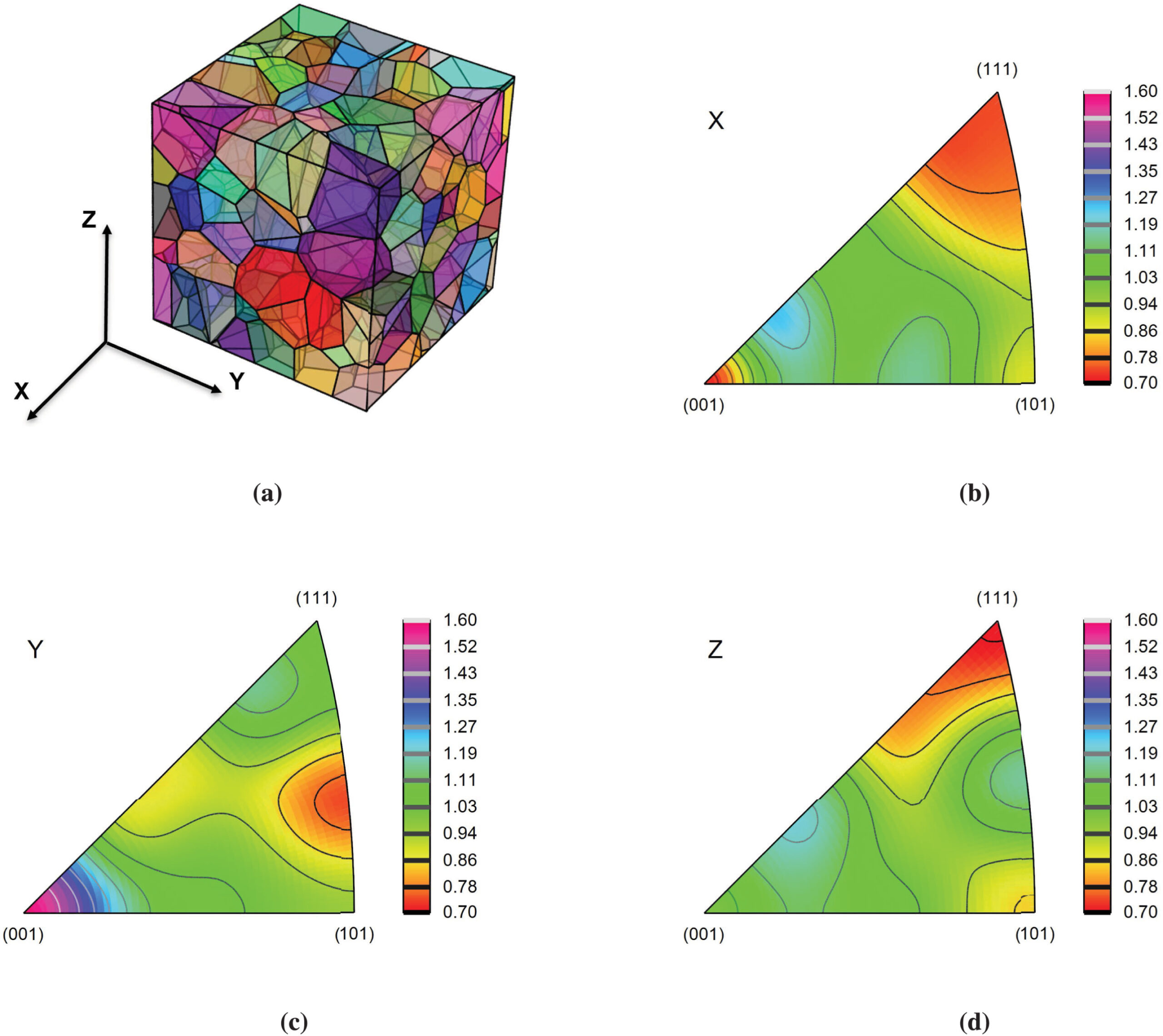
They implement the polycrystal as a 250-grain aggregate with random orientations and a Gaussian grain-size distribution, then connect local grain stresses to the macroscopic state through the implicit β-transition rule. Here the modeling choice is quite telling. The β variable gives each grain access to a non-linear accommodation of internal stress through the aggregate average, so the model can generate harder local response without forcing the sharp domino-like propagation that full-field compatibility can produce. That is exactly the kind of adjustment complex thermo-mechanical paths need, because transformation onset in one part of the aggregate should influence the rest of the material, though not in a mechanically abrupt way. The calibration proceeds on isobaric tests across several stress levels, after which the same parameter set is used for out-of-phase and in-phase paths.
The computed isobaric responses recover the experimentally observed strain evolution with smooth hardening, and the transformation strain rises strongly with stress up to about 470 MPa before approaching saturation, while total strain continues to grow through TRIP. That separation is important: it tells the reader that the model does not treat all extra deformation at high stress as new transformation strain. When the authors move to out-of-phase loading, the simulated loops retain the expected hysteretic form and reproduce the experimentally observed trends in transformation and actuation strain. For in-phase loading, the framework reproduces the unusual first-cycle character associated with an initially self-accommodated martensitic state, where the reverse-transformation peak is largely absent, and it also produces the stronger hysteresis seen on subsequent cycles. The paper treats that first-cycle feature as a real mechanistic signature of variant selection during initial reverse transformation, not as a curiosity at the edge of the data.
The work of Texas A & M University researchers built constitutive model for shape memory alloys as well as reorganizes the way complex loading paths are handled in HTSMAs by tying the description of path dependence to grain-scale activation, stress-dependent saturation of transformation strain, and a self-consistent mean-field transfer of internal stress. That is a different modeling logic from one that begins with separate phenomenological rules for each loading route. Here, isobaric calibration remains the experimental foundation, yet the model attempts to carry that information into non-proportional loading through internal variables whose meaning remains local and mechanistic. For a field that often has to choose between macroscopic tractability and microstructural fidelity, that is a substantive shift in emphasis.
The grain-size dependence is especially meaningful and by embedding transformation thresholds in the statistical grain structure of the aggregate, the authors move hysteresis control away from a purely path-tagged rule and toward a microstructure-linked activation picture. In this paper, that step serves two purposes at once. It gives the mean-field model a way to spread transformation more smoothly across grains, and it gives the constitutive law a basis for responding to complex loading without being written separately for every test type. The Hall–Petch-like form used for the thresholds is part of that logic: smaller relative grains carry different activation costs, which changes how the aggregate enters and exits transformation. That kind of treatment matters for HTSMA design because actuator behavior is often judged at the scale of the whole component, yet the component response is assembled from grain-level events whose sequence changes under mixed thermal and mechanical driving.
The β-transition rule also has broader implications. In this paper it functions as more than a numerical bridge. It gives the model room to represent intergranular hardening through an implicit internal variable, and that in turn lets the homogenized response keep contact with grain-scale stress redistribution during non-proportional loading. For alloys expected to operate under thermal gradients, changing loads, or cycling histories that do not follow textbook isothermal or isobaric paths, that is an important capability. It means the constitutive description can remain sensitive to local accommodation and variant activity without paying the full cost of a full-field calculation for every cycle. The paper does not treat mean-field averaging as a retreat from physics. It treats it as a controlled way to keep the physics that matter most for the problem at hand.
A second implication comes from the in-phase results. The model reproduces the shape of the first cycle that begins from a self-accommodated martensitic state, including the muted reverse-transformation peak. That point reaches beyond one loading protocol. It shows that initial microstructural state can decisively reorganize the first thermo-mechanical cycle, and that a constitutive framework can register that reorganization when variant-resolved transformation remains explicit. The same framework also separates the roles of transformation strain and TRIP across different paths, with the paper showing that stress level during forward or reverse transformation alters where TRIP accumulates most strongly. For people building predictive tools for HTSMA actuators, that matters because actuation, residual strain, and cycle history do not arise from one scalar hysteresis parameter. They emerge from coupled internal processes whose order changes with the loading path.

Interim Department Head, Aerospace Engineering
Professor, Materials Science & Engineering
University Distinguished Professor
Texas A&M University
Dimitris C. Lagoudas is a Greek American mechanical engineer, academic, and author. He is a professor of aerospace engineering and materials science and engineering as well as a University Distinguished Professor at Texas A&M University.
Lagoudas is most known for his works on the characterization, modeling, and design of multifunctional material systems and composites, utilizing methods that connect different length scales and functionalities to create “smart structures”.

Reference
Adrien R. Cassagne, Dimitris C. Lagoudas, Jean-Briac le Graverend, A multi-scale modeling of complex thermomechanical loading paths in high-temperature shape memory alloys using a crystal-plasticity framework, International Journal of Plasticity, Volume 197, 2026, 104598,