Advances in Engineering Advances in Engineering features breaking research judged by Advances in Engineering advisory team to be of key importance in the Engineering field. Papers are selected from over 10,000 published each week from most peer reviewed journals.

Significance
Gate errors accumulate long before a quantum processor reaches the scale needed for factoring, chemistry, networked entanglement, or error-corrected computation, and the mismatch is not subtle: present devices can already execute coherent operations and system demonstrations, yet the hardware stack still falls far short of the sustained, low-overhead performance demanded by those ambitions. That tension defines the scientific territory addressed here. In a recent review paper published in Science Journal, Professor David Awschalom and Dr. Hannes Bernien from University of Chicago together with Professor Ronald Hanson from Delft University of Technology and Professor William Oliver from Massachusetts Institute of Technology and Professor Jelena Vučković at Stanford University, developed a cross-platform hardware framework for quantum information processing that compares superconducting qubits, quantum dots, spin defects, trapped ions, neutral atoms, and photonic approaches through the shared demands of scalability. They identify four recurring hardware pressures—materials and fabrication, wiring, calibration and control, and size and power—and treat modular architecture as the organizing response. They also define quantum interconnects, heterogeneous integration, and photonic interfaces as the technical bridge from high-performing modules to large quantum systems. A central difficulty comes from the fact that quantum technologies have already left the stage of laboratory curiosities, yet the metrics that would let the community judge maturity in a rigorous and widely accepted way are still being formed. The authors make this point clearly when they discuss technology readiness across superconducting circuits, trapped ions, neutral atoms, photonics, quantum dots, and spin defects. Relative maturity can be observed, but high readiness in an emerging system does not mean that the end-state machine has arrived. That distinction matters because quantum hardware is now being pushed in operational environments, cloud platforms, sensing systems, and early network demonstrations, even as the raw performance needed for large-scale utility still demands a very different degree of control, reproducibility, and systems integration.
The review also argues that the unresolved character of this problem is not simply a matter of adding more qubits. Classical computing advanced through repeated shifts in base technology, fabrication practice, and systems-level co-design; the authors bring that history forward not as decoration but as a design lesson. Once device concepts were established, progress in electronics accelerated when system requirements began to guide materials and process development from the top down. Quantum hardware, in their reading, has reached the point where that same logic becomes productive. Bottom-up discovery remains valuable, yet scaling depends on choosing targets that are defined by the requirements of whole machines. That is the motivation running through the review. The question is no longer which isolated qubit can be made to function in a clean experiment. The harder and more consequential question concerns how one turns early platform success into extensible hardware: hardware that can be manufactured reproducibly, wired sensibly, calibrated in large numbers, powered within a realistic footprint, and linked into modules without losing the quantum character that gave the system value in the first place.
In their paper, the authors organized the evidence platform by platform, and that choice gives the review its practical force because it lets hardware performance be read together with the physical logic of each architecture. Superconducting qubits and lithographically defined quantum dots are treated as artificial atoms built by electrical design and operated at dilution-refrigerator temperatures. For superconducting processors, they describe arrays exceeding one hundred qubits, single-qubit fidelities in the 99.95 to 99.99% range, two-qubit fidelities around 99.5 to 99.9%, gate times of roughly 10 to 40 ns, and readout above 99% in 100 to 200 ns. Those numbers matter in context because speed compresses the error-correction cycle to about a microsecond, and that in turn makes large encoded demonstrations a meaningful systems test rather than a mere component benchmark. Their discussion of code distances three, five, and seven is especially telling: adding physical qubits reduced logical error rates stepwise, so scale itself began to function as an error-suppressing resource.
For semiconductor spin qubits, the review highlights a different design logic. Their lithographic compactness is attractive because it aligns naturally with industrial fabrication, and gate rates can approach the gigahertz regime. That same compactness also places pressure on wiring selectivity and cross-talk management, making control architecture part of the qubit problem rather than a peripheral engineering detail. The authors note single- and two-qubit operations at 99% fidelity, replication in a 300-mm foundry environment, three-nuclear-spin control above 99%, and four-qubit universal control in Ge/SiGe devices. They also point to valley splitting and operating temperature as physically meaningful materials parameters, since mixing with excited valley states directly feeds leakage and control error. A report of 99.8% Clifford fidelity at 1 K is framed not as a side result but as a sign that temperature itself can be reworked into the device strategy. Their treatment of spin defects, trapped ions, and neutral atoms shows how coherence, optical access, and modular networking are starting to converge. In solid-state spin systems, the researchers describe photonic interfaces, second-long electronic coherence, minute-long nuclear coherence, few-node networks, telecom-band frequency conversion, and entanglement through deployed fiber. In atomic systems, they emphasize the value of homogeneity: identical atoms simplify scaling because reproducibility is built into the physical object itself. Trapped ions exploit shared motional modes for high-fidelity gates, whereas neutral-atom tweezers convert optical field-of-view into a scaling variable and Rydberg excitation into an interaction mechanism over micrometer separations. That contrast is scientifically useful because it shows that “more qubits” is not a single route; each platform grows by leaning into its own physical resource.
Photonics threads through nearly every part of the review. The authors discuss all-photonic computing, cavity-QED cluster-state generation, and high-efficiency single-photon sources, then widen the frame to argue that photons are the preferred carriers for interconnects and multiplexed control across almost all hardware classes. This is not presented as a generic statement about light. It arises from the repeated experimental fact that long-range quantum linkage, modularity, trapping, readout, and chip-to-chip communication all begin to depend on optical functionality once systems move beyond monolithic demonstrations.
The scientific weight of the review comes from the way it changes the question. Rather than asking which platform is winning in a narrow sense, the authors ask what sort of hardware logic can carry quantum information technologies from impressive prototypes to extensible machines. That reframing matters because the review identifies a common structure across very different qubit modalities. Whether the qubit is a Josephson circuit, an electron in a gate-defined dot, an ion in vacuum, a neutral atom in a tweezer, a color center in a crystal, or a photonic cluster-state resource, the path forward begins to converge around a shared set of system demands: manufacturing discipline, scalable routing of signals, acceptable power and footprint, and calibration methods that remain tractable when qubit counts stop being small enough for manual tuning. That shift in emphasis has methodological value. It means quantum hardware can no longer be judged only by its best isolated fidelity number or by a striking demonstration in a carefully prepared setting. The review presses the community toward a more integrated standard in which device performance, architectural choices, and manufacturability must be read together. The authors’ appeal to the history of classical electronics sharpens this point. Progress in computing did not emerge from one magical device class maturing in isolation; it came from repeated coordination across materials, processes, circuits, and system requirements. By importing that lesson into quantum hardware, the review makes co-design feel less like managerial language and more like a scientific necessity.
A second implication concerns modularity. The review treats modular architecture as the route to the large performance jump that monolithic scaling alone is unlikely to deliver. This is a serious conceptual move. Once a machine is understood as an assembly of smaller units joined by quantum links, problems that looked overwhelming at whole-system scale become local design problems repeated many times. Wiring density, cooling burden, calibration load, and control complexity can then be capped at the module level. The price of that move is that interconnect quality becomes central. Fidelity, speed, and availability of the link start to shape the computer as much as the qubit itself. That is why the discussion of quantum memories, heralding, transduction, and hybrid interfaces carries so much weight. The authors are effectively arguing that future hardware may be defined as much by how subsystems talk to one another as by how any single subsystem computes. The review also gives photonics a broader scientific role than simple signal delivery. Photonic materials, couplers, waveguides, electro-optic elements, and single-photon sources become enabling pieces for modular quantum systems and, at the same time, a meeting point for quantum hardware and advanced classical interconnect technology. That convergence may shape future design culture in the area. Quantum hardware is starting to look less like a collection of isolated platform races and more like a heterogeneous engineering stack in which communication, memory, processing, sensing, and control can be optimized in distinct subsystems and then joined through carefully designed interfaces.
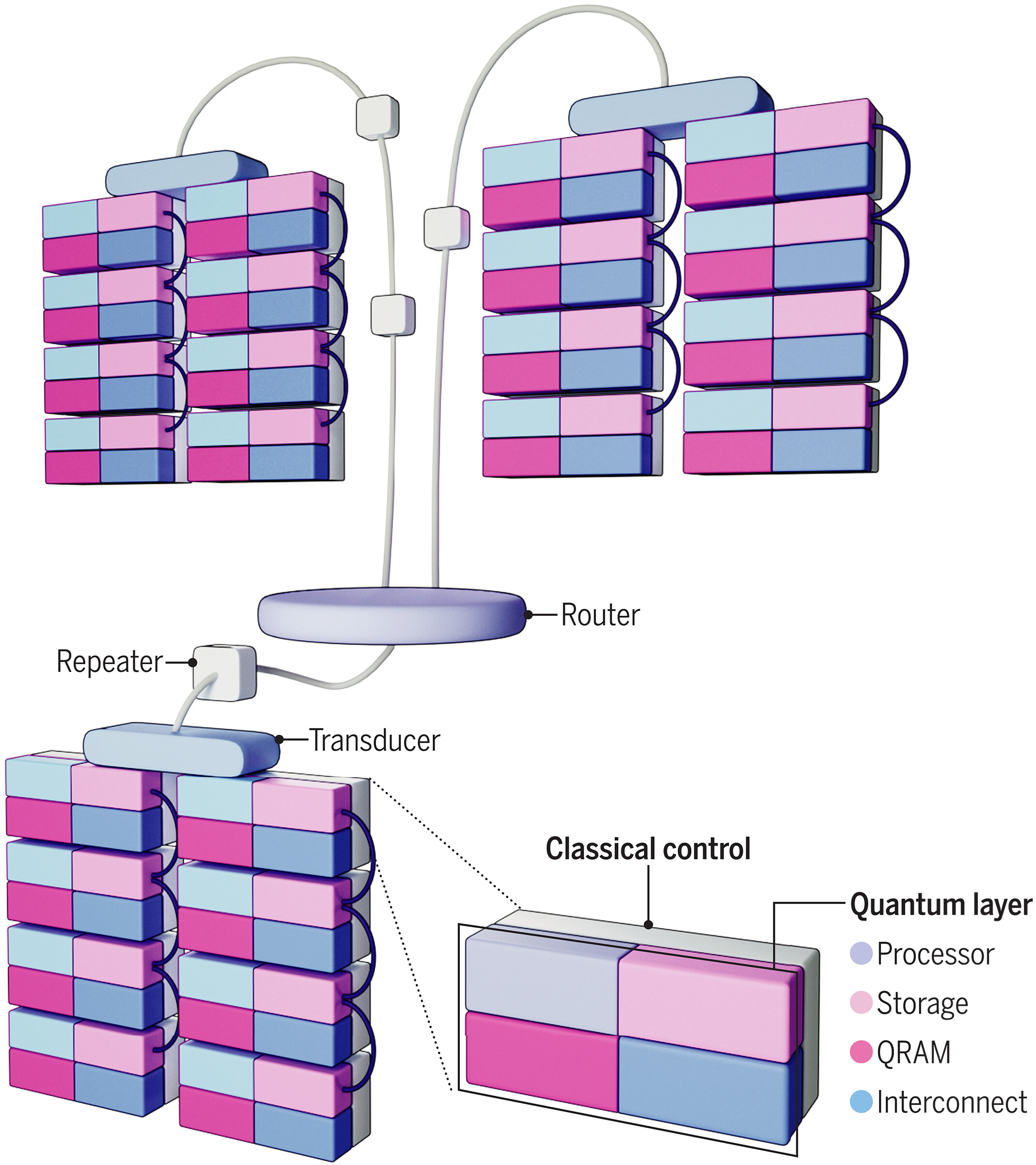
Image credit: Science. 2025 Dec 4;390(6777):1004-1010. doi: 10.1126/science.adz8659.

Reference
Awschalom DD, Bernien H, Hanson R, Oliver WD, Vučković J. Challenges and opportunities for quantum information hardware. Science. 2025 Dec 4;390(6777):1004-1010. doi: 10.1126/science.adz8659.
Go to Sicence