Advances in Engineering Advances in Engineering features breaking research judged by Advances in Engineering advisory team to be of key importance in the Engineering field. Papers are selected from over 10,000 published each week from most peer reviewed journals.

Significance
Gas penetration through a fluidized bed can stop being spatially even when cohesive porous particles cluster into larger agglomerates, because the precursor reaches some regions quickly and other regions only after a delayed axial transit through the bed. That physical mismatch matters for fluidized bed atomic layer deposition, where coating quality depends not just on self-limiting surface chemistry but also on how effectively reactive gas can contact moving particulate surfaces throughout the reactor. Treating porous primary agglomerates as the mobile units in a tiny fluidized bed makes the modeling problem tractable while preserving the clustered nature of the particulate system. Once that simplification is adopted, the problem becomes one of coupling particle cohesion, bed motion, gas transport, and surface reaction kinetics within a single framework. What had not been resolved in a systematic way was the role of the fluidization state itself in shaping coating behavior, especially coating uniformity across a bed of cohesive particulate matter. Experiments can relate operating conditions to final coating outcomes, but they do not easily expose how local gas access, transient saturation, and particle motion combine during a full precursor cycle. That gap is especially serious for cohesive nanoparticle systems, where fluidization proceeds through agglomerates rather than isolated hard particles, and their contact mechanics, porosity, and gas drag alter how the bed opens, mixes, and presents surface area to the precursor.
In a recent research paper published in International Journal of Heat and Mass Transfer, Dr. Zuyang Zhang and Professor Daoyin Liu from Southeast University (China), developed a coupled CFD-DEM and surface-reaction model for atomic layer deposition on cohesive porous particles in a tiny fluidized bed. The framework combines a hysteretic cohesive contact law for porous primary agglomerates with Langmuir adsorption and heterogeneous reaction kinetics for the full TMA-H2O ALD cycle. They also derived a prediction surface for recommended precursor exposure time from the simulated relation between precursor concentration and utilization. The researchers first established the mechanical part of the model by testing the cohesive contact law under low- and high-velocity collisions. At low relative velocity, particles stuck after their motion damped out; at higher impact velocity, they rebounded after losing energy through plastic deformation and damping. It controls whether the bed remains loose enough for widespread gas access or compacts into larger structures that alter precursor penetration. In parallel, the gas-solid momentum exchange used a modified Wen-Yu formulation scaled to reflect the porous agglomerate structure, so the model could carry both cohesive mechanics and fluidization drag without reducing the particles to idealized solid spheres.
They then examined the adsorption-reaction submodel in fixed-particle cases before turning to full fluidization. Under the chosen operating conditions, hydroxyl groups on the surface were consumed rapidly during TMA exposure, then restored during the H2O half-cycle while Al2O3 mass accumulated synchronously. The simulated growth per cycle remained near 1.302 Å across several cycles, close to common experimental values cited in the article. That agreement is scientifically useful because it shows that the surface bookkeeping inside the model is internally consistent: the sequence of adsorption, desorption, reaction, and site regeneration reproduces the cyclic mass gain expected for the TMA-H2O chemistry.
Once the particles were allowed to fluidize, the coupling between bed motion and ALD behavior became much more vivid. The reaction chemistry was fast relative to fluidization, so particles nearer the bottom of the bed coated earlier and a reaction front moved upward through the bed. Outlet species histories showed periodic escape of unconsumed TMA and H2O, which allowed precursor utilization to be read directly from the simulated gas stream. Those outlet differences varied from cycle to cycle because even a self-limiting chemistry reaches saturation through a transient fluidized structure that does not repeat exactly. The authors defined actual saturation time from the decay of the average TMA adsorption rate to 0.1% of its maximum value and compared that with a stoichiometric exposure time, turning utilization into a measurable consequence of coupled transport and reaction rather than a purely feed-based quantity.
Cohesion altered the bed most strongly through agglomeration. Higher cohesion promoted larger complex agglomerates, reduced dispersion, and kept more particles closer to the lower part of the bed. Gas still formed a reaction front, but in cohesive cases that front advanced through clustered structures rather than through a loose, bed-wide layer. Uniformity was evaluated from the standard deviation of OH coverage fraction, which served as a marker for both half-cycles because OH fell during TMA exposure and rose during H2O exposure. Higher bed height weakened uniformity during TMA dosing because precursor needed more axial transport time, and within a restricted height window stronger cohesion lowered uniformity further by reducing direct precursor-particle contact inside complex agglomerates. Lower TMA concentration improved uniformity and lengthened saturation time. At the same time, utilization fell almost linearly as molar fraction increased, with the article reporting a strong linear fit. The logic is straightforward: when concentration rises faster than the bed can convert incoming precursor, excess gas escapes through particle voids instead of reacting, whereas lower concentration stretches the reaction window and gives the same residence time greater reactive value. On the basis of that relation, the authors built a prediction surface for recommended exposure time as a function of total particle surface area and inlet precursor molar fraction.
Dr. Zuyang Zhang and Professor Daoyin Liu demonstrated that coating behavior in such a reactor cannot be read from surface chemistry alone, even when the chemistry itself is self-limiting and well characterized. Uniformity emerges from a three-way coupling among precursor transport, bed structure, and reaction timescale. Cohesion is no longer just a powder property. It becomes a regulator of agglomerate size, precursor accessibility, and axial progression of saturation through the bed. Precursor concentration is no longer just a feed specification. It sets the pace at which adsorption-driven saturation competes with convective escape.
Their new model shows that a reactor can preserve cyclic ALD growth and still produce spatially uneven coating when transport outruns bed mixing or when cohesion reorganizes the solids into gas-shielding agglomerates. For particulate ALD, that means process design has to be read in terms of timescale matching. The article repeatedly links better uniformity to slower adsorption progression or better gas access, not because a slower process is inherently preferable, but because the bed needs time to distribute precursor over the moving particulate population before local saturation cuts off the chemistry. The reported benefit of lower precursor concentration reflects a more favorable balance between precursor residence time and saturation time inside the fluidized structure.
By combining cohesive CFD-DEM fluidization with Langmuir adsorption and heterogeneous ALD reactions, the authors created a route for reading particle-scale coating evolution and gas-phase precursor consumption within the same simulation. That joint view is valuable because industrial decisions often hinge on two outcomes at once: how uniformly the coating grows and how much costly precursor leaves unused. Here those outcomes are connected but not identical. Cohesion strongly affects uniformity through agglomerate formation and bed structure, whereas utilization depends much more directly on precursor concentration. Separating those controls gives process optimization a clearer basis. One can target mixing and contact when uniformity is the main concern, or tune feed concentration and exposure time when precursor economy dominates.
The new work also notes that some fluidized beds use widening outlets to retain particles and extend precursor residence. The simulations give that configuration an additional mechanistic interpretation: a longer residence time relative to saturation time should improve both precursor use and coating uniformity under the same concentration conditions. It converts an observed trend into a design logic that can be tested, scaled, and adapted for particulate substrates with large internal surface areas. The proposed exposure-time prediction surface works in the same spirit. It does not replace experimentation, but it gives an excellent quantitative starting point for selecting exposure duration while reducing precursor waste.
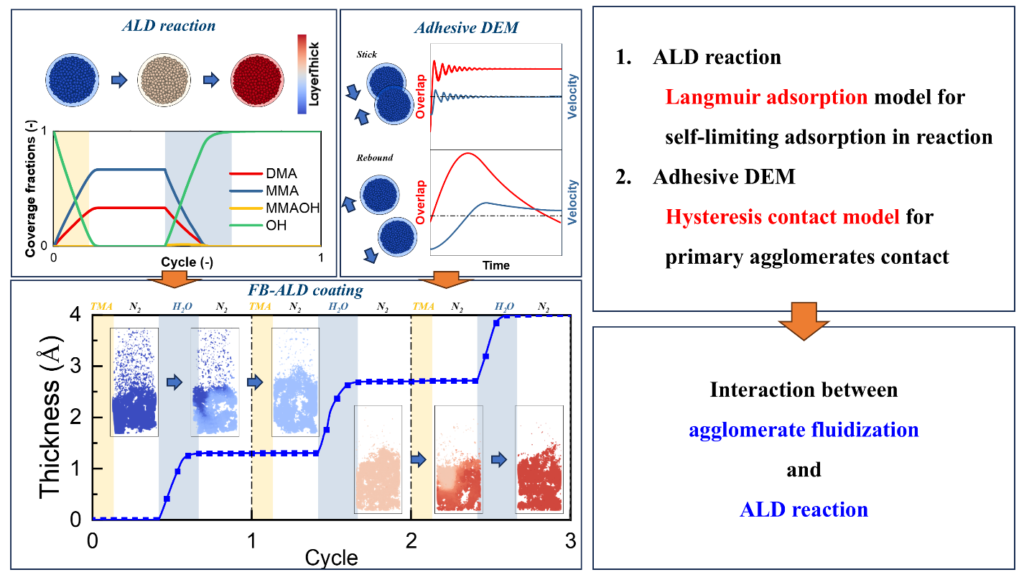
FIGURE 1 Schematic of the model
Reference
Zuyang Zhang, Daoyin Liu, Simulation of atomic layer deposition on cohesive porous particles during fluidization by coupling CFD-DEM with particle surface reactions, International Journal of Heat and Mass Transfer, Volume 249, 2025, 127269,
Go to International Journal of Heat and Mass Transfer