Advances in Engineering Advances in Engineering features breaking research judged by Advances in Engineering advisory team to be of key importance in the Engineering field. Papers are selected from over 10,000 published each week from most peer reviewed journals.

Significance
Dynamic axial strain in lightweight subgrade fills does not remain proportional to repeated loading once pore collapse, interparticle slip, and local damage begin to compete within the same stress cycle. That problem matters acutely in transportation earthworks, where a material may be chosen not only for low unit weight, but for how it stores stiffness and dissipates vibrational energy under thousands of load reversals. Foamed concrete can reduce embankment weight, limit settlement, and provide useful thermal and damping behavior, however, it has environmental burden, since conventional formulations still depend heavily on Portland cement, and the carbon cost of that binder remains substantial. The search for a lighter fill with lower embodied emissions has pushed researchers toward binders that do more than harden the matrix and they also must alter the chemistry of curing itself. This is where serpentine carbon-sequestration foamed concrete has become more interesting to scientists. The material draws on reactive MgO, serpentine powder, silty clay, water, and CO2 foam, so the gas phase is not just a pore-forming aid but part of the hardening route itself. In that sense, the scientific question is not simply whether a low-density geomaterial can be made from alternative constituents. The harder issue is whether carbonation-based bonding creates a cyclic response that differs in kind from the behavior already documented for cement-based foamed concrete and EPS-modified lightweight soils. A binder system built around magnesium carbonation develops through hydration, mineral precipitation, pore filling, and residual unreacted phases. That history leaves behind a skeleton whose stiffness, damping, and strain accumulation under repeated loading cannot be assumed from older constitutive traditions.
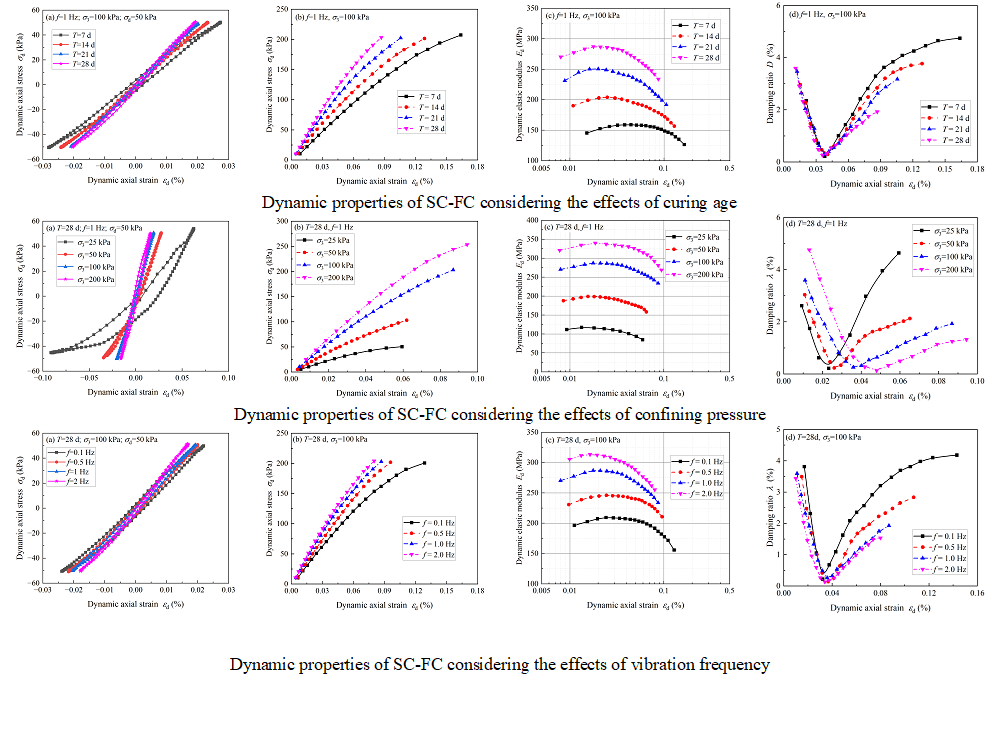
There are practical limitations because dynamic design of subgrades depends heavily on quantities such as dynamic elastic modulus and damping ratio, but those parameters are sensitive to stress state, loading frequency, curing condition, and microstructure. Existing models were largely framed around cement-stabilized soils or polymer-modified lightweight fills. They are useful as a starting point, though they do not automatically carry over to a material whose bonding arises from carbonate formation in a porous, closed-cell matrix. Even the testing is not trivial and a single monotonic strength value says very little about whether cyclic loading first compacts the pore system, then damages it, or does both in alternating sequence across strain levels. In a recent research paper published in Construction and Building Materials, Dr. Mengyao Li, Dr. Xiang Zhang, and Professor Songyu Liu from the School of Transportation at Southeast University working together with Dr. Zhengcheng Wang from Chongqing Three Gorges University, developed a cement-free serpentine carbon-sequestration foamed concrete formulated with reactive MgO, serpentine powder, silty clay, and CO2 foam, then characterized its cyclic behavior under multistage triaxial loading. They also developed a modified Darendeli-based model for dynamic elastic modulus evolution, with Edmax expressed as a function of curing age, confining pressure, and vibration frequency. The team examined specimens cured for 7 to 28 days under multistage cyclic triaxial loading across a range of confining pressures and frequencies which allowed the investigators trace stiffness and dissipation across a widening strain range within the same specimen, which reduced specimen-to-specimen noise at the very point where nonlinear behavior begins to emerge. The authors also kept the tests in an unsaturated state, consistent with the intended service condition of the material as a protected subgrade fill; saturating such a pore system would have changed the internal structure enough to blur the mechanism they wanted to examine. The researchers observed a clear change in hysteresis morphology as loading intensified. At small dynamic strains, loops remained close to linear and comparatively tight. With rising stress amplitude, the loops became spindle-shaped and later developed concave crescent-like forms, while asymmetry also grew, with tensile-side strain exceeding compressive-side strain. It means the material does not simply cycle elastically around a stable centerline; it accumulates irreversible deformation as pore collapse, contact friction, and microcrack growth begin to separate loading from unloading. The new study examined backbone curves alongside those loops and found a hyperbolic trend that shifted toward smaller strains as curing age, confinement, or frequency increased.
The authors found using SEM that after 28 days, enclosed and broken pores, partially carbonated MgO and serpentine particles, and interlaced dypingite and hydromagnesite, features that help explain the cyclic response. Carbonation products fill voids, cement particles together, and stiffen the internal skeleton; once loading rises far enough, that same carbonate-bonded framework begins to lose local integrity, so the initial compaction benefit gives way to stiffness loss and higher dissipation. The researchers observed an early increase in Ed with strain amplitude, then a nonlinear drop. The damping ratio moved in the opposite way at first, decreasing to a minimum and then rising before stabilizing. Curing age, confining pressure, and frequency each changed that pattern differently. Longer curing shifted the material toward higher Ed and lower damping after the transitional strain range of about 0.03 to 0.04%, which fits a denser carbonate network and fewer loose particles. Increased confinement produced higher stiffness but also a sharper decline in modulus once degradation began, a reminder that a stiffer skeleton under stronger lateral restraint may carry larger cyclic stresses before it starts to lose integrity. Frequency raised Ed and reduced damping at larger strains without changing loop shape very much, so the rate effect was real but structurally selective. The authors then fitted the data with a modified Darendeli-type framework and showed that confining pressure dominated Edmax, curing age followed, and vibration frequency contributed the least. Even so, the model showed some deviation under long curing, high confinement, and extreme loading rates, where early hardening and coupled effects become more difficult to capture within a compact equation.
To summarize, Professor Songyu Liu and colleagues demonstrated direct linkage between carbonate mineral formation, hysteretic deformation, and strain-dependent stiffness loss in a lightweight geotechnical material intended for repeated loading service. They showed mineral carbonation changes how a lightweight fill should be read mechanically. SC-FC does not behave like a generic porous filler. Its dynamic response comes from a carbonate-bonded skeleton whose stiffness can rise briefly under early cyclic compaction, then deteriorate once pore collapse and crack growth reach the point where dissipation begins to dominate. The authors treat dynamic elastic modulus and damping ratio not as isolated descriptors but as coupled traces of internal change. When Ed climbs slightly before decaying, and D drops before turning upward, the two curves together reveal a material that first reorganizes and then degrades. That interpretation gives engineers a more discriminating basis for selecting fill materials in rail approaches, embankments, and similar systems exposed to repeated traffic or seismic disturbance. A lightweight material that gains apparent stiffness at low strain but loses it abruptly at higher confinement cannot be judged by a single index and the research work push toward strain-dependent qualification criteria tied to realistic stress paths.
We believe it is important findings that SC-FC replaces Portland cement with reactive MgO and serpentine-derived constituents while incorporating CO2 during foaming and curing because the combination creates a plausible route toward lower-emission geotechnical fills, but only if mechanical reliability survives the transition from laboratory concept to cyclic service condition. The environmental argument becomes more persuasive once the dynamic behavior is quantified in terms that geotechnical practice already understands. The proposed predictive model offers also a practical description of the tested response within the studied curing ages, confining pressures, and frequencies, although some deviations remain under more demanding conditions. Materials created through carbonation do not always soften from the first increment of cyclic loading; some briefly tighten before damage takes command, and a model that misses that moment also misses part of the physics.
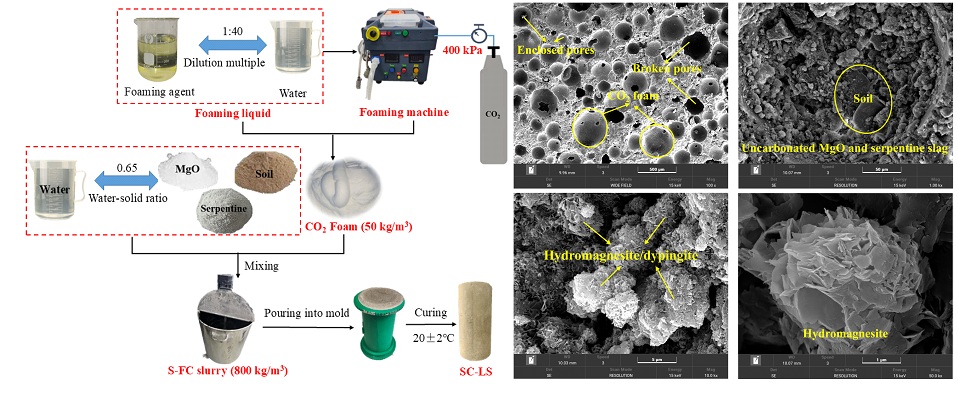
Preparation method and SEM images of serpentine carbon sequestration foamed concrete

Reference
Mengyao Li, Songyu Liu, Xiang Zhang, Zhengcheng Wang, Dynamic behaviors of serpentine carbon sequestration foamed concrete under multistage cyclic loading, Construction and Building Materials, Volume 495, 2025, 143656,
Go to Journal of Construction and Building Materials