Advances in Engineering Advances in Engineering features breaking research judged by Advances in Engineering advisory team to be of key importance in the Engineering field. Papers are selected from over 10,000 published each week from most peer reviewed journals.

Significance
Optical flat metrology requires absolute surface evaluation when reference standards of higher accuracy are not available. Among the available approaches, the three-flat test has long been valued because it can recover the shapes of three unknown flats through self-consistent interferometric measurements. Extending that logic from line-based assessment to full-aperture surface reconstruction, however, has remained technically demanding, especially when high spatial fidelity must be retained across the reconstructed surface. Earlier full-field approaches generally followed two computational routes. Pixel-based methods reconstructed the surface directly from measured phase maps, which preserved finer spatial structure but introduced symmetry-linked residual components under rotational processing. Zernike-based methods instead expanded the measured data into modal coefficients, which gave greater flexibility in angle selection but removed higher spatial content once the retained order was fixed. That unresolved tension became more significant as interferometric repeatability improved. When hardware operates at sub-nanometer precision, the reconstruction model itself becomes the point at which that precision is either preserved or discarded. In a recent research paper published in Optics Express, Keita Tomita of Olympus Corporation, who is also a Ph.D. student, together with Dr. Toshiki Kumagai from Olympus Corporation, Dr. Kenichi Hibino from the National Institute of Advanced Industrial Science and Technology, and Dr. Satoru Takahashi from the University of Tokyo, addressed this problem by developing a symmetric full-field absolute testing algorithm for three optical flats based on three classical measurements and one additional rotated measurement. The method reconstructs each surface from a linear combination of 8N datasets created by systematic rotation and inversion of the measured phase maps. Its technical novelty lies in deriving the dataset weights from symmetry-based assignment equations and selecting the final coefficients through a minimum-norm Moore–Penrose pseudoinverse solution. That combination gives a pixel-based reconstruction whose first structured cross-talk term moves upward with N and whose spatial resolution improves as N increases.
The research team used four interferometric configurations: A with C, B with C, B with A, and B with a rotated C. In the rotated configuration, flat C turns by α = 2π/N, and each measured phase map is also paired with its inverted form. Repeated rotations of those maps generate 8N transformed datasets, and the reconstructed surface is written as a linear combination of all of them. That construction matters because it makes the reconstruction problem global at the dataset level. Instead of asking one measurement to carry a privileged share of the surface information, the method distributes the burden across a symmetry-complete family of rotated and inverted data.
The weight determination is central to the method. The authors first derive necessary assignment relations by inserting delta-function surfaces for A, B, or C and comparing where peaks must appear after transformation. Those conditions do not close exactly into a fully consistent system, so the authors introduce small constants o_j and rewrites the constraints in a modified but solvable form. The important point is not only algebraic convenience. Once the exact system becomes inconsistent, the reconstruction must be organized around an approximation principle that still respects the geometry of the problem. The authors choose uniform small constants tied to 1/6N and then determine the 8N weights by a minimum-norm solution obtained through the Moore–Penrose pseudoinverse. That decision gives the algorithm a controlled regularity: the weights are not chosen ad hoc, and the residual structure can be traced back to the same symmetric formulation that created the dataset family in the first place.
Their theoretical analysis then identifies the form of the remaining structured error. For Zernike components containing sin(Nθ), the reconstructed shape carries a cross-talk term equal to minus one third of the combined contribution from A, B, and C; for axial symmetry and cos(mθ) terms, the reconstruction error vanishes within the formulation they derive. This is important because it replaces a vague statement about “noise” with a very specific symmetry rule. The algorithm does not blur everything equally. It preserves some modal content exactly, and it pushes the first structured cross-talk to the N² + 1st Zernike component. Raising N is effective for a simple reason: the first symmetry-governed contamination is moved to higher order. The simulations use sinusoidal grating surfaces rather than random Zernike combinations, which is a thoughtful choice because the paper has already shown that some modal classes reconstruct exactly and would mask trends if mixed indiscriminately. With N = 16, reconstruction at f = 3 lines per aperture showed no cross-talk error, and higher-frequency degradation emerged at f = 4 and 5. The interpolation error from bilinear rotation stayed below 0.005 nm rms in the case examined. The modulation transfer analysis then put numerical weight behind the design logic: the 99.9% MTF cut-off rose with N, reaching 4.78 lines per aperture for N = 16. At that same cut-off, the rms error stayed below 0.5 nm, and the investigators report that the N = 16 symmetric method reduced rms error to about one third of the N-position averaging result with the same nominal 8N degrees of freedom.
The laboratory validation was designed to test the same reconstruction logic. Using a wavelength-tuning Fizeau interferometer at 633 nm, with 15 phase-shifted images and a motorized rotation stage accurate to better than 0.05°, the authors reconstructed the absolute shape of a 60 mm clear-aperture flat for N = 2, 4, 8, and 16. Spatial detail increased as N increased. Cross-sectional comparison with the classical three-flat line result along the x-axis kept the deviations below 1 nm, and the rms difference dropped monotonically from 0.420 nm at N = 2 to 0.187 nm at N = 16. Repeated measurements of the three flats gave sub-nanometer standard deviations, listed as 0.697, 0.574, and 0.682 nm rms.
The new study by Keita Tomita and colleagues produced another reconstruction algorithm for optical flats and reorganized absolute three-flat testing around a tunable symmetry parameter and then shows, analytically and experimentally, what that parameter actually does to spatial fidelity. In a field where full-field reconstruction often becomes a negotiation among residual symmetry terms, modal truncation, and computational convenience, the paper supplies a cleaner design rule. N is no longer just a descriptive count associated with a special rotation. It becomes the knob that sets where structured cross-talk first appears in the modal hierarchy. That changes how one thinks about algorithm selection, because the trade is stated in a form that is visible before any measurement is taken.
There is also a methodological shift here. The paper keeps the reconstruction in pixel space, where fine spatial content can remain visible, yet it does not treat that choice as just empirical. The authors derive the weight equations from transformed delta responses, regularize the inconsistent constraint system in a controlled way, and then solve for minimum-norm coefficients through the pseudoinverse. That chain of reasoning matters and means the algorithm is both a better-performing recipe and also a reconstruction framework whose behavior can be tracked from symmetry assumptions to modal cross-talk, from modal cross-talk to transfer characteristics, and from transfer characteristics to the measured line-profile agreement with the classical test. An explicit analytical expression for the residual structure makes the reconstruction behavior easier to interpret.
The comparison with Zernike decomposition sharpens the broader meaning. The paper does not frame pixel-space and Zernike-space methods as interchangeable computational preferences. It shows that they preserve different kinds of information. Zernike reconstruction can remain clean when the retained order is chosen carefully, which is useful for low-spatial-frequency form evaluation. The symmetric pixel-based route keeps much finer spatial detail, because it does not discard the higher-order content through modal truncation. That distinction has practical weight in optical metrology. Production engineers interested in smooth low-order form may favor one representation; users who need to inspect finer surface structure have a strong reason to keep reconstruction in pixel space. The paper articulates that split in a way that is grounded in the measured and simulated behavior of the algorithms rather than in generic preference for one basis over another.
Another important implication comes from data use. The study notes that the N-position averaging method has the same nominal 8N data count as the present method, yet its utilization rate approaches only about fifty percent for large N. The symmetric algorithm extracts more from the transformed dataset family because the weight construction uses the full set as a coupled system. That is not a cosmetic computational detail. In absolute metrology, the value of an extra measurement often depends less on simply having more data than on whether the reconstruction actually knows how to use the symmetry those data carry. The present method does. The experimental repeatability and the estimated sensitivity to rotation error keep the claims properly anchored. Rotational error below 0.10° left the rms behavior largely independent of N except at N = 2, and the actual experiment kept the angle error below 0.05°, placing its influence around 0.1 nm rms. That scale matters because it shows the algorithm is not floating in abstraction; it operates inside a realistic interferometric tolerance budget. To sum up, the study gives full-field absolute flat testing a more explicit symmetry logic, a sharper account of where residual structure enters, and a practical route to higher spatial fidelity with only four measurements. Beyond optical flat calibration, the method may also be relevant to semiconductor metrology, where nanometer-level full-aperture form measurement is increasingly important for wafers, wafer chucks, and precision reference surfaces.
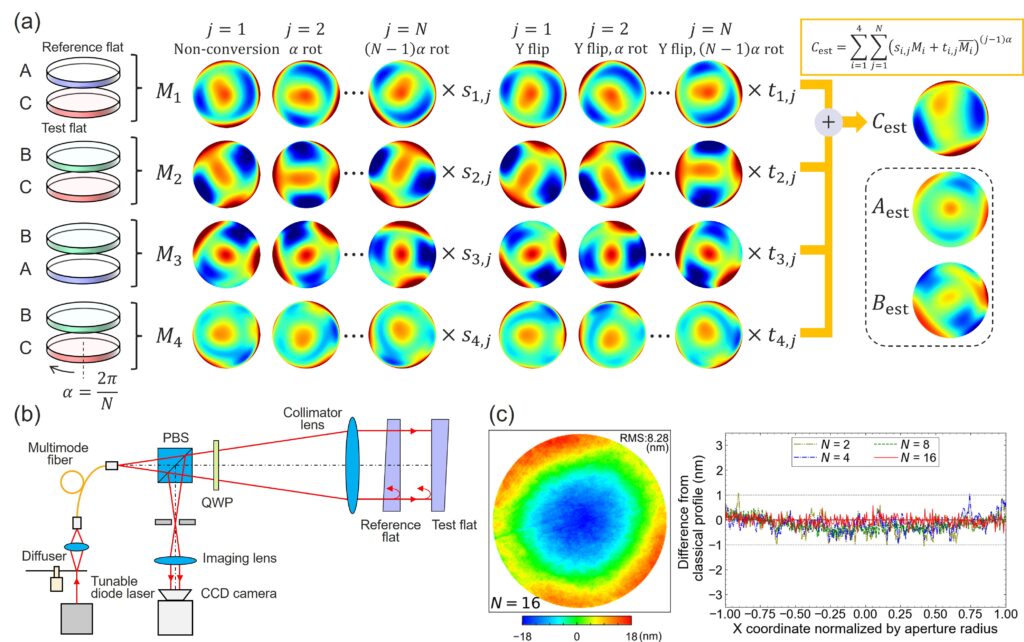
Fig. 1. (a) Conceptional procedure for calculating the absolute surface shape using the symmetric algorithm. (b) Experimental setup for the wavelength-tuning Fizeau interferometer. (c) Measured absolute shape of flat C using the symmetric algorithm (N = 16), and the differences between the four algorithms (N = 2, 4, 8, and 16) and the classical three-flat test.




Reference
Keita Tomita, Kenichi Hibino, Toshiki Kumagai, and Satoru Takahashi, “Absolute testing method for three optical flats using symmetric algorithms,” Opt. Express 34, 7220-7238 (2026)
Go to Journal of Optics Express