Advances in Engineering Advances in Engineering features breaking research judged by Advances in Engineering advisory team to be of key importance in the Engineering field. Papers are selected from over 10,000 published each week from most peer reviewed journals.

Significance
Photonic integrated circuits have become central to the effort to move optical functions from discrete laboratory assemblies into compact, manufacturable chip-scale systems. Much of the strongest progress has occurred in the telecom band, where low propagation loss has enabled high-Q resonators, coherent optical synthesis, microwave generation, lidar architectures, and photonic processing. The shorter-wavelength region, extending from the violet through the visible and into the short near-infrared, presents a more difficult materials problem. As wavelength decreases, surface roughness becomes optically larger and Rayleigh scattering rises; at the same time, absorption becomes more severe as photon energy approaches the Urbach tail of common dielectric materials. These two loss channels are not merely inconvenient. They raise power requirements, degrade resonator performance, and constrain the use of integrated photonics in spectral regions needed for optical clocks, quantum systems, bioimaging, underwater communication, compact lidar, and atomic physics experiments. A useful platform would need to do several things at once. It would have to suppress scattering without distorting waveguide geometry, preserve broad spectral transparency, allow controlled dispersion for nonlinear photonics, and remain suitable for future integration with active or temperature-sensitive components. It would also need to support the physical mechanisms that make resonators useful beyond passive routing: high-Q optical storage, acoustic confinement, low thermorefractive noise, and stable laser feedback. In a recent research paper published in Nature Journal, Postdoctoral fellow Dr. Hao-Jing Chen, graduate student Kellan Colburn, Peng Liu, Hongrui Yan, Hanfei Hou, Jinhao Ge, Jin-Yu Liu, Phineas Lehan, Qing-Xin Ji, Zhiquan Yuan, Christopher Holmes, Dr. Henry Blauvelt & Professor Kerry Vahala from California Institute of Technology working together with Professor James Gates from University of Southampton and Professor Dirk Bouwmeester from Leiden University, developed a CMOS-foundry-compatible germano-silicate photonic integrated circuit platform using GeO2-doped silica cores on silicon wafers. The technically distinct element is the combination of fibre-like low material absorption, DUV-defined planar waveguides, ruthenium-assisted deep etching, and surface-tension reflow smoothing to produce ultrahigh-Q resonators from violet to telecom wavelengths. They also showed that the same platform can support dispersion-engineered soliton generation, optical–acoustic confinement for Brillouin lasing, and large-mode-area resonators for low-noise self-injection-locked lasers.
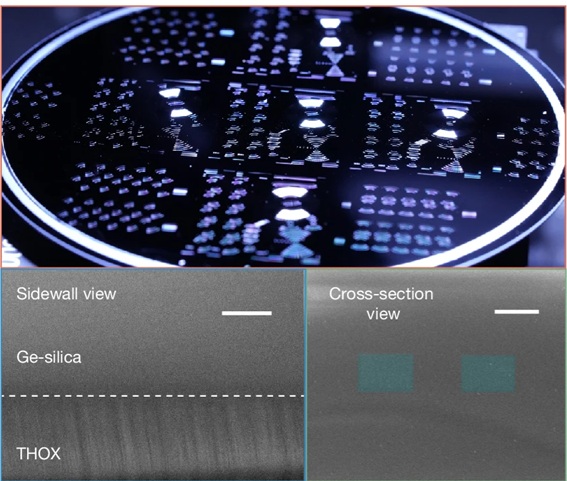
The researchers developed a germano-silicate photonic integrated circuit platform in which GeO2 doping raises the refractive index of the core relative to silica cladding, allowing optical confinement in a material family closely related to optical fibre. The fabrication route used plasma-enhanced chemical vapour deposition to form a 4-μm-thick germano-silica layer with 25 mol% GeO2 on thermal oxide, followed by ruthenium and silica hard masking, deep-ultraviolet stepper lithography, and inductively coupled plasma etching. The ruthenium mask was important because its selectivity enabled deep, high-fidelity etching of germano-silica. A standard furnace anneal then exploited the low-viscosity reflow behavior of Ge-silica, smoothing etched sidewalls through surface tension while leaving the thermal oxide substrate essentially unaffected. This material feature has a direct scientific consequence: by reducing roughness-induced scattering, the platform addresses one of the major loss mechanisms that becomes increasingly severe at visible wavelengths.
The authors evaluated performance through microring resonators across a wide spectral span. Air-cladded 3-mm-diameter rings were used to avoid substrate leakage and bending loss during measurement. Using tapered-fibre coupling and calibrated tunable lasers, the team measured intrinsic Q factors from 458 nm to 1,550 nm. The resonators exceeded Q values of 180 million across this full range, reaching 463 million at 1,064 nm, corresponding to a waveguide loss of 0.08 dB m−1. At 458 nm, the measured loss was 0.49 dB m−1, reported as a 13-dB improvement over previous integrated-platform records in that wavelength region. The annealed loss values remained below 1 dB m−1 from the violet to the telecom band, which is the central experimental evidence that the platform can carry fibre-like material advantages into a planar chip format. The fabrication results also included an important anneal-free case. Even without reflow smoothing, air-clad resonators reached nearly 200 million Q and a lowest loss of 0.15 dB m−1 at 1,550 nm. The study emphasizes this because many active materials and heterogeneous integration schemes cannot tolerate high-temperature post-processing. In that sense, the anneal-free result is not a side observation; it changes how the platform can be considered for integrated systems that combine passive ultralow-loss routing with III–V materials, organic photonics, thin-film lithium niobate, quartz substrates, or germanium-on-silicon photodetectors.
The device demonstrations then tested whether low loss could coexist with functional photonic behavior. For soliton microcomb generation, the researchers designed a single Ge-silica microring with anomalous dispersion and single-mode transmission. Characterization of the mode family between 1,520 nm and 1,630 nm showed no observable distortion from mode crossings, and soliton triggering produced a spectrum with a sech2 envelope. The repetition rate was near 21.2 GHz, with electrical spectrum analysis supporting pulse-stream stability. For stimulated Brillouin scattering, the platform used the lower longitudinal acoustic velocity of Ge-silica relative to silica to confine both optical and acoustic modes. A 25-mm waveguide with a 4 μm × 6 μm Ge-silica core and thick silica claddings showed a measured SBS gain spectrum that agreed with simulation, with a gain peak at 9.55 GHz and a mechanical quality factor of about 210. Integrated resonators then produced a Brillouin laser with a 9.68 GHz frequency shift and a coherent microwave beatnote. A third demonstration addressed thermorefractive noise in self-injection-locked lasers. The large mode area possible in Ge-silica reduced simulated thermorefractive noise compared with low- and high-confinement silicon nitride resonators of the same diameter. Experimentally, a C-band distributed-feedback laser coupled to a Ge-silica resonator with Q above 100 million showed a 46-dB frequency-noise reduction under self-injection locking and reached a Hz-level fundamental linewidth. The same stabilization concept was extended into the visible using Fabry–Pérot diode lasers locked to high-Q microrings, yielding fundamental linewidths of 15 Hz at 632 nm, 12 Hz at 512 nm, and 90 Hz at 444 nm.
The engineering applications of Professor Kerry Vahala and colleagues are strongest in visible and short-near-infrared integrated photonics, where low loss has been a persistent barrier to compact system design. By achieving ultrahigh-Q germano-silicate resonators from violet to telecom wavelengths, the platform can support chip-scale optical systems that need stable, low-noise, wavelength-specific light in spectral regions that are difficult for conventional integrated platforms. Optical clocks, quantum sensors, quantum computing and networks, atom and ion control, bioimaging, astronomical observation, underwater communication, data-centre links, compact lidar, and atomic physics instruments are all directly aligned with the wavelength range identified in the new work. The practical engineering value is not simply that light can be guided at these wavelengths, but that it can be guided with very low propagation loss, reducing optical power requirements and preserving resonator performance. This matters for miniaturizing systems that currently rely on larger fibre- or free-space optical assemblies. The authors’ schematic concept of combining III–V lasers, germano-silicate resonators, lithium niobate electro-optic modulators, and grating couplers points to integrated visible photonic modules in which light generation, stabilization, modulation, routing, and delivery could be assembled on or near the same chip. The anneal-free ultralow-loss result is also important for engineering, because it makes the platform more compatible with temperature-sensitive active materials, including III–V devices, organic photonics, thin-film lithium niobate, quartz-based substrates, and germanium-on-silicon photodetectors.
The device demonstrations point to more specialized applications in frequency synthesis, precision navigation, microwave photonics, sensing, and low-noise laser engineering. Dispersion-engineered single-ring soliton microcombs could be useful for compact optical frequency comb sources, coherent ranging, portable precision clocks, and photonic systems that require stable multi-wavelength output from a small footprint. The stimulated Brillouin lasing demonstration is especially relevant to chip-scale gyroscopes, integrated microwave photonics, and temperature or strain sensing, because the platform combines ultralow optical loss with optical and acoustic mode confinement. In practical terms, that means the waveguide is not only a passive low-loss channel; it can mediate coherent photon–phonon interactions useful for narrowband signal generation and sensing. The large-mode-area resonators are equally important for low-noise lasers: by reducing thermorefractive noise and enabling self-injection locking of diode lasers, the platform supports Hz-level linewidth operation in the telecom and visible bands. That capability is directly relevant to metrology, coherent optical communication, quantum control, and instrumentation where laser phase noise limits measurement precision. The study also notes possible future use in solid-state gyroscopes, advanced frequency comb systems for portable clocks, large-scale low-loss quantum circuits, high-power amplifiers, and mode-locked lasers if deposition and fabrication continue to improve toward the material-loss limit.


Reference
Chen HJ, Colburn K, Liu P, Yan H, Hou H, Ge J, Liu JY, Lehan P, Ji QX, Yuan Z, Bouwmeester D, Holmes C, Gates J, Blauvelt H, Vahala K. Towards fibre-like loss for photonic integration from violet to near-infrared. Nature. 2026 ;649(8096):338-344. doi: 10.1038/s41586-025-09889-w.
Go to Nature