Advances in Engineering Advances in Engineering features breaking research judged by Advances in Engineering advisory team to be of key importance in the Engineering field. Papers are selected from over 10,000 published each week from most peer reviewed journals.

Significance
Air-breathing propulsion at hypersonic speed depends on the ability to sustain combustion within short aerodynamic timescale. In a scramjet combustor, the incoming flow remains supersonic, and the fuel–air mixture must ignite, release heat, and remain anchored before it is convected out of the combustor. This creates a demanding coupling between fluid residence time, chemical ignition delay, turbulent mixing, and flame stabilization. Even when the inflow temperature is high enough to make reaction possible, stable combustion is not guaranteed, because the chemical induction time may still exceed the residence time available within the cavity shear layer. For this reason, forced ignition and flame-holding strategies have become main issues in scramjet combustion research. Cavity flame holders are often used because the recirculation region and shear layer can increase the effective residence time of the reacting mixture and provide a region where heat and radicals can support flame stabilization. However, cavity-based stabilization is not a purely geometric problem. The ignition process depends strongly on the thermochemical state of the mixture within the shear layer, where fuel, main airflow, recirculated products, and torch gases interact. A cavity that is aerodynamically suitable still needs to provide a shear-layer residence time compatible with the chemical induction time. In a recent research paper published in Journal of Engineering for Gas Turbines and Power Professor Shinichiro Ogawa from the Department of Aerospace and Marine-System Engineering at Osaka Metropolitan University, developed a numerical evaluation method that combines the forced ignition model in the shear layer with a plug flow reactor calculation for cavity-held scramjet ignition. The technically distinct feature is that the model links local shear-layer residence time, torch-modified gas composition, and detailed hydrocarbon chemistry through a Damköhler-number ignition criterion. It was then used to separate forced-ignition behavior under H₂O-vitiated and nonvitiated airflow conditions. The approach also enabled direct comparison of Type A and Type B cavity geometries under varied micro-rocket torch input energies. Instead of treating the combustor as a fully resolved turbulent reacting flow, the analysis extracted the shear-layer velocity, temperature, residence time, and gas composition through the forced ignition model and then used a one-dimensional chemical reaction analysis to determine whether the ignition delay was short enough for ignition to occur within the available residence time.
When the residence time in the shear layer exceeded the calculated ignition delay, the condition corresponded to forced ignition; when the ignition delay was longer, ignition failed within that region. This is a useful reduction because it ties the chemistry directly to the cavity’s flow time rather than treating ignition as a temperature threshold alone. The comparison with prior combustion experiments gave the model its practical anchor: cases that ignited experimentally fell into the region where the calculated Damköhler number exceeded unity, while nonignition cases corresponded to values at or below unity. The validation covered two cavity geometries and several torch operating conditions, including cases with different helium dilution levels in the torch gas.
A methodological comparison between two plug-flow implementations helped establish the calculation route. The Lagrangian particle simulation and the chain-of-reactors approach produced nearly the same ignition-delay behavior for representative Type A and Type B cavity cases, with only small differences near the temperature-rise front. Because the chain-of-reactors method required lower computational cost and gave stable solutions during rapid reaction progress, it was used for the forced-ignition limit calculations and by enabling multiple parameter variations, the chain reactor strategy allowed the study to map how torch energy, cavity residence time, and H₂O vitiation interact.
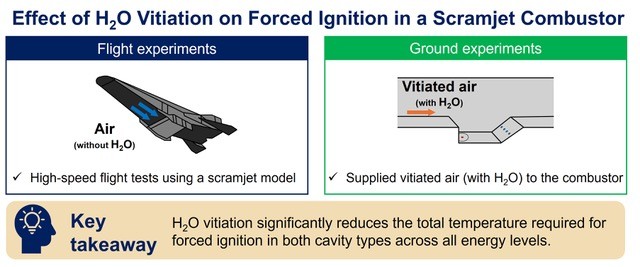
Professor Shinichiro Ogawa used vitiation analysis and compared shear-layer ignition with and without water vapor contamination under otherwise matched Type A cavity conditions. In the vitiated case, the onset of temperature and CO₂ changes occurred farther upstream than in the nonvitiated case. The temperature-rise gradient was initially gentler with H₂O present, but the reacting flow eventually reached comparable high-temperature levels near the cavity ramp. The CO₂ behavior sharpened the interpretation: H₂O vitiation increased CO₂ production and shifted its onset, which indicates a change in oxidation progress rather than a simple passive dilution effect. The author performed species-based analysis which gave the chemical picture more texture. He found that fuel consumption of methane and ethylene became stronger downstream of the early shear-layer region under H₂O vitiation, while OH production increased markedly over the region where ignition developed. Formaldehyde and ketene formation also rose, consistent with activation of oxygen-containing intermediate pathways. The presence of H₂O therefore did not just delay or weaken the reaction through heat-capacity effects. Under the modeled conditions, it also promoted radical and intermediate formation in ways that supported oxidation and moved the ignition process upstream.
Torch energy also changed the sensitivity of the ignition process. As the net input energy increased, the forced-ignition limit temperature fell for both cavity types, indicating that stronger torch input partly compensated for conditions in which ignition chemistry required a longer induction time. This effect was clearest when the net input energy increased from 20 to 25 kW, where the required airflow temperature dropped markedly in both cavity configurations. The influence of H₂O was strongest in the lower-to-moderate torch-energy range, where chemical delay still governed whether ignition could occur within the shear layer residence time. At higher torch energy, the thermal and radical content supplied by the torch became more dominant, reducing the relative importance of vitiation. The cavity comparison clarifies why residence time matters. Type A, with its shorter residence time, showed greater sensitivity to H₂O vitiation because a small change in ignition delay had a larger consequence when the available flow time was limited. Type B, with a longer shear-layer residence time, was less affected. The design choice of cavity length therefore had a direct scientific consequence: shorter residence time amplified the chemical influence of vitiated-air composition, whereas longer residence time reduced the dependence of forced ignition on the presence of H₂O.
The findings of Professor Shinichiro Ogawa have direct engineering relevance for the design and interpretation of scramjet combustor ignition systems, especially when ground-test data are used to support flight-oriented combustor development. In many high-enthalpy ground tests, the main airflow contains H₂O from the combustion heater, while flight air would not contain the same level of water vapor. Ogawa’s analysis shows that this difference can shift the forced-ignition behavior by changing radical chemistry, ignition delay, and the location where reaction begins in the cavity shear layer. For engineers, the implication is that ignition limits measured in vitiated facilities need to be interpreted with explicit attention to H₂O effects before being used for flight-oriented assessment. A combustor that appears to ignite reliably in a ground facility may require different torch energy, airflow temperature, or cavity residence time under nonvitiated conditions.
For cavity design, the practical message from the study is that residence time controls how strongly facility chemistry enters the ignition margin. Compact cavities require greater attention to torch input energy and facility-to-flight chemical differences, whereas longer-residence-time configurations reduce that dependence. If a compact cavity is preferred for aerodynamic or structural reasons, the ignition system must be designed with greater attention to torch input energy and facility-to-flight chemical differences. If the design allows a longer residence-time cavity, the combustor may be less dependent on chemically favorable vitiated-air conditions. Increasing the net input energy lowered the forced-ignition limit temperature and reduced the relative influence of H₂O vitiation. This suggests that torch power can be used as a design parameter to preserve ignition margin under conditions with longer ignition delay, especially in short-residence-time configurations. However, the paper also notes that higher torch energy increases thermal loading on the torch body, especially during prolonged uncooled operation. Therefore, the results can help define a practical operating envelope: enough torch energy to secure ignition, but not so much that durability or permissible operating time becomes limiting.
A further application of Professor Shinichiro Ogawa study is in reduced-order combustor modeling and by linking shear-layer residence time, ignition delay, torch-gas composition, and Damköhler number, the model provides a useful engineering tool for screening ignition limits before more expensive full reacting-flow simulations or combustion tests are performed. This is particularly valuable during early-stage design, where many combinations of cavity geometry, torch condition, and inflow temperature must be screened before full reacting-flow simulations or combustion tests. The paper therefore improved our understanding of H₂O vitiation and also in developing a more rational workflow for designing and interpreting forced-ignition systems in scramjet combustors.

Reference
Ogawa, Shinichiro. (2025). Evaluation of the Effect of H2O Vitiation on Forced Ignition in a Scramjet Combustor Using a Forced Ignition Model. Journal of Engineering for Gas Turbines and Power. 147. 1-12. 10.1115/1.4068663.
Go to Journal of Engineering for Gas Turbines and Power