Advances in Engineering Advances in Engineering features breaking research judged by Advances in Engineering advisory team to be of key importance in the Engineering field. Papers are selected from over 10,000 published each week from most peer reviewed journals.

Significance
Prefabricated concrete construction places unusual demands on its connection systems. Unlike cast-in-place members, where reinforcement continuity is formed directly within a continuous concrete body, prefabricated structures achieve structural continuity through connection regions that transfer force between separately manufactured components. The fully-grouted sleeve connection is one of the principal solutions for this purpose and its performance depends on the coordinated action of reinforcing steel, grout, sleeve confinement, and interfacial bond, so its mechanical response cannot be understood only as the tensile behaviour of a steel bar or the compressive behaviour of grout. Under earthquake–fire coupling conditions, the problem becomes more demanding: cyclic loading introduces repeated tension and compression, while thermal exposure changes the mechanical properties of the grout and steel and may alter the bond conditions within the sleeve. Under these conditions, conventional external measurements, such as axial load, displacement, and final failure mode, remain essential, but they do not fully describe how tensile damage, compressive damage, rebar ductile damage, and interfacial force transfer evolve inside the sleeve before fracture or pull-out occurs.
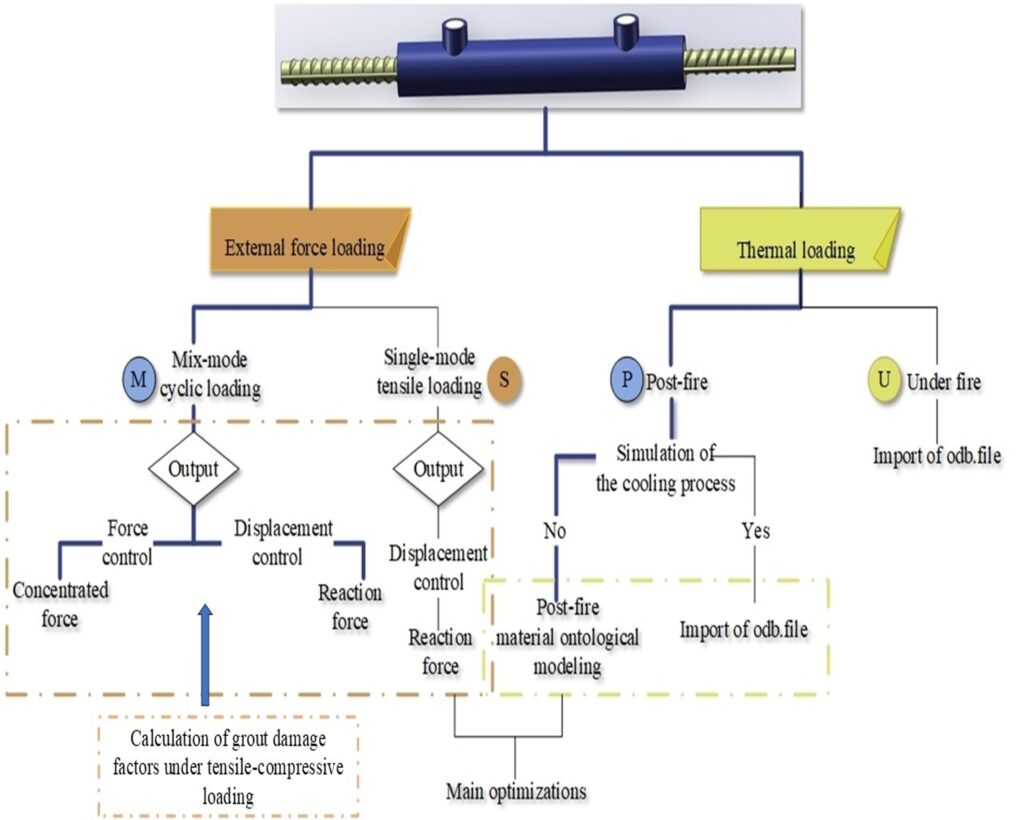
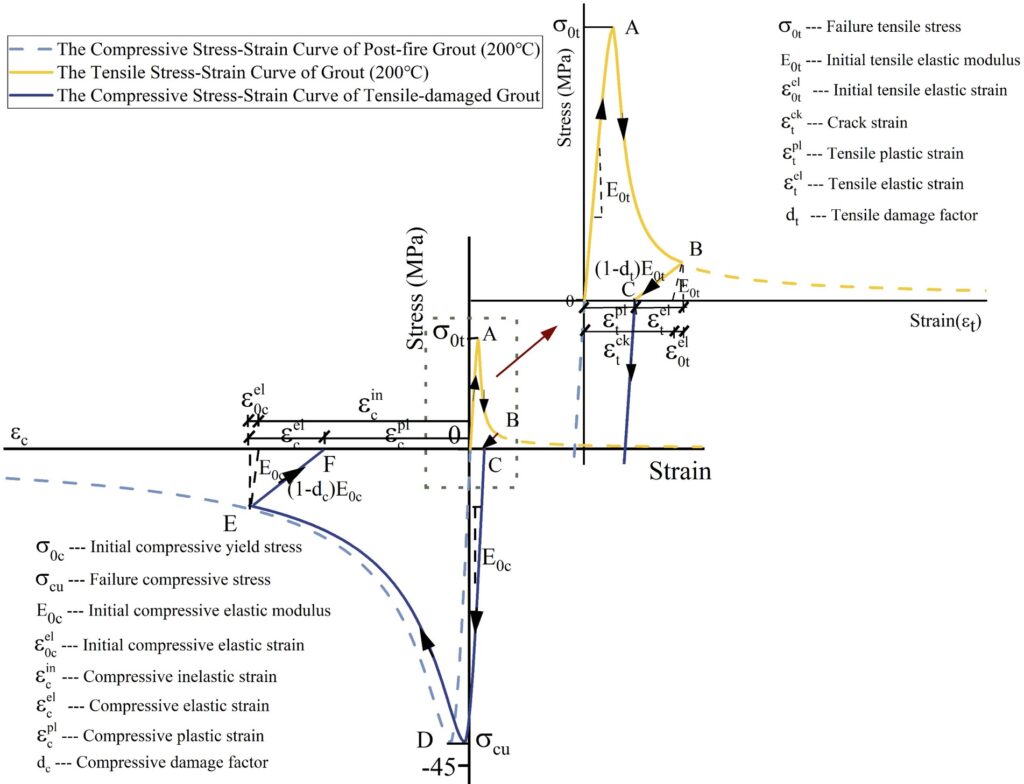
Previous studies have provided important experimental knowledge on fully-grouted sleeve connections under monotonic tension, cyclic loading, and elevated-temperature or post-fire conditions. They have clarified major failure modes, including steel bar fracture, pull-out, and bending, and have shown that thermal exposure can affect ultimate strength, displacement capacity, and bond-slip behaviour. However, few challenges still exist: first, a reliable quantitative indicator for damage in fully-grouted sleeve connections under mixed cyclic loading–thermal coupling is still not well established and secondly, the internal stress mechanism has often been treated mainly through the axial force state, leaving the radial force and third-axis bending response less fully explained. To address these gaps, a recent research paper published in Engineering Fracture Mechanics, Dr. Yitong Wang and Professor Guoxin Wang from Dalian University of Technology working with Associate Professor Fujian Yang from Changzhou University developed an optimized finite element model for fully-grouted sleeve connections under mixed-mode cyclic loading–thermal coupling, including both force-controlled and displacement-controlled stages. They introduced a quantitative damage pathway for post-fire grout under tensile–compressive cyclic loading and combined it with ductile damage evaluation of the rebar. They also developed a triaxial force interpretation using radial force, axial force, and third-axis bending moment, together with ratio-based measures linking bending response to radial and axial force components.
The researchers built their analysis around an optimized ABAQUS model of the fully-grouted sleeve connection, using a two-dimensional axisymmetric representation to reflect the geometry while keeping the calculation efficient. The model incorporated post-fire constitutive relations for grout and HRB400 rebar, tensile and compressive damage parameters for the grout, and ductile damage for the rebar. Two contact interfaces were central to the calculation: the rebar–grout surface and the grout–sleeve surface. They validated against reference post-fire cyclic loading experiments on grouted sleeve specimens heated to target temperatures and then loaded under high-stress cyclic conditions. The authors found the model reproduced the main load–displacement behaviour and captured the observed distinction between rebar fracture outside the sleeve and bond-slip pull-out. It was also checked against time–strain behaviour at the sleeve midpoint and against large-displacement cyclic loading data at room temperature and 600 °C. These comparisons gave the later damage analysis a stronger basis, because the model was not used only as a qualitative visualization tool; it was tied back to measurable cyclic response. Afterward, the damage maps gave a more detailed interpretation of failure than the experiments alone could provide. Both tensile and compressive grout damage were concentrated more severely at the rebar–grout interface than at the grout–sleeve interface, and damage decreased from the inner surface toward the outer surface. The rebar–grout interface is where force transfer is most directly imposed, while the sleeve modifies the stress field through confinement rather than acting as the primary bond surface. When rebar fracture occurred, grout compressive damage was more severe than in bond-slip failure, which the authors linked to the role of mechanical interlock. Once bond-slip develops, the interlocking contribution is reduced, and the associated grout damage is correspondingly lower.
The team also performed rebar damage analysis which added another useful distinction. Inside the sleeve, the reinforcement showed almost no ductile damage, confirming the protective influence of the sleeve over that embedded length. Damage began near the sleeve end and increased toward the exposed rebar end. Under bond-slip failure, the ductile damage outside the sleeve was more uniform, rather than sharply developing into the fracture pattern and this is an important separation between failure appearance and internal damage state. The authors did performance degradation analysis which showed that yield behaviour was comparatively insensitive to grout strength and thermal damage within the investigated range. Yield displacement varied only modestly, and yield force decreased slightly with temperature. Ultimate behaviour was more temperature-sensitive. Ultimate displacement remained relatively stable up to around 400 °C and then declined between 400 and 600 °C, with different reduction levels for the two grouts. Ultimate force also stayed broadly stable within 400 °C, followed by a decrease above that level. The choice to combine simulation data with existing high-stress cyclic experimental results allowed the authors to treat 400 °C not as an isolated observation from one specimen set, but as a practical turning point in the post-fire cyclic performance pattern.
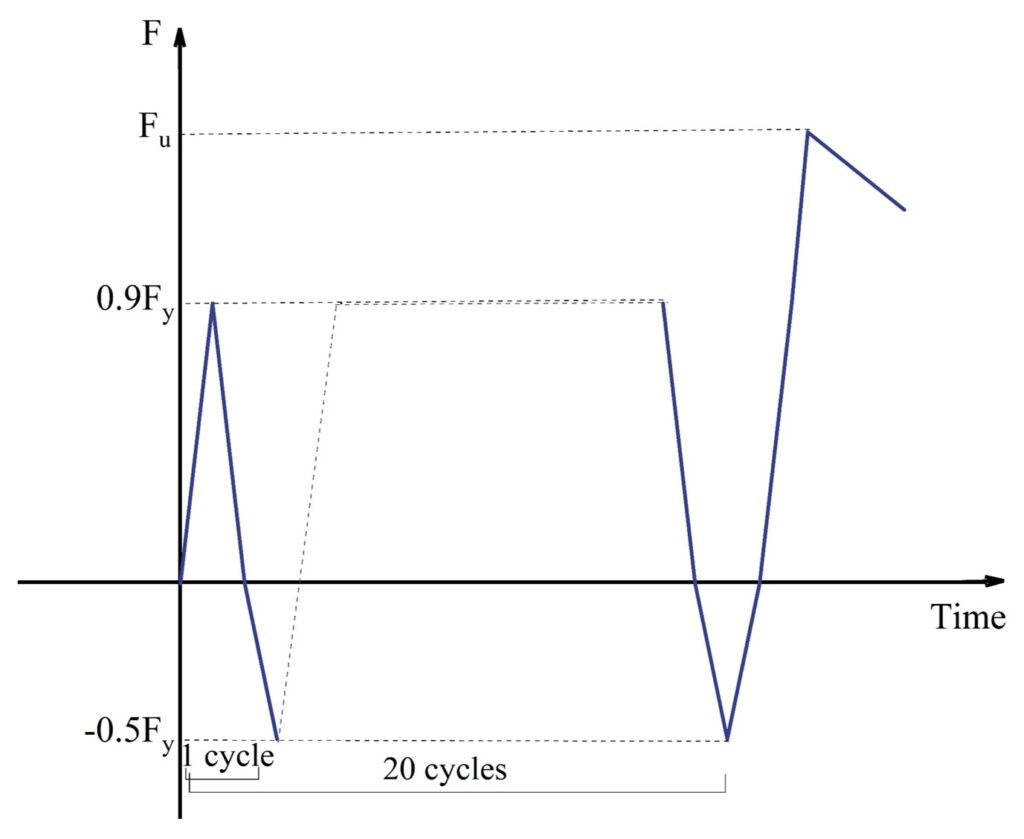
The force-mechanism analysis moved beyond the usual axial interpretation and by extracting radial force, axial force, and the third-axis bending moment, the authors showed that axial loading induces a coupled triaxial response through sleeve restraint and grout-mediated force transfer. High-stress and large-displacement cyclic schemes produced different histories of damage accumulation. Although their final tensile stages were comparable, the earlier cyclic phase changed the internal condition of the connection. High-stress cyclic loading produced greater accumulated damage and lower capacity than large-displacement cyclic loading, while the radial force and bending moment followed closely related trends. The analytical strategy therefore linked the loading scheme directly to a mechanical consequence: the cyclic path altered triaxial force development and damage accumulation, not only the final axial capacity.
The engineering implications of the research work reported by Yitong Wang, Guoxin Wang, Fujian Yang are mainly in post-fire safety assessment, seismic qualification, and damage-informed design of prefabricated concrete connections. Fully-grouted sleeve connections are therefore critical local regions in precast construction. A connection may still carry load in the early part of testing, while damage has already developed internally at the rebar–grout interface, where bond transfer, confinement, and local cracking interact most strongly. The new study is vital because it gives engineers a more resolved way to examine that hidden damage process. We think the most immediate application is post-fire evaluation of prefabricated concrete structures. After a fire, an engineer must decide whether a precast column, wall, beam, or joint region can remain in service, whether it requires strengthening, or whether the connection should be treated as unsafe. The study shows that yield behaviour may not change dramatically across the investigated thermal range, but ultimate performance becomes more vulnerable once the temperature exceeds about 400 °C. A connection that appears acceptable at lower load levels may still have reduced deformation capacity, weaker bond resistance, or greater susceptibility to pull-out under later cyclic demand. In structural safety decisions, residual ductility and ultimate resistance are often just as important as initial stiffness or yield strength. The study also has implications for seismic qualification of precast concrete connections. Earthquake-resistant design depends on how a connection behaves under repeated loading, not only on its monotonic tensile capacity. By comparing high-stress and large-displacement cyclic schemes, the work shows that the loading history influences damage accumulation and triaxial force development. This can help researchers and engineers interpret cyclic qualification tests more carefully, especially when post-fire damage is involved.
A further application is connection detailing and repair design. The finding that grout damage is more severe at the rebar–grout surface than at the grout–sleeve surface points to the inner bond-transfer region as a critical zone. This could guide future improvements in grout formulation, sleeve geometry, anchorage design, inspection priorities, or strengthening strategies. By quantifying grout damage, rebar ductile damage, radial force, axial force, and third-axis bending moment, the model provides a basis for locating high-risk regions inside the sleeve and for understanding why axial response alone does not fully represent the mechanical state of the connection.



Reference
Yitong Wang, Guoxin Wang, Fujian Yang, Quantitative damage analysis and triaxial stress mechanism of fully-grouted sleeve connections under cyclic loading-thermal coupling based on an optimized model, Engineering Fracture Mechanics, Volume 327, 2025, 111445,
Go to Journal of Engineering Fracture Mechanics