 Advances in Engineering Advances in Engineering features breaking research judged by Advances in Engineering advisory team to be of key importance in the Engineering field. Papers are selected from over 10,000 published each week from most peer reviewed journals.

Significance
Low cycle fatigue life prediction remains a challenge in the structural assessment of high-strength alloys used under demanding cyclic loading. For nickel-based superalloys, the difficulty arises because fatigue failure depends on multiple interacting factors, namely, material state, welding history, local deformation, cyclic strain evolution, and accumulated damage, which make life prediction particularly complex. GH4169 is a precipitation-hardened nickel-based alloy used where high strength and resistance to elevated-temperature degradation are required. It is commonly joined by inertia friction welding, but this introduces additional complexity: the weld joint must be evaluated not only as a nominal material but also as a structural region whose cyclic response is shaped by processing and local deformation. Traditional low cycle fatigue prediction has usually relied on strain-life relations, empirical equations, strain-energy approaches, and damage or critical-plane concepts. These methods remain important because they incorporate physically meaningful variables. However, their practical limitation lies in the dependence on empirically fitted parameters and the challenge of capturing fatigue life when multiple interacting factors are involved. In welded GH4169 joints, the prediction problem is made sharper by the need to connect measurable deformation during cyclic loading with final fatigue life in a way that is both data-efficient and physically interpretable.
Deep learning offers an alternative route by extracting patterns from complex datasets without requiring every feature to be predefined. A model trained directly on deformation images may receive information-rich input, but much of that information—such as speckle motion, contrast, and local texture—can be optically complex rather than mechanically decisive for fatigue life. The key question is: what form of experimental information allows neural network to learn a meaningful relationship between cyclic deformation and fatigue life? To address this, Professor Ming-Liang Zhu and Professor Fu-Zhen Xuan from East China University of Science and Technology developed convolutional neural network models in a recent paper published in Fatigue & Fracture of Engineering Materials & Structures for predicting the low cycle fatigue life of GH4169 inertia friction welded joints using three input formats: deformation images, average strain values, and combined average strain with damage fraction. The best-performing model used the combined strain and damage-fraction dataset and achieved the highest reported prediction accuracy in the study, whose framework is shown in Fig.1.
The research team generated a controlled low cycle fatigue dataset from GH4169 homogeneous inertia friction welded joint specimens. The material composition, welding parameters, and tensile properties were specified. Cyclic testing was performed at room temperature under stress control with a stress ratio of -1 and sinusoidal loading. Stress amplitudes ranged from 930 to 1160 MPa, producing fatigue lives from approximately 1,170 to over 25,000 cycles.
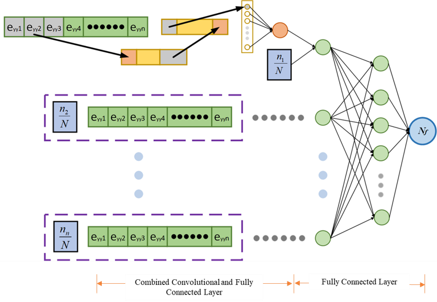
In their experimental design, the team simultaneously collected fatigue response data and optical deformation information. Speckle patterns were prepared on specimen surfaces, and a camera-based observation system was used during cyclic loading. Instead of retaining all images, they divided each specimen’s life into five equal periods and selected deformation images associated with peak strain within sampled cycles. This is important because peak strain is a mechanically relevant state within the cyclic response and by using peak-strain-associated images, the dataset was guided toward deformation states more directly related to fatigue accumulation. They generated three data streams from the same experimental foundation. The first consisted of cropped deformation images, used as input to a three-dimensional convolutional neural network (CNN). The second replaced raw images with average axial strain values extracted by digital image correlation (DIC). The third added a damage fraction calculated from the ratio of sampled cycle count to the corresponding fatigue life, following a linear cumulative damage representation. Notably, comparing these inputs was the main methodological strength of the work, because it isolated the effect of image richness from that of mechanically processed information.
The image-based network used convolutional layers to process deformation images from multiple life periods before passing concatenated features to fully connected layers for life prediction. The strain-based and combined-input models achieved higher predictive accuracy. With the smaller image dataset, the test coefficient of determination(R2) was 0.4652; with the larger dataset, it fell to 0.2089. The authors interpreted this as evidence that more image data did not necessarily provide more fatigue-relevant information. Additional images may have introduced optical variation that was less directly connected to fatigue life, increasing the complexity of the learning task when the network had to infer the connection from surface texture to deformation state and then to fatigue life. When average strain values replaced deformation images as network input, prediction accuracy improved markedly. The corresponding one-dimensional convolutional networks reached test R2 of 0.8159 for the smaller dataset and 0.9371 for the larger dataset. This improvement is important because the strain values were derived from the same image source that gave poorer results when used directly. It clarifies the role of image processing: digital image correlation acted as a physics-guided feature extraction step, translating optical deformation into a compact variable with direct fatigue relevance.
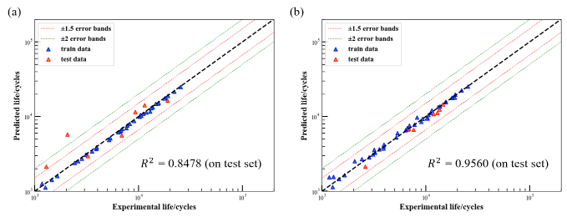
The combined strain and damage fraction model achieved the strongest prediction. Under the smaller dataset, the test R2 increased to 0.8478; and under the larger dataset it reached 0.9560 (Fig.2). The addition of damage fraction allowed the network to receive not only a deformation feature but also a normalized indication of where the sampled state lay within the specimen’s fatigue process. The larger combined dataset produced the most reliable predictions, with test points distributed within the narrower error band. The work therefore supports a clear hierarchy: raw deformation images were less effective, strain values were substantially more informative, and strain values combined with a physics-based damage descriptor yielded the best fatigue life prediction among the tested models.
The findings of East China University of Science and Technology researchers have direct engineering relevance for fatigue assessment of nickel-based welded components, especially where inspection must move beyond visual observation and toward measurable indicators of remaining life. GH4169 inertia friction welded joints are used in demanding mechanical systems, and their low cycle fatigue response is strongly tied to local deformation under repeated loading. By showing that average strain extracted from deformation images provides a much stronger prediction basis than raw images alone, the study points toward a practical monitoring strategy: optical measurements can be useful, but their engineering value increases when converted into mechanically meaningful strain features. For components operating under cyclic loading, this distinction matters. Surface texture, contrast, and image noise may complicate life prediction if they are treated as direct model input. In an engineering setting, the more useful route is to process deformation images through digital image correlation, extract peak strain-related information, and use those values as compact descriptors of the fatigue state. This makes the approach more compatible with inspection systems that must provide interpretable and repeatable indicators rather than opaque image-based judgments.
The integration of damage fraction adds another practical layer. By combining strain response with a measure of accumulated fatigue damage, the model connects what is observed at a given stage of loading with where the component lies in its fatigue life. This is especially relevant for non-destructive evaluation of in-service equipment, where maintenance decisions depend not only on whether deformation is occurring, but on how that deformation relates to life consumption. The demonstrated improvement in prediction accuracy suggests that data-driven fatigue assessment can benefit from physics-based descriptors when they are chosen carefully.
In design and maintenance workflows, the approach could support more informed evaluation of welded joints, fatigue-critical regions, and components subjected to controlled cyclic loading. It may help engineers compare fatigue states across specimens or service intervals using strain-based features rather than relying only on final failure data. Within the tested range, the strongest engineering message is the value of a focused data-physics framework that estimates low cycle fatigue life from experimentally accessible deformation and damage information.


Reference
Liu, Yu‐Ke & Chen, Yu‐Hao & Lu, Wen-Qing & Zhu, Ming-Liang & Xuan, Fu-Zhen. (2025). Fatigue Life Prediction of GH4169 Alloy with Convolutional Neural Networks Based on Images, Average Strain, and Damage Fraction. Fatigue & Fracture of Engineering Materials & Structures. 48. 5064-5078. 10.1111/ffe.70082.
Go to Fatigue & Fracture of Engineering Materials & Structures