Advances in Engineering Advances in Engineering features breaking research judged by Advances in Engineering advisory team to be of key importance in the Engineering field. Papers are selected from over 10,000 published each week from most peer reviewed journals.

Significance
Liquid-loaded membranes represent a familiar yet mechanically demanding class of fluid–structure interaction problems. A thin membrane held under initial tension may appear, at first sight, to respond to liquid self-weight in a straightforward way: the liquid applies pressure, the membrane deflects, and a larger liquid volume should produce a deeper deformation. This expectation is natural because conventional membrane models often treat the liquid load as a prescribed pressure acting on the undeformed configuration. Under that view, the liquid level is effectively fixed by the initial volume, and the membrane’s response follows from the balance between pressure and tension. The difficulty arises when the membrane deformation is no longer negligible relative to the available liquid depth. As the membrane deflects, it creates additional space that must be filled by part of the liquid. The liquid level therefore changes after deformation, and the hydrostatic pressure acting on the membrane is no longer determined only by the initial height. The load follows the evolving configuration. This seemingly small distinction becomes central, because the membrane shape, the liquid level, and the region of liquid contact are all coupled through volume conservation. A model that ignores this coupling may still perform well for small deflections, high membrane tension, short spans, or low-density liquids, but it cannot explain the full range of observed membrane–liquid configurations. In a recent research paper published in International Journal of Engineering Science, Dr. Weiting Chen and Professor Quanzi Yuan from the University of Chinese Academy of Sciences developed an analytical model for liquid-loaded initially stressed membranes in which the hydrostatic pressure is determined by the deformed liquid configuration rather than by the initial liquid height. They derived closed-form solutions for one-dimensional and two-dimensional axisymmetric membrane deflections, including membrane-prevails, equipoise, and liquid-prevails regimes. This allowed them to identify a dimensionless control parameter that determines the membrane–liquid configuration independently of liquid volume.
The researchers treated the membrane as initially tensioned, linearly elastic, and thin enough that bending stiffness could be neglected. Rather than prescribing the liquid pressure from the initial liquid height, they enforced liquid-volume conservation after deformation. For the one-dimensional membrane, the classical model gives a parabolic deflection controlled by the dimensionless parameter λ = √(ρgL²/T). In the present model, the same parameter acquires direct physical meaning as the measure of competition between gravity-driven loading and membrane tension. When 0 < λ < π, the membrane prevails, and the liquid remains in contact with the full membrane span. The deformed liquid level decreases as λ increases, following an analytical expression derived from the volume constraint. At λ = π, the system reaches the equipoise configuration, where the deformed liquid level is exactly flush with the bottom. For λ > π, the liquid prevails, and the interaction region shrinks. In that regime, the boundary of contact is determined analytically, and its location depends on λ but not on the original liquid volume.
Chen and Yuan used a PET membrane clamped in a tension apparatus with a transparent tank, varying the membrane tension to control λ. The experiments reproduced the three predicted configurations. The membrane prevailed for λ below π, equipoise occurred at λ = π, and liquid prevailed when λ exceeded π. The measured liquid levels and interaction regions agreed closely with the analytical predictions, while the classical model did not reproduce the observed regime selection with the same accuracy. The authors also compared their formulation with a nonlinear classical model for an inextensible membrane under uniform pressure. Including geometric nonlinearity changed the predicted deflection, especially as λ and the initial liquid level increased, but it did not resolve the central discrepancy. The reason is instructive: curvature and tension variation matter, yet they do not replace the need to update the liquid loading according to the deformed configuration.
The team extended same reasoning to two-dimensional axisymmetric membranes. With ξ = √(ρgR²/T), the axisymmetric formulation yields analytical solutions involving Bessel functions. The transition occurs at the first nontrivial zero of J0, approximately 2.4. Below this value, the membrane prevails; at the critical value, equipoise is reached; above it, the liquid prevails and the liquid-contact radius decreases according to the dimensionless parameter. This extension shows that the volume-independent regime selection is not a peculiarity of the one-dimensional geometry.
The findings are directly useful for engineering systems in which a thin, tensioned membrane supports or confines a liquid but the liquid level is free to adjust during deformation. A practical example is flexible covering films exposed to rainwater. In such systems, designers often estimate deformation from the applied water depth or total accumulated volume. Chen and Yuan’s analysis indicates that this can be misleading when the membrane deflection significantly alters the water configuration. The relevant design question becomes whether membrane tension, span, and liquid density place the system in a membrane-prevailing, balanced, or liquid-prevailing regime. This gives engineers a clearer criterion for deciding when ponding remains shallow and distributed, and when liquid contact may shrink into a central region with much larger local deflection.
In these cases, the membrane is not simply a passive surface under a fixed pressure; it reshapes the liquid domain. The dimensionless parameter identified in the paper provides a compact way to tune design variables. Increasing initial membrane tension or reducing the characteristic span lowers the competition parameter, keeping the system closer to the classical small-deflection regime. Larger spans, lower tensions, or denser liquids push the system toward stronger configuration-dependent behavior. This is useful because the engineer can adjust geometry or prestress before relying on more complex numerical simulations. The work shows when classical uniform-pressure membrane theory is likely sufficient and when it is not. When this dimensionless parameter is small, the classical model and the configuration-dependent model give nearly identical predictions. For larger values, especially beyond the critical regime, classical predictions may miss the magnitude of deflection as well as the actual liquid–membrane contact area. That distinction matters for load paths, seal design, drainage planning, support spacing, and failure-risk assessment. The findings of Chen and Yuan may also guide experimental design for soft membranes, flexible electronics, biological-mimetic membranes, and liquid blister systems where researchers need to distinguish material effects from loading-configuration effects. By separating the role of liquid volume from the role of density, length scale, and tension, the model offers a more reliable way to interpret membrane deformation tests and its value in that it identifies the mechanical control parameter that must be respected before such models can be meaningfully applied.
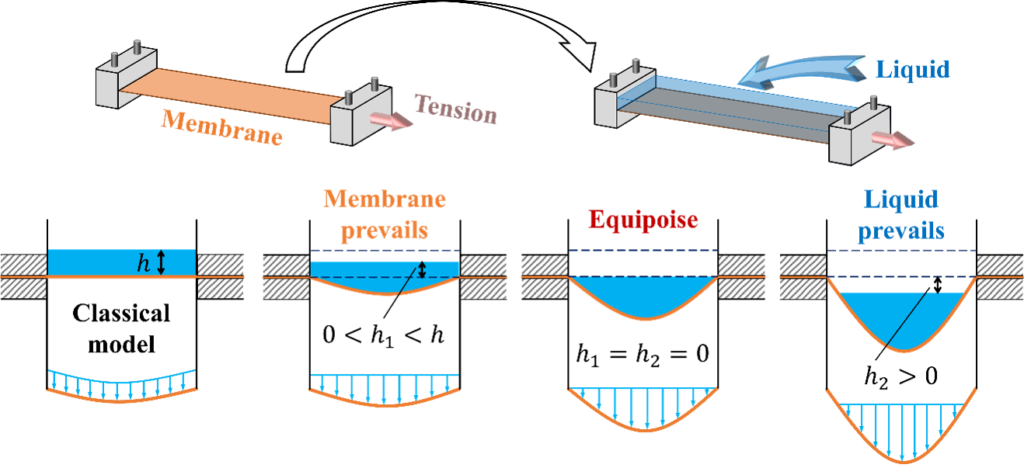
Fig. 1. Configurations of the membrane–liquid interaction. (a) The classical model. (b) Membrane prevails type: The deformed liquid level is above the bottom. (c) Equipoise type: The deformed liquid level is flush with the bottom. (d) Liquid prevails type: The deformed liquid level is below the bottom.
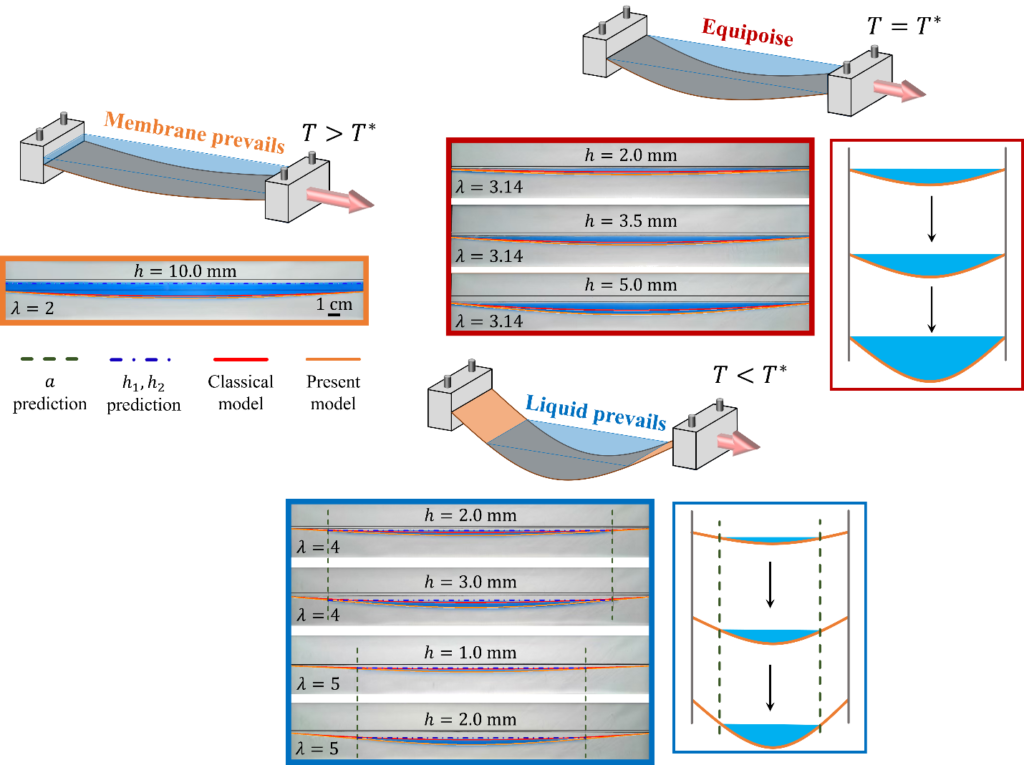
Fig. 2. Experimental observations and the theoretical predictions of the classical and present models.


Reference
Weiting Chen, Quanzi Yuan, Tug-of-war between liquids and membranes, International Journal of Engineering Science, Volume 217, 2025, 104395.
Go to International Journal of Engineering Science