Advances in Engineering Advances in Engineering features breaking research judged by Advances in Engineering advisory team to be of key importance in the Engineering field. Papers are selected from over 10,000 published each week from most peer reviewed journals.

Significance
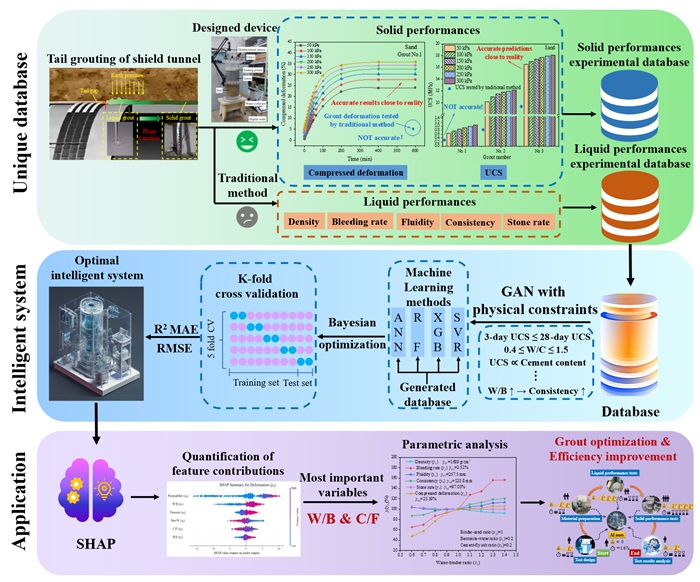
Urban rail construction depends on shield tunneling because it allows underground space to be developed beneath active streets, buildings, and infrastructure with comparatively limited surface disruption. However, the method inevitably disturbs the surrounding ground and as the shield advances, excavation, face support, segment erection, and tail void closure interact within a narrow construction window, and even small mismatches between volume loss and compensation can appear later as surface settlement. In densely built ground, that settlement is not just a geometric response of soil; it becomes a serviceability and safety concern for nearby structures, utilities, and transport corridors. Tail grouting sits at the center of this control problem. The annular gap between the excavated soil and the newly installed tunnel lining must be filled by a material that can be transported and injected as a fluid, occupy the tail void effectively, and then develop enough stiffness and strength to restrain subsequent deformation. The scientific difficulty is that the grout is not a material with one fixed performance state. During mixing, pumping, and injection, its liquid properties dominate: density, bleeding rate, fluidity, consistency, and stone rate determine whether it can be placed reliably. After injection, the same material enters a different physical regime, where pressure, soil permeability, water dissipation, consolidation, and cementitious hardening govern compressed deformation and strength development. This liquid-to-solid transition makes grout proportioning more difficult than ordinary empirical mix adjustment. This is important because field performance depends on a balance between pumpability, filling stability, deformation resistance, and strength development. The challenge, therefore, is multi-performance optimization under construction-relevant conditions, not simply maximizing one index. In a recent research paper published in Computer-Aided Civil and Infrastructure Engineering, Dr. Jiaxin Liang, Prof. Wei Liu, Dr. Jingyi Gong, and Prof. Xiaoqiang Dong from Taiyuan University of Technology and Soochow University, working with Dr. Cheng Chen of Suzhou City University and Dr. Chunqing Fu of Beijing Uni-Construction Group Co. Ltd., addressed this problem by developing an explainable intelligent system for shield tunnel tail grout optimization. The system combines experimental liquid and solid performance databases, physics-constrained GAN data augmentation, Bayesian-optimized machine learning, and SHAP interpretation. Its technical distinction is the use of different optimal algorithms for different grout responses rather than a single uniform model. The system links mix proportions and ground conditions to workability, deformation, strength, and settlement-control performance.
The researchers organized the database around the actual performance sequence of tail grout. Fresh grout behavior was represented through water–binder ratio, bentonite–solid ratio, bentonite–water ratio, and cement–fly ash ratio, with five measured outputs: density, bleeding rate, fluidity, consistency, and stone rate. After hardening, the authors incorporated compressed deformation, 3-day unconfined compressive strength, and 28-day unconfined compressive strength. This separation was technically important because it allowed the system to distinguish workability during injection from mechanical performance after consolidation and hardening.
The authors conducted solid-performance tests under three soil conditions and three pressures. They used sand, silt, and clay to represent different permeability environments, while the applied pressures ranged from 100 to 300 kPa. This design choice links the testing strategy directly to the scientific problem: after grout enters the tail void, soil permeability and ground pressure influence water migration, compressed deformation, and the development of stiffness. The authors therefore did not evaluate hardened grout as a detached laboratory material, but as a material responding to boundary conditions that resemble the underground environment. The researchers used a physics-constrained generative adversarial network to expand the available data and their liquid-performance dataset was enlarged to 526 sets and the solid-performance dataset to 582 sets. The generated data were guided by physical rules and screened to remain consistent with the expected mechanical and chemical behavior of cementitious materials.
The team examined four algorithms: artificial neural network, random forest, extreme gradient boosting, and support vector regression. Bayesian optimization and 5-fold cross-validation were used to tune and evaluate these models. The final system did not force one algorithm onto all performance indicators. For liquid-state properties, the artificial neural network gave the strongest and most stable prediction across density, bleeding rate, fluidity, consistency, and stone rate. For solid-state behavior, the best algorithm depended on the output: extreme gradient boosting was selected for compressed deformation, artificial neural network for 3-day strength, and support vector regression for 28-day strength. This property-specific structure is technically important because liquid workability, consolidation deformation, and strength development do not have identical data behavior. The interpretive layer was built through SHAP analysis. Water–binder ratio appeared as the dominant variable for liquid properties and also strongly affected deformation. Cement–fly ash ratio was the main factor for strength development, especially early strength. Bentonite-related variables influenced bleeding and fluidity through water retention and thickening behavior, while confining pressure and soil permeability mainly influenced solid-state deformation. The parameter analysis sharpened these relationships: increasing water–binder ratio improved fluidity but increased bleeding and deformation sensitivity, whereas increasing cement–fly ash ratio enhanced both 3-day and 28-day strength, with stronger sensitivity at lower cement–fly ash ratios. Validation gave the system both laboratory and field grounding. Independent laboratory comparisons showed strong agreement between measured and predicted values for density, bleeding rate, consistency, stone rate, compressed deformation, and 28-day strength. In the Harbin Metro Line 2 case, the optimized grout reduced compressed deformation and lowered the required grouting volume per ring from 4.24 to 3.46 m³. The maximum surface settlement was reduced from about 6 mm to about 3.5 mm, corresponding to a reported reduction of approximately 42%. The paper also contrasts the rapid prediction time of the intelligent system with the lengthy traditional testing workflow, which can require about two months for a typical orthogonal experiment.
The findings of Dr. Jiaxin Liang and Prof. Wei Liu and colleagues have direct engineering value for shield tunnel construction, especially in projects where tail grouting must control both constructability and ground deformation. The developed system can be used to optimize grout formulations before construction by balancing fluidity, bleeding rate, density, consistency, stone rate, compressed deformation, and early- and later-age strength. By linking mix proportions, soil permeability, and pressure conditions to multiple grout responses, the new system gives engineers a rational basis for selecting mixtures suited to different ground conditions rather than applying one empirical formulation across an entire tunnel alignment. This approach enables site-specific optimization and adapts to varying geological conditions encountered along the tunnel, significantly improving project efficiency and deformation control. The intelligent system eliminates trial-and-error testing, substantially reducing testing time, labor costs, and material waste while enabling efficient multiperformance optimization. Engineers can now rapidly evaluate numerous formulation scenarios before construction, ensuring optimal grout selection tailored to site-specific ground conditions and project requirements, ultimately enhancing both construction efficiency and deformation control in complex tunneling projects.


Reference
Jiaxin Liang, Wei Liu, Jingyi Gong, Cheng Chen, Xiaoqiang Dong, Chunqing Fu, An explainable intelligent system for multi‐performance shield tunnel tail grout optimization, Computer-Aided Civil and Infrastructure Engineering, Volume 40, Issue 30, 2025, Pages 6165-6183,
Go to Computer-Aided Civil and Infrastructure Engineering