Advances in Engineering Advances in Engineering features breaking research judged by Advances in Engineering advisory team to be of key importance in the Engineering field. Papers are selected from over 10,000 published each week from most peer reviewed journals.

Significance
Cavitation erosion results from the intense interaction between a collapsing bubble and a solid surface. A vapor-filled bubble can expand and collapse very quickly, and the resulting liquid motion can break the protective surface film, deform the material, and create localized pits. Near a rigid wall, the bubble usually collapses asymmetrically. The pressure difference caused by the wall pushes the bubble toward the surface, generates a high-velocity micro-jet, and changes the rebounding bubble into a ring-shaped structure. When this structure collapses, it can produce fragmented flow directed toward the wall. Separating the damage caused by these different stages is important for understanding single-bubble erosion. The main difficulty is both temporal and physical. High-speed imaging can capture changes in bubble shape, jet penetration, movement, rebound, and fragmentation, but it does not directly track how the material responds during these events. Surface microscopy can reveal pits and depressed regions, but these features are usually examined after the collapse sequence or after repeated impacts. A depressed area may be linked to a jet, while a ring of pits may result from toroidal bubble collapse. Surface morphology alone, however, cannot always determine the contribution of each event. Chronoamperometry offers a way to connect bubble motion with surface damage on the relevant timescale. Pure aluminum carries a thin passive oxide film. When collapse-induced loading ruptures that film and exposes the underlying metal to an oxygen-containing electrolyte, oxidation produces a transient current. The height of the resulting current peak reflects the area and depth of the disturbed surface, while repassivation returns the current toward its baseline. This electrochemical response can therefore provide a real-time measure of erosion that complements optical observations rather than replacing them.
In a recently published research paper in International Journal of Multiphase Flow, Professor Qingmiao Ding, Professor Yanyu Cui, Dr. Yunlong Shan, Dr. Jiakui Yu, and Dr. Futai Guo from the Civil Aviation University of China developed an experimental method that combines high-speed bubble imaging with real-time chronoamperometric measurement of passivation-layer damage on pure aluminum. They introduced a controlled eccentric bubble position that diverts the first-collapse micro-jet away from the working electrode while allowing ring-vortex crushing flow to reach it.
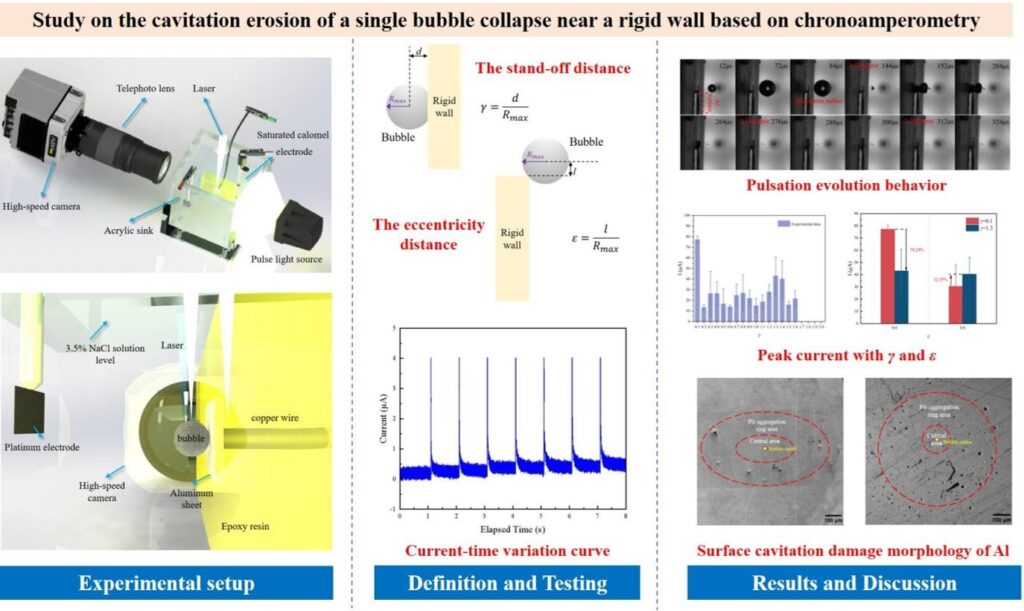
The researchers generated cavitation bubbles with a pulsed Nd:YAG laser and positioned them at controlled distances from a polished, high-purity aluminum working electrode immersed in a saline solution. They defined the dimensionless stand-off distance, γ, as the distance between the bubble centre and the wall divided by the maximum bubble radius. Repeated measurements were used to determine the mean peak current at each position.
Bubble motion changed markedly across the examined distances. Far from the wall, the cavity remained nearly spherical through much of its first contraction, moved gradually toward the surface, and formed a penetrating micro-jet during collapse. Rebound produced a ring vortex that continued toward the boundary and fragmented during later collapse, but the resulting flows had to travel a relatively long distance before reaching the aluminum.
The authors found a different sequence appeared at γ = 1.3 and the wall distorted the contracting bubble from a spherical to an ellipsoidal form. Its first collapse generated a hemispherical jet directed toward the surface, after which the bubble became a ring vortex. During the second collapse, that toroidal structure collapsed asymmetrically and produced a crushing flow accompanied by numerous small bubbles spreading close to the wall. At γ = 0.1, the bubble was tightly adjacent to the boundary and became strongly flattened. The first-collapse jet moved radially along the surface, while the subsequent ring vortex expanded, broke apart, and drove fragmented flow against the near-wall region.
They also performed chronoamperometric measurements which showed a non-monotonic dependence of erosion on stand-off distance. The largest peak current occurred at γ = 0.1, identifying this condition as the most damaging among those tested. Damage then decreased, varied at intermediate positions, and rose again near γ = 1.3 before declining with increasing separation. At sufficiently large distances, current transients became barely detectable. Distance therefore did more than scale impact strength; it altered the collapse mode and, consequently, the mechanism by which energy reached the surface.
To separate micro-jet damage from ring-vortex damage, the team introduced a dimensionless eccentricity of ε = 0.8. This design choice displaced the bubble vertically so that the first-collapse jet struck the surrounding insulating substrate rather than the aluminum electrode, while the more spatially distributed crushing flow from the toroidal collapse could still reach the metal. At γ = 1.3, the measured peak current changed by less than 1% when eccentricity was introduced. The micro-jet thus contributed little to erosion under that condition, whereas the second-collapse ring-vortex flow accounted for most of the electrochemical response. At γ = 0.1, eccentricity reduced the peak current to less than half its centred value, showing that the micro-jet made a substantial contribution there.
The team observed repeated-bubble exposure to produce surface morphologies consistent with this interpretation. At γ = 0.1, the aluminum developed a central depressed region surrounded by an asymmetric annulus of concentrated pits. The central deformation was associated with the jet, while the annular pitting corresponded to fragmented crushing flow from the later toroidal collapse. At γ = 1.3, the centre remained comparatively flat and the damage consisted mainly of densely distributed, shallower pits in an asymmetric ring. The agreement among bubble imaging, current response, and surface morphology supported the distinction between the two erosion mechanisms.
The findings of Professor Yanyu Cui and colleagues provide a useful basis for interpreting and managing cavitation erosion in hydraulic machinery, marine equipment, piping systems, valves, pumps, propellers, and other components exposed to repeated bubble collapse near solid boundaries. A key engineering implication is that erosion severity cannot be estimated from bubble proximity alone. The dimensionless stand-off distance changes the collapse mode and determines whether surface damage is driven mainly by a direct micro-jet, by the fragmented flow produced during ring-vortex collapse, or by both mechanisms acting together. A centrally depressed region surrounded by annular pitting is consistent with the combined action of a wall-directed jet and the later collapse of a toroidal bubble. In contrast, dense ring-shaped pitting with a comparatively flat centre indicates that ring-vortex crushing flow is likely to be the dominant source of erosion. Such morphological signatures may help engineers relate observed surface damage to the underlying bubble dynamics rather than treating all cavitation pits as products of a single impact mechanism.
The non-monotonic relation between stand-off distance and damage is also relevant to equipment design. The most severe erosion occurred when the bubble was very close to the wall, but pronounced damage reappeared at an intermediate distance where the direct jet contributed little. Geometric modifications intended to redirect bubbles, alter near-wall flow, or move collapse zones away from vulnerable surfaces should account for the possibility that toroidal collapse and fragmented crushing flow can remain damaging even when direct jet impact is limited. The combined measurement approach proposed in the new study has practical value for laboratory evaluation of cavitation-resistant materials and protective surfaces. Chronoamperometry records passivation-layer disruption in real time, while high-speed imaging identifies the corresponding collapse stage and surface microscopy confirms the accumulated damage pattern.

Reference
Qingmiao Ding, Yunlong Shan, Yanyu Cui, Jiakui Yu, Futai Guo, Study on the cavitation erosion of a single bubble collapse near a rigid wall based on chronoamperometry, International Journal of Multiphase Flow, Volume 193, 2025, 105394,
Go to International Journal of Multiphase Flow