Advances in Engineering Advances in Engineering features breaking research judged by Advances in Engineering advisory team to be of key importance in the Engineering field. Papers are selected from over 10,000 published each week from most peer reviewed journals.

Significance
Hydrogen storage remains one of the central materials challenges limiting the broader use of hydrogen as an energy carrier. At ambient conditions, hydrogen has a low volumetric energy density, so established storage methods depend on compression or liquefaction. Both approaches add system mass and energy demand. Solid-state storage can achieve high hydrogen density at lower pressure, but its practical value depends on more than the hydrogen content of the material itself. The storage vessel, thermal-management components and fuel cell all contribute to the final system mass. A useful hydride must therefore combine reversible capacity with hydrogen release at temperatures compatible with the surrounding energy system.
Lightweight complex hydrides are attractive because they contain substantial quantities of hydrogen. Their sorption chemistry, however, often requires temperatures that are too high for efficient use of low-grade heat. Lithium borohydride, LiBH₄, illustrates this difficulty: it has a high theoretical hydrogen capacity, yet substantial dehydrogenation and subsequent rehydrogenation occur only under demanding thermal and pressure conditions. Magnesium amide–lithium hydride chemistry offers a more accessible reversible pathway through cooperative reactions that form mixed-metal imides. Its usefulness is still restricted by slow hydrogen-release kinetics at moderate temperature, and ammonia-forming side reactions can contribute to capacity loss during cycling.
Reactive hydride composites seek to overcome these limitations by combining hydrogen-bearing phases that react cooperatively. In the Mg–Li–N–H system, adding LiBH₄ can accelerate sorption and alter the phases formed during dehydrogenation. Earlier studies focused mainly on small or moderate borohydride additions. These compositions reduced the apparent release temperature, but rapid hydrogen delivery near ambient conditions remained difficult because improved thermodynamics did not fully remove the kinetic restrictions of solid-state reactions.
The key unresolved question was whether much higher LiBH₄ contents would continue to produce incremental changes or instead establish a different chemical pathway. In a recently published Nature Communications paper, Professor Martin Dornheim and Professor David Grant from the University of Nottingham, together with an international research team, examined a series of Mg(NH₂)₂–LiH–LiBH₄ composites across a broad range of borohydride concentrations. They investigated how high LiBH₄ loading affects hydrogen-release temperature, gas composition, reversibility and phase evolution, with particular attention to reaction intermediates that are absent from conventional low-borohydride formulations.
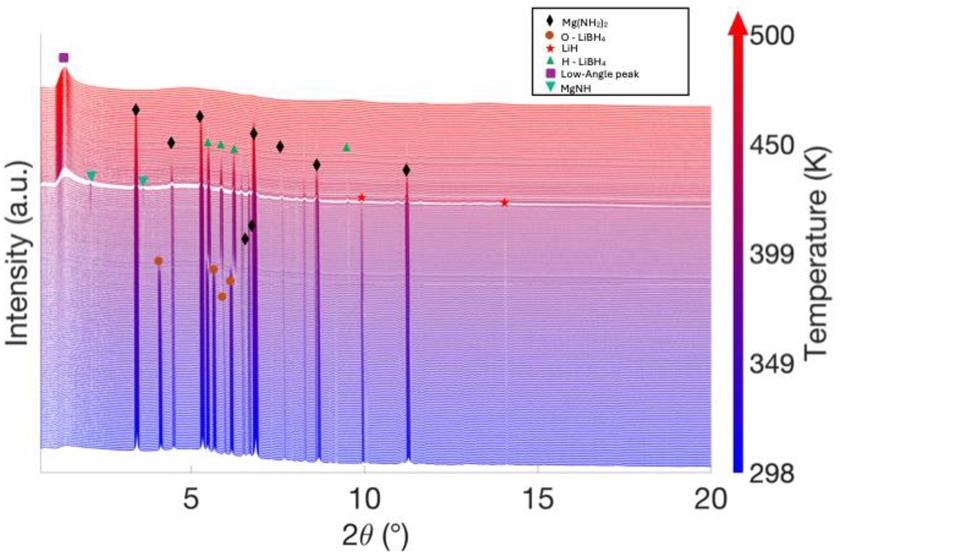
The researchers prepared milled composites containing progressively larger amounts of LiBH₄. Coupled thermogravimetric analysis, differential scanning calorimetry and mass spectrometry resolved the temperature, magnitude and gaseous products of successive release events. Temperature-ramped synchrotron powder X-ray diffraction then followed the associated structural changes, allowing hydrogen evolution to be interpreted alongside the consumption and formation of crystalline or poorly ordered phases.
Composition altered both the onset and character of dehydrogenation. The borohydride-rich materials began releasing hydrogen at substantially lower temperatures than the corresponding Mg(NH₂)₂–LiH system without LiBH₄. Among the compositions examined, the intermediate high-LiBH₄ formulation, designated 6-9-18, gave the strongest balance of low-temperature release and reversible storage capacity. It began releasing hydrogen near the lower end of the temperature interval associated with low-grade fuel-cell waste heat and delivered approximately three weight percent hydrogen over the principal operating range.
The authors performed gas analysis and found no ammonia was detected over the main dehydrogenation interval for the higher-LiBH₄ compositions, whereas weak ammonia signals remained in materials containing less borohydride. This distinction suggests that high LiBH₄ loading redirects nitrogen-containing intermediates away from pathways that release ammonia. The change is not simply a reduction in reaction temperature; it also concerns which chemical products become accessible during heating. They also
The research conducted as well calorimetry and showed that the early thermal events could not be explained by the known structural transition of LiBH₄ alone. The measured heat flow was considerably larger than expected for that transformation, indicating that additional chemical or structural rearrangements occurred in the same temperature region as the initial hydrogen release. This observation directed attention toward transient phases that conventional ex situ measurements could easily miss.
Synchrotron diffraction revealed a marked divergence between low- and high-borohydride composites. The low-LiBH₄ material formed the established crystalline imide and borohydride–amide products. In the richer formulations, these familiar phases were replaced by a prominent low-angle diffraction feature associated with a large-period, poorly ordered structure. Its intensity increased during hydrogen release as LiBH₄ was consumed. The researchers therefore assigned it cautiously to a partially decomposed Li–Mg–N–B–H intermediate, possibly with layered or intercalated character.
The magnesium-containing intermediates also changed with composition. In the 6-9-18 material, MgNH appeared during the lower-temperature stage and disappeared as the reaction shifted toward direct interaction between Mg(NH₂)₂ and LiBH₄. At still higher LiBH₄ loading, MgNH was no longer detected, indicating that the borohydride-rich environment controlled the pathway from an earlier stage. This design choice had a clear scientific consequence: increasing LiBH₄ beyond the conventional range changed the reacting partners and the sequence of phase formation, thereby lowering the temperature at which hydrogen became available.
At elevated temperature, the team found the diffraction patterns of the richest formulations became broad and largely non-crystalline, consistent with molten, amorphous or nanocrystalline material. Weak reflections also indicated the formation of a primitive cubic phase, tentatively assigned to Mg₂NH. The authors propose that a partially molten or electrolyte-like borohydride phase may improve ionic transport through the composite and reduce the kinetic restrictions associated with reactions between separate solid particles. Initial cycling measurements confirmed that the 6-9-18 composition remained reversible and retained approximately its original hydrogen capacity, although release became slower after repeated cycling.
The research work of University of Nottingham scientists is the demonstration that LiBH₄ concentration can determine the identity of the dehydrogenation pathway, rather than simply modifying the rate of an established reaction. Small additions support familiar crystalline products. Higher concentrations generate poorly ordered and possibly molten intermediates, accompanied by a different sequence of magnesium nitride-hydride chemistry. The composite therefore enters a distinct reaction regime once the borohydride fraction becomes sufficiently large. This distinction changes the design logic for reactive hydride composites. Their behaviour cannot be predicted by assuming that an additive performs the same role at every concentration. In the borohydride-rich materials, LiBH₄ appears to function as a structurally active reactant. Its abundance is linked to the formation of the large-period intermediate, the weak cubic phase and broad scattering associated with melt-like behaviour. These features provide a coherent explanation for the lower hydrogen-release temperature, although the precise structures and compositions of the transient phases remain provisional.
We believe the 6-9-18 formulation is important because it combines reversible hydrogen storage, release within the temperature range of low-grade fuel-cell waste heat and suppression of detectable ammonia during the principal dehydrogenation interval. The paper does not establish operation within a dynamically loaded fuel-cell system, and the authors distinguish their controlled laboratory measurements from the fluctuating pressures and thermal gradients expected in service. Long-term cycling also remains to be established. Within these boundaries, the new findings provide a clear materials-design principle. Exploring compositions beyond the traditionally studied range can reveal reaction pathways and transport conditions that are inaccessible at lower additive contents. The next scientific task is to resolve the large-period intermediate, the amorphous or molten component and the proposed cubic Mg₂NH phase using complementary structural methods. Their identification would clarify how high borohydride loading couples phase mobility, nitrogen chemistry and reversible hydrogen release.


Reference
Hall, N.J., Grant, D.M., Prosser, J.L. et al. Reversible hydrogen storage in reactive hydride composites under 400 K. Nat Commun (2026). https://doi.org/10.1038/s41467-026-75313-0