Advances in Engineering Advances in Engineering features breaking research judged by Advances in Engineering advisory team to be of key importance in the Engineering field. Papers are selected from over 10,000 published each week from most peer reviewed journals.

Significance
Hydrogen isotope separation is difficult because protium and deuterium have nearly identical physicochemical properties. Deuterium is an important fuel for deuterium–tritium fusion, but it occurs at very low natural abundance in water. Conventional separation methods, including cryogenic distillation and the Girdler-sulfide process, require high energy input and complex operation. Porous adsorbents offer another way to separate hydrogen isotopes under milder conditions. Separation can occur through kinetic quantum sieving or chemical affinity quantum sieving. Kinetic quantum sieving depends on differences in how the isotopes move through very small pores. Chemical affinity quantum sieving depends on differences in adsorption energy caused by zero-point energy. A good adsorbent needs small pores that can distinguish D2 from H2 and easy access to the adsorption sites. Designing a pore structure that provides both effects is an important challenge. Nanoporous carbons have high surface area, chemical stability and tunable structures, but controlling their micropore size and pore distribution can be difficult. Metal–organic frameworks offer a useful starting material because their pore structure and composition are well defined before carbonization. During heating, the material is converted into carbon, and new pores can form as the structure decomposes and metal atoms are removed.
Bio-MOF-1 is well suited for this process because it contains zinc–adeninate units connected by biphenyldicarboxylate linkers, forming one-dimensional channels. During carbonization, Zn is gradually removed and can leave behind additional pores, while contraction of the original structure can preserve smaller micropores. The key question is whether this combination can create a hierarchical pore structure that supports isotope-selective adsorption and efficient molecular transport.
In a recently published research paper in Dalton Transactions, Jiyu Zhu, Xinlu He, Dr. Zhu Zhuo, Professor Wenjing Wang and Professor Daqiang Yuan from the Fujian Institute of Research on the Structure of Matter, Chinese Academy of Sciences, produced hierarchical nanoporous carbons by carbonizing bio-MOF-1 at high temperatures. The resulting carbons retained micropores from the original framework while also developing new mesopores as the structure reorganized and Zn was removed.
The researchers heated bio-MOF-1 under nitrogen at three temperatures to produce bio-MOF-C950, bio-MOF-C1000 and bio-MOF-C1050. After carbonization, the original crystalline structure was lost and the materials became mainly amorphous carbon. The amount of remaining Zn decreased as the temperature increased. They performed raman analysis which showed that the carbons contained many structural defects, with the carbon structure becoming more ordered at the highest temperature. Carbonization produced a pronounced change in pore architecture. Bio-MOF-1 was primarily microporous, and carbonization preserved this microporosity while also generating mesopores. Surface area and total pore volume increased substantially up to 1000 °C, then decreased slightly at the highest temperature. The team noted Bio-MOF-C1000 had the best balance between pore generation and structural retention. Carbonization temperature directly affected how Zn removal and structural changes shaped the hierarchical pore structure.
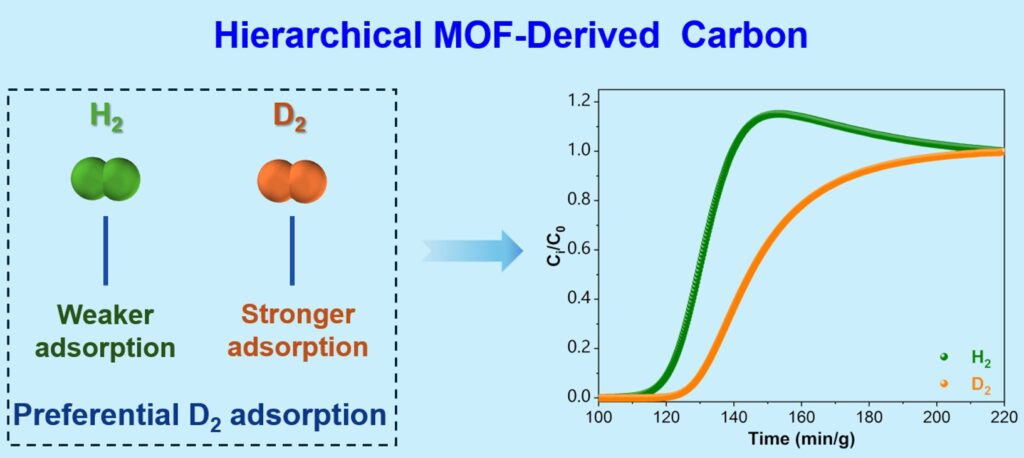
That structural optimum was reflected in isotope adsorption and at 77 K, bio-MOF-C1000 adsorbed way more D2 and H2 than the parent MOF, with increases of about 57% and 51%, respectively. D2 uptake remained consistently higher than H2 uptake, consistent with equilibrium adsorption differences associated with zero-point energy in confined pores. The adsorption isotherms were reversible with negligible hysteresis, indicating little evidence of pronounced diffusion limitation under the measured equilibrium conditions. Bio-MOF-C1000 also exhibited stronger D2 adsorption affinity than bio-MOF-1, supporting enhanced adsorbate–framework interactions after carbonization.
The team conducted equilibrium calculations and observed improved D2/H2 selectivity after carbonization. More importantly, this improvement persisted under flowing-gas conditions. Dynamic breakthrough measurements showed earlier H2 elution and delayed D2 elution, with bio-MOF-C1000 providing higher adsorption capacities, a longer separation time and a greater separation factor than the parent framework. At the higher measurement temperature, where adsorption became weaker, the carbonized material still retained substantially better separation performance than bio-MOF-1.
The authors found adsorption rates for both isotopes were higher in bio-MOF-C1000, consistent with reduced transport limitation after formation of the hierarchical pore system. The authors interpret the micropores as the principal confinement environments supporting isotope-dependent adsorption, with mesopores improving access and molecular transport. H2 remained kinetically faster than D2, indicating that strong kinetic quantum sieving was not the dominant origin of separation under these conditions. Three consecutive breakthrough cycles also produced no noticeable loss of separation performance.
The authors findings can help design adsorbent beds for hydrogen isotope separation. Bio-MOF-C1000 combines strong adsorption with better molecular transport through its hierarchical pores and the impressive performance also supports its use in regenerable adsorption systems. The temperature dependence of the carbonization process also provides a practical materials-processing guideline. The best-performing carbon was obtained at 1000 °C, where pore generation, Zn removal, defect formation and retention of useful microporosity produced a favorable balance between adsorption affinity and pore accessibility. This temperature dependence provides a practical processing parameter for tuning adsorbent performance. Increasing the carbonization temperature does not produce a continuous improvement in pore properties; the pore architecture instead depends on balancing confinement with structural reorganization at higher temperature. The retention of separation performance at 87 K is also relevant to cryogenic adsorption systems, indicating that the advantages of the hierarchical carbon persist across the two operating temperatures examined. The new study provides a way to design porous carbons with different pore sizes that support both adsorption and molecular transport. The stable performance over repeated cycles also supports the use of these MOF-derived carbons in regenerable separation systems.


Reference
Jiyu Zhu, Xinlu He, Zhu Zhuo, Wenjing Wang, Daqiang Yuan; MOF-derived hierarchical nanoporous carbons for improved hydrogen isotope separation. Dalton Trans. 2026; 55 (16): 6523–6529. https://doi.org/10.1039/d6dt00516k
Go to Dalton Trans