Advances in Engineering Advances in Engineering features breaking research judged by Advances in Engineering advisory team to be of key importance in the Engineering field. Papers are selected from over 10,000 published each week from most peer reviewed journals.

Significance
Soft robotic actuators must combine large reversible deformation with rapid response, mechanical durability, and remote control. Magnetic stimulation is particularly attractive for microscale systems because it can produce wireless motion without physical connections to the actuator. Many magnetic soft actuators are based on polymeric or elastomeric matrices containing magnetic particles, but obtaining sufficient magnetic response often requires substantial filler loading or relatively thick structures. These material and geometric requirements can affect flexibility, mechanical stability, and repeated operation, making the simultaneous realization of compact dimensions, fast actuation, and durable motion an important design challenge.
Bioinspired geometries provide another way to address this problem because structural form can contribute directly to motion. The coiled proboscis of a butterfly is a useful example: a long structure can be stored in a compact configuration and subsequently extended through controlled uncoiling. Rolled and spiral actuators inspired by this behavior have already demonstrated reversible deployment using thermal, optical, dielectric, and other stimuli. For microscale robotic systems, however, an actuator architecture that combines this compact geometry with magnetic responsiveness and mechanically driven recovery is particularly attractive.
Vanadium pentoxide nanofiber films provide a suitable basis for such an architecture. Their aligned nanofibers self-assemble into thin, layered structures held together through hydrogen-bond-mediated interactions. Despite their ceramic composition, these films retain flexibility at micrometer thickness and possess relatively high stiffness. Their nanofibrous structure also allows functional particles to be incorporated without destroying the continuity of the layered matrix. Introducing Fe3O4 nanoparticles into this structure adds magnetic responsiveness, creating a hybrid material in which the inorganic nanofiber network provides mechanical support and the dispersed magnetic phase interacts with an external field.
Dr. Semi Kim, Dr. Shravan Kousik, Dr. Petia Atanasova, Professor Eberhard Goering, Professor Joachim Bill and Dr. Zaklina Burghard from the Institute for Materials Science at University of Stuttgart in Germany developed magnetically responsive microscroll actuators from aligned V2O5 nanofiber films containing 8.6–11 wt% Fe3O4 nanoparticles. A razor blade-assisted process converts the free-standing hybrid films into tunable multilamellar coils that store elastic strain during formation. Their distinct feature is a dual magneto-mechanical operating principle in which field-induced magnetic torque initiates and directs unrolling, and stored bending energy drives cascade propagation and rapid recoil. The same architecture supports multidirectional opening, compact-to-expanded motion, load lifting, repeated cycling, and simple switching functions. The new research is now published in Advanced Materials.
The researchers produced free-standing hybrid films by incorporating a modest amount of Fe3O4 nanoparticles into aligned V2O5 nanofibers. Microscopy showed that the magnetic particles were distributed throughout the layered matrix, including the spaces between adjacent lamellae, without disturbing the continuity of the nanofiber structure. Mechanical testing showed that the hybrid films largely retained the stiffness of the original V2O5 film, accompanied by higher tensile strength and substantially greater toughness. The layered nanofiber matrix remained the main load-bearing structure, and the embedded particles contributed to crack deflection, interlamellar sliding, and interfacial energy dissipation. This combination allows the material to retain a coherent ceramic architecture during repeated bending and scrolling.
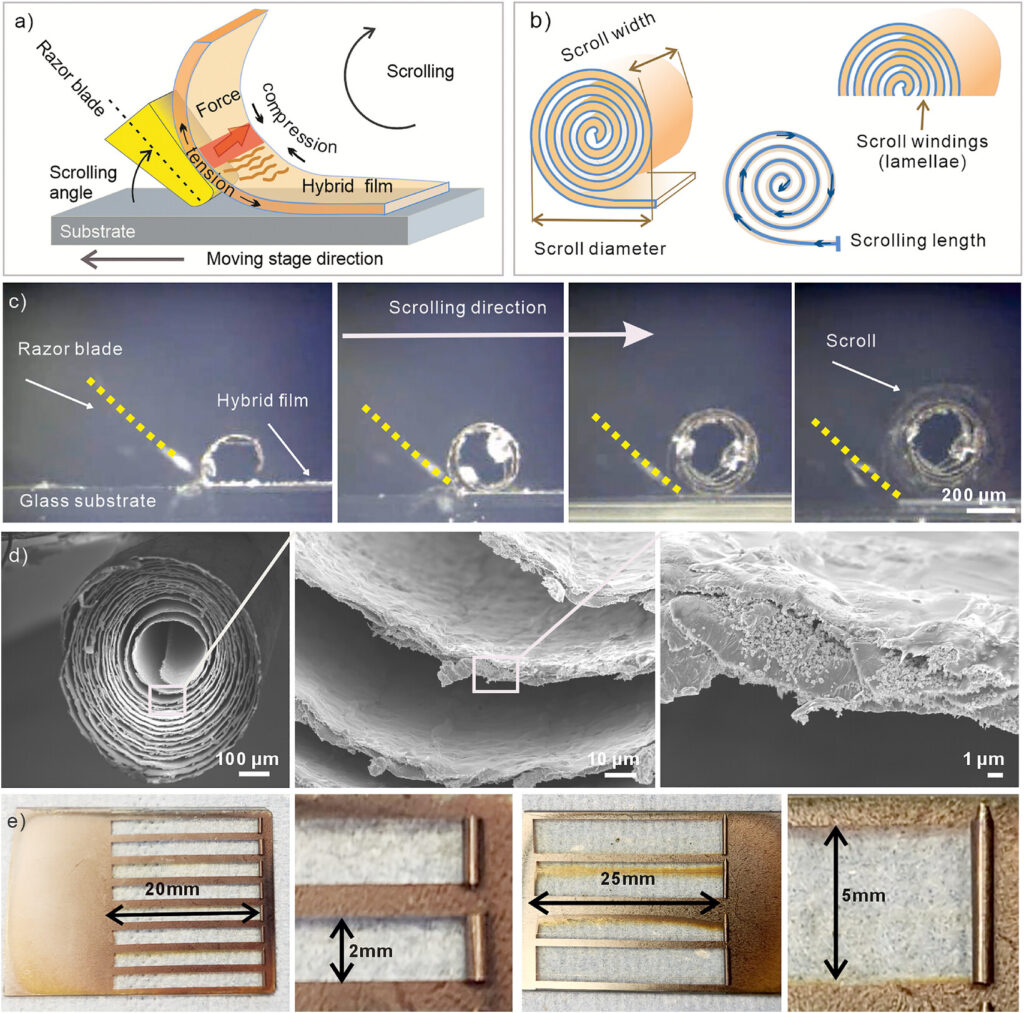
The planar films were converted into cylindrical microscrolls using a razor blade-assisted process. Changing the scrolling length allowed the researchers to control scroll diameter, compactness, and the number of windings. Narrow scrolls produced the most reproducible response under the permanent magnet used in the experiments. When the magnet approached, the scrolls opened rapidly and could be directed across a broad angular range within their natural curvature plane. The response depended on the relationship between scroll geometry and field orientation, showing that curvature, lamellar packing, magnetic loading, and stored elastic strain collectively determine how the actuator opens.
The actuation mechanism became clearer by combining magnetic measurements, mechanical opening tests, optical observations, and analytical modeling. The embedded Fe3O4 nanoparticles developed field-induced magnetic moments that generated torque on the outer lamellae, initiating their release and directing the unrolling motion. Mechanical measurements showed that this magnetic torque was sufficient to trigger local opening but was smaller than the restoring contribution stored across the complete multilamellar scroll. The scrolling process had already placed the structure in a mechanically pre-stressed state, leaving elastic bending energy available for subsequent motion. Once the magnetic field initiated release, that stored energy helped propagate unrolling through the lamellae and drove the rapid recoil that returned the actuator to its coiled state. Magnetic input therefore acts mainly as the trigger and directional control, with the pre-stressed geometry supplying much of the mechanical response.
Performance testing showed that the rolled geometry greatly reduced the actuator footprint yet still allowed large deployment during opening. Unrolling occurred rapidly, followed by an even faster elastic recoil after removal of the magnetic field. The microscrolls continued to open reversibly after thousands of actuation cycles, with the compact inner structure remaining intact as the outer lamellae gradually accommodated repeated movement. The actuators could also lift objects many times their own mass and perform measurable mechanical work. Simple demonstrations of object lifting and reversible electrical switching confirmed that the same magneto-mechanical principle can be used for practical microscale motion and mechanical interaction.
The scientific value of the microscroll is not only that a ceramic-based film can move under a magnet. More consequential is the way the architecture divides actuation across two energy sources with distinct functions. The Fe3O4 phase provides a field-responsive trigger and directional control, and the mechanically pre-stressed scroll stores elastic energy introduced during fabrication. Because these contributions act at different stages, a modest magnetic input can release motion from a structure whose full mechanical response is larger than the magnetic trigger alone would imply. The reported apparent magneto-mechanical amplification factor of about 5.6 captures that leverage without describing it as thermodynamic efficiency; part of the delivered work originates from elastic energy stored during scroll formation.
That mechanism changes the design logic for magnetic microactuators. Magnetic material content, field strength, and magnetic anisotropy are not the only variables that determine motion. Curvature, internal radius, winding number, lamellar packing, residual strain, and field orientation become active design parameters because they control when an outer layer releases and how unrolling propagates through the scroll. The actuator can be programmed through fabrication geometry as well as material composition. The authors’ torque comparison gives this idea quantitative substance: the field-induced torque is sufficient to unlock local motion, and the multilamellar body supplies a larger stored mechanical contribution. This is a useful shift in emphasis for nanostructured actuators because mechanical history becomes part of the actuation mechanism rather than simply a consequence of fabrication.
The geometry also connects compact storage with large deployable motion. A thin planar strip can be packed into a submillimeter-scale coil, then extend over a distance many times its rolled diameter with small intrinsic material strain. That distinction between geometric expansion and material strain helps explain why large motion and repeated cycling can coexist in the same device. The measured recoil time, load lifting, work density, and cycling behavior show that the architecture is not restricted to visual deformation; it can perform mechanical work and operate as part of simple microsystem functions. The demonstrated switching and lifting examples are modest in complexity, but they directly establish that the scroll can couple to passive components and transfer motion outside its own body.
The authors place the concept within a larger class of compact, remotely addressable actuator systems. Because the scrolls can be fabricated in parallel with comb-like blades and because dimensions can be varied across an array, geometry-programmed actuation patterns become plausible within the demonstrated fabrication logic. The same V2O5 / Fe3O4 material also supported strip-type gripping behavior, so the underlying hybrid film is not tied to one shape. Applications discussed by the authors include microscale gripping, remotely triggered switches, adaptive robotic components, reconfigurable arrays, and lab-on-a-chip or microrobotic manipulation. The strongest implication is methodological: a high-modulus nanostructured film can participate in soft robotic motion when its geometry is designed to store, release, and recover elastic energy in concert with a remote magnetic trigger.


Reference
Kim, Semi & Kousik, Shravan & Atanasova, Petia & Goering, Eberhard & Bill, Joachim & Burghard, Zaklina. (2026). Mechanically Assisted Magnetic Actuation in Ceramic‐Based Microscrolls for Fast and Durable Soft Robotic Systems. Advanced Materials. 38. 10.1002/adma.74544.