 Advances in Engineering Advances in Engineering features breaking research judged by Advances in Engineering advisory team to be of key importance in the Engineering field. Papers are selected from over 10,000 published each week from most peer reviewed journals.

Significance
Excavating tunnels through hard rock presents major challenges for tunnel boring machines (TBMs). These machines use rotating disc cutters to penetrate and fracture the rock. In very strong formations, cutting requires high forces and causes severe cutter wear and replacing worn or damaged cutters interrupts excavation, increases maintenance costs, and reduces tunneling efficiency.
One possible solution is to weaken the rock through heating before mechanical cutting. Granite contains minerals such as quartz, feldspar, and biotite, which differ in their thermal and mechanical properties and when heated, these minerals expand by different amounts, generate internal stresses that can produce cracks within individual grains or along their boundaries. The extent of damage depends on mineral strength, stiffness, and grain geometry. Cooling can cause further cracking, which makes the granite easier to break.
Selecting an effective heating strategy is critical because higher temperatures cause greater weakness, but heating requires energy and time, and the amount of new damage may eventually decline. Repeated heating and cooling raises a similar question: how many cycles are useful before further treatment produces little additional benefit? Answering these questions require us to understand how thermal cracks develop and affect the mechanical strength of granite.
In a recent research paper published in Rock Mechanics and Rock Engineering, Dr. Jie Li, Dr. Pengchuxuan Xu, and Professor Yalong Jiang from East China Jiaotong University, together with Dr. Helin Fu from Central South University, investigated the response of granite to heating and cooling. Their research focused on the Gangdese orogenic belt, where a deep tunnel project encounters granite with a compressive strength of approximately 200 MPa.
The researchers heated cylindrical granite specimens to temperatures ranging from 300°C to 800°C, cooled them with water, and measured their compressive strength. Untreated specimens were tested for comparison. They found that the granite became weaker as the treatment temperature increased. Its failure behavior changed from mainly splitting in untreated specimens to more extensive fragmentation and shear failure after exposure to higher temperatures. This is relevant to tunnel boring machines, whose disc cutters break rock through penetration and shearing.
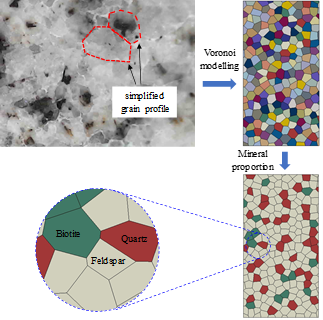
To examine the internal damage responsible for these changes, the team built a grain-based numerical model using the finite-discrete element method. The model represented the mineral structure of granite and simulated cracking both inside individual grains and at their interfaces.
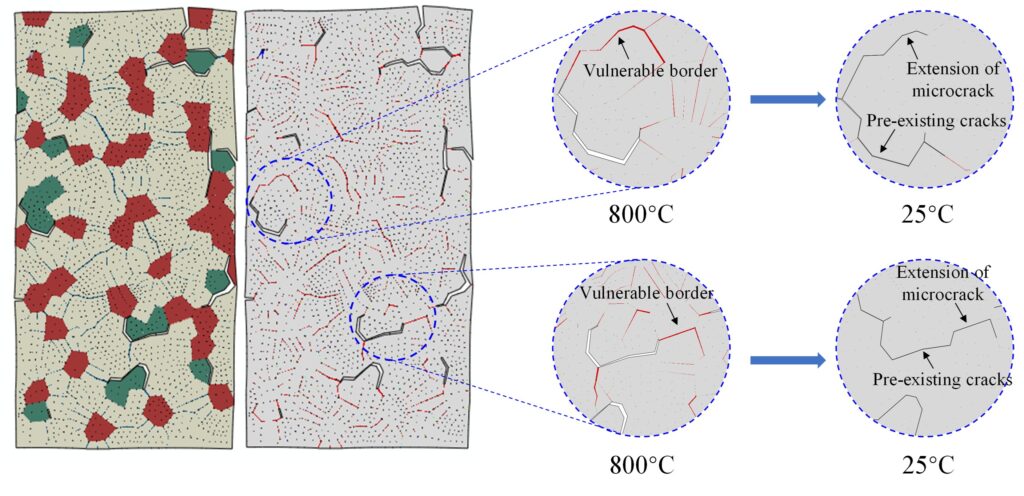
Their simulations indicated that cracks within mineral grains developed mainly in feldspar. This mineral accounted for approximately 76% of the investigated granite, making it a major contributor to the observed damage. Its relatively low strength compared with quartz made it more susceptible to internal fracture. Extensive damage occurred along boundaries between different minerals, where differences in thermal expansion and elastic properties generated stresses capable of breaking the bonds between grains.
To understand these boundary stresses, the authors developed simplified models of interacting quartz and feldspar grains. Differences in their expansion produced shear stresses along the shared contact surface, with the highest values occurring near its edges. These locations were therefore more susceptible to crack initiation.
Grain geometry influenced the stress distribution. Increasing the relative length of the feldspar grain in the shear direction raised the maximum interface stress, although the increase became smaller as the length ratio increased. This showed how the size of neighboring grains can affect cracking even when their material properties remain unchanged.
A separate mechanical analysis examined the compressive stresses generated when neighboring grains were constrained during thermal expansion. Under the investigated conditions, the calculated stress was higher in feldspar than in quartz, consistent with its greater susceptibility to internal cracking.
Cooling caused further damage. The simulations showed that some existing cracks extended and new fractures developed as the temperature decreased. The researchers associated this behavior with stress concentrations around previously weakened regions and temperature differences between the surface and interior of the cooling rock. However, most of the damage occurred during heating.
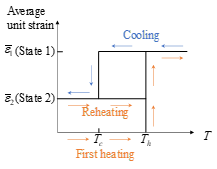
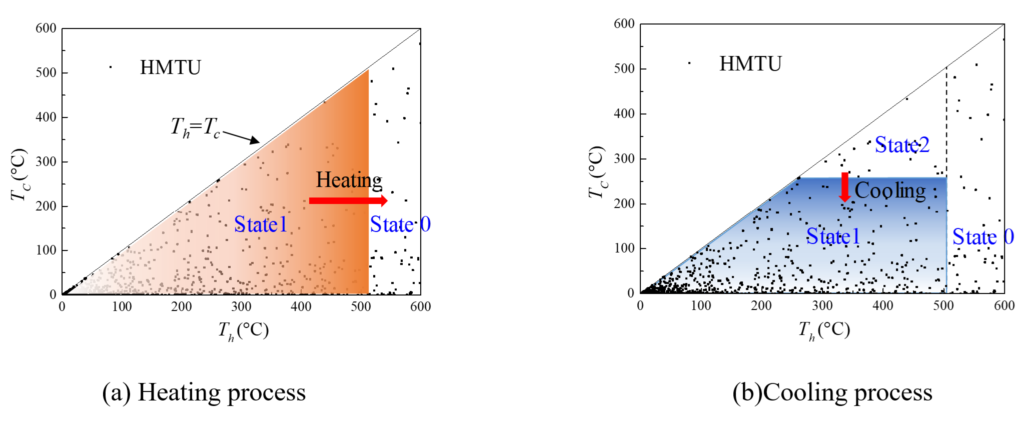
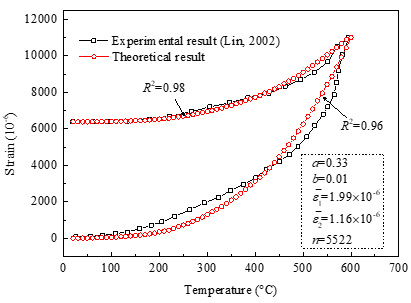
The team developed an improved thermal Preisach–Mayergoyz (PM) model to describe deformation during temperature changes. The model represents granite through numerous small thermal units that change state at particular temperature thresholds. It accounts for the fact that expansion during heating is not completely reversed during cooling, leaving residual deformation.
When they compared with published experimental measurements on Inada granite, they demonstrated that the model closely reproduced the observed strain, including the deformation remaining after the rock returned to its initial temperature. The researchers then examined how peak temperature influences damage. Measurements of compressive strength, elastic properties, and ultrasonic wave velocity showed that deterioration accelerated as the temperature approached 600°C. Beyond this point, further heating continued to weaken the granite, but damage accumulated more slowly.
They associated this change with the thermal behavior of quartz, including its phase transition near 573°C and changes in its expansion response. These properties may help explain why the rate of damage growth changes at higher temperatures. Based on the experimental findings, approximately 600°C was identified as a suitable temperature for weakening granite without excessive additional heating.
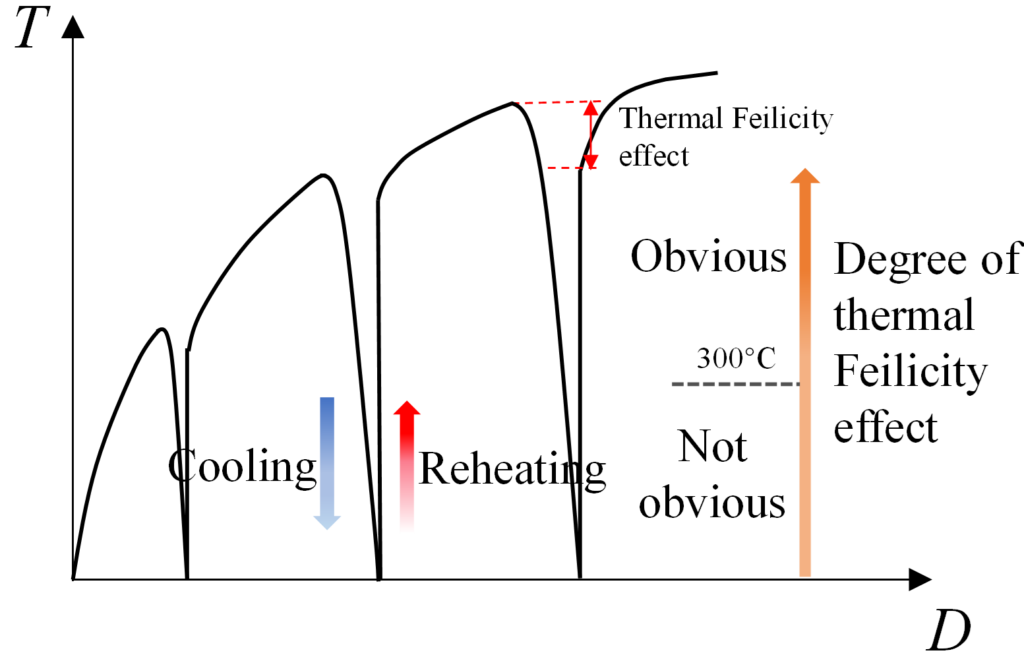
The next investigation concerned repeated treatment. Specimens initially heated to 600°C showed little additional weakening when reheated to much lower temperatures. Reheating closer to the previous maximum, however, produced greater strength loss. The researchers interpreted this behavior through the thermal felicity effect, in which new damage develops when the temperature approaches a level previously experienced by the rock. Finally, they studied repeated heating–cooling cycles at 600°C and noticed the first cycle caused extensive damage, with later cycles producing smaller increases. After six cycles, the rate of damage accumulation slowed markedly, indicating that further treatment would offer diminishing benefits.
The new study by Professor Yalong Jiang and colleagues clarifies how the properties and arrangement of mineral grains influence thermal cracking in granite. It distinguishes the factors controlling fractures within grains from those responsible for failure along their boundaries, providing a better understanding of how heating weakens the rock.
This study is beneficial to tunnel excavation, where thermal treatment could reduce the resistance encountered by mechanical cutters. The relationship between internal cracking, compressive strength, and failure behavior provides a basis for selecting heating conditions that assist rock breaking.
The findings offer guidance for balancing the degree of weakening against the energy and time required for treatment. Applying higher temperatures or additional cycles does not necessarily provide a corresponding increase in effectiveness. Choosing suitable conditions could therefore improve the practical value of thermally assisted excavation.
The mathematical PM model provides a means of estimating deformation and residual strain from temperature history. This could help assess the effects of different heating and cooling conditions without relying entirely on mechanical testing.
For comparable granite formations, the authors recommend peak temperatures around 600°C and no more than six heating–cooling cycles. The exact number should depend on rock-breaking effectiveness and economic considerations. These recommendations provide a basis for developing thermal treatment procedures for TBM excavation, with operating conditions requiring further evaluation during practical implementation.
Reference
Li, J., Xu, P., Jiang, Y. et al. Response of Hard Rock to Heating–Cooling Treatment and Optimal Temperature Scheme for Assisting Rock-Breaking. Rock Mech Rock Eng 59, 3959–3984 (2026). https://doi.org/10.1007/s00603-025-05034-1