 Advances in Engineering Advances in Engineering features breaking research judged by Advances in Engineering advisory team to be of key importance in the Engineering field. Papers are selected from over 10,000 published each week from most peer reviewed journals.

Significance
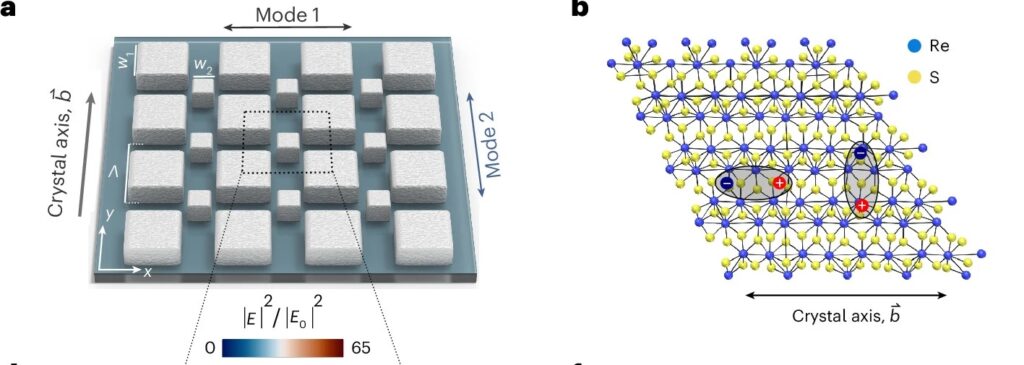
Rhenium disulfide (ReS₂) responds differently to light polarized along different directions of its crystal. This optical anisotropy comes from its distorted atomic structure and is also reflected in its excitons, the bound electron–hole states that interact strongly with light. These properties make ReS₂ interesting for controlling light at the nanoscale, especially when it is patterned into a metasurface: an ordered array of resonators smaller than the wavelength of light.
A major challenge in metasurface design is controlling how an optical mode’s energy changes with its in-plane momentum. Most modes have curved dispersion bands, meaning their energy varies with momentum. In a flatband, the energy changes very little over a range of momenta, greatly reducing the group velocity associated with propagation across the structure. Flatbands can also increase the number of available optical states at a given energy, making them attractive for strong light–matter interactions. Achieving this behaviour in modes that can be excited and observed from outside the structure, however, often requires carefully tuned arrangements of resonators or interactions between several optical modes.
Metasurfaces can support narrow optical resonances known as quasi-bound states in the continuum, or qBICs. They arise from modes that would otherwise be trapped without radiating, but become accessible to external light through a controlled structural perturbation. Their narrow spectral linewidths are useful for coupling light to excitons. In the symmetric design considered here, a square resonator array made from an optically isotropic material supports two modes with the same resonant frequency. In ReS₂, the crystal responds differently along its two in-plane optical axes, potentially separating these modes even though the patterned array retains its fourfold rotational geometry.
The researchers investigated how this mismatch between geometric symmetry and material anisotropy changes the resonances, their polarization patterns and their dispersion. They combined theoretical modelling with measurements of patterned ReS₂ to determine whether the altered optical modes could form directional flatbands and whether these states could couple to the material’s excitons.
The team began with a square array of nanoscale resonators, introducing a controlled change in resonator dimensions that made two normally non-radiating modes optically accessible. The resonator pattern retained its fourfold rotational shape, and the array was aligned with a known crystallographic axis of ReS₂. This alignment mattered because the two orthogonally polarized resonances encountered different optical responses from the crystal.
To isolate that effect, the researchers first modelled the structure without excitonic contributions. When the material was treated as optically isotropic, the two resonances coincided in frequency. Introducing the in-plane anisotropy of ReS₂ separated them: one shifted toward longer wavelengths and the other toward shorter wavelengths. The separation increased in proportion to the difference between the two in-plane dielectric responses. An analytical treatment based on resonant-state expansion reproduced the behaviour obtained from full electromagnetic simulations, linking the spectral splitting directly to the crystal’s anisotropy.
The more unusual change appeared in the modes’ momentum-dependent polarization. In the isotropic model, each mode had an integer-valued polarization winding centred at zero in-plane momentum. With anisotropy, that winding separated into two displaced singularities carrying half-integer topological charges. These points coincided with crossings of the optical bands, known as Dirac points. At the same time, the bands became strongly direction dependent: a mode could be nearly flat along one momentum direction but remain curved along the perpendicular direction. The analysis connected the changes in polarization topology to the formation of these directional flatband branches.
The team then fabricated the resonator arrays directly from ReS₂ crystals on a silica substrate. By measuring transmitted light as a function of wavelength, angle and polarization, they mapped the optical modes across momentum space. With incident light polarized along the crystal axis, one direction showed a nearly flat dispersion and the perpendicular direction showed a pronounced curvature. Rotating the excitation polarization by 90 degrees reversed which direction was flat. Analysis of the measured bands showed that their curvature was suppressed by more than a factor of 100 relative to the curved branches. The flat behaviour extended across more than 90% of the accessible momentum range, rather than appearing only near a single point.
Polarization-resolved measurements provided a separate test of the proposed topological change. The team observed crossings between the optical branches and reconstructed how the far-field polarization direction changed around them. The polarization followed a half-integer winding around the singularities, matching the predictions of the analytical model and confirming the fractional topological charges associated with the Dirac points.
The final question was whether these engineered photonic states could remain directionally flat after coupling to excitons. By adjusting the resonator dimensions, the team brought the two optical modes into resonance with the nearly orthogonally polarized excitonic transitions of ReS₂. The resulting spectra showed distinct upper and lower exciton–polariton branches, indicating that the light and excitonic states had hybridized. Fits to the measurements gave Rabi splittings of 110 and 108 meV for the two polarizations, with the measured linewidths supporting strong coupling rather than a simple overlap of resonances. Momentum-resolved measurements showed that the polariton branches retained the flat or curved dispersion of the underlying photonic modes, depending on propagation direction. The excitonic and photonic contributions also remained nearly constant along the flat direction.
The researchers fabricated and characterized a ReS₂ metasurface that supports far-field-accessible, polarization-selective photonic and exciton–polariton flatbands. They also established an analytical description connecting the crystal’s in-plane optical anisotropy to half-integer polarization singularities, Dirac points and direction-dependent optical dispersion.
The authors identifies material anisotropy as a direct means of controlling the topology and directional dispersion of resonant optical modes. The resonator lattice keeps its square geometry, but the crystal’s different responses along two axes remove the optical degeneracy that the geometry would otherwise impose. This gives material selection and crystal orientation a role in band design that does not depend solely on changing the shape or arrangement of the resonators.
The flatbands in this system are directional, not flat in every in-plane direction. That distinction is useful: the same metasurface supports strongly reduced dispersion along one direction and ordinary curved dispersion along the other, with the response selected by light polarization. Because the qBIC modes remain accessible in the far field, the effect can be examined and potentially used with external optical excitation. The broad momentum range over which the bands remain flat is also relevant to optical processes that involve a range of incident or emitted angles.
A further consequence comes from forming the resonators from the excitonic material itself. The optical resonances and excitons occupy the same patterned structure, enabling strong coupling without a separate active layer. The resulting mixed states carry the directional behaviour into the polaritonic regime. The authors identify polarization-selective polariton lasing and slow-light-enhanced nonlinear emission as possible applications, although neither device function was demonstrated in this work.



Reference
Heimig, C., Weber, T., Cruciano, C. et al. Topological control of polaritonic flatbands in anisotropic van der Waals metasurfaces. Nature Materials (2026). https://doi.org/10.1038/s41563-026-02776-3
Go to Nature Materials