 Advances in Engineering Advances in Engineering features breaking research judged by Advances in Engineering advisory team to be of key importance in the Engineering field. Papers are selected from over 10,000 published each week from most peer reviewed journals.

Significance
RV reducers play an important role in industrial robots by transmitting motion with high precision and reliability. They contain several mechanical components, including rolling bearings that can be susceptible to damage from repeated loading and wear. Early detection of bearing faults can help maintain the performance of robotic systems and avert unexpected equipment failures. However, identifying these faults from vibration measurements remains challenging because of the highly complex internal structure of RV reducers.
RV reducers combine planetary and cycloidal-pin gear transmissions and can produce vibrations from several interacting sources. When a bearing develops a defect, the damaged surface generates brief vibration impulses as the rolling elements pass over it. These impulses then travel through multiple mechanical components before reaching an external sensor, attenuating considerably along the way. Strong vibrations from normal gear meshing and other operating processes can easily mask these weak fault signals.
Changes in rotational speed make diagnosis even more difficult and a model trained to recognize faults at one speed may become less accurate when the machine operates at another because the measured vibration patterns change even when the bearing condition remains the same. This problem, known as domain shift, makes it harder to distinguish actual damage from changes caused by normal operation.
Machine learning methods can address this challenge through domain adaptation, which uses labeled measurements from known operating conditions to improve diagnosis under new conditions where fault labels are unavailable. However, differences between the datasets can cause unrelated fault patterns to be incorrectly matched. The problem can become worse when unreliable predictions are used as labels for further training. Many advanced methods also require substantial computing resources, making them difficult to use on compact industrial monitoring devices.
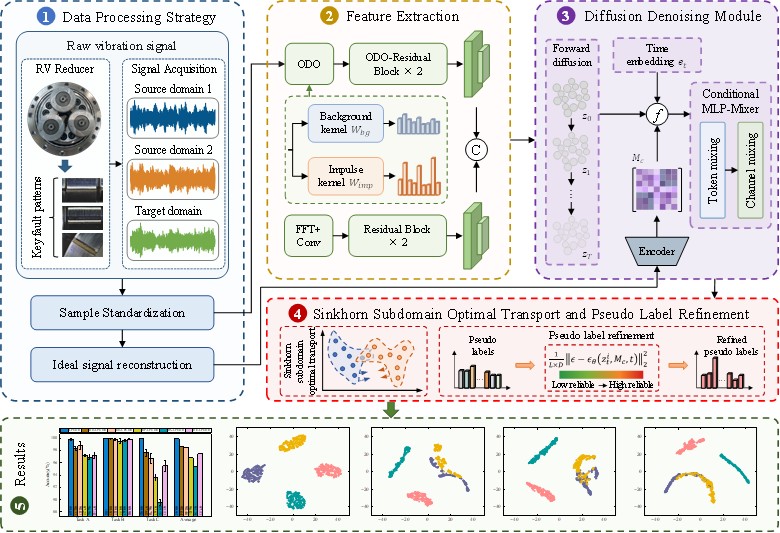
In a recent research paper published in Mechanical Systems and Signal Processing, Linlin Xue, Kun Wang, Yukun Huang, Wanyang Zhang and Professor Huageng Luo from Xiamen University developed a lightweight method called LPGDR for detecting bearing faults in RV reducers under different operating conditions. LPGDR combines knowledge of bearing vibrations with artificial intelligence to identify weak fault signals, reduce background interference, and recognize the same faults at different operating speeds. The researchers tested their method using an experimental RV reducer with three types of bearing damage affecting the crankshaft and support bearings. They trained the model using labeled vibration measurements collected at two rotational speeds and then adapted it using unlabeled measurements at a third speed to evaluate its ability to recognize faults under unseen operating conditions.
To make the vibration measurements easier to compare, the researchers developed a method for selecting signal samples based on prominent vibration peaks. Unlike conventional methods that divide recordings into fixed segments, their approach uses the peaks as reference points to locate fault-related impulses. The signals are also adjusted for differences in rotational speed so that these impulses appear at similar positions across samples. During training, the researchers randomly removed portions of the signals in both time and frequency domains to make the model recognize fault patterns without relying too heavily on specific features.
The method includes an orthogonal decoupling operator which is designed to distinguish background vibrations from weak fault impulses. Conventional neural networks can focus too heavily on strong periodic vibrations because these dominate the recorded signals. To address this, the authors used two groups of filters with mathematical constraints that discourage them from learning overlapping information: one filter group captures the operating background, while the other concentrates on the impulses associated with bearing damage. Examination of the extracted features showed that the operator distinguishes relatively smooth background patterns from the repeated impulses produced by faults.
The extracted features are then processed using a diffusion-based denoising module, which learns to recover useful information from noisy data. The researchers guided this process using the characteristic vibration frequencies associated with bearing faults. These frequencies provide a physical reference for preserving fault-related information and reducing unwanted interference. To keep the model small, they used a compact neural network called a multilayer perceptron mixer instead of a larger conventional diffusion network.
Afterward, the investigators matched the fault patterns collected under different operating conditions and to do this, they used a technique called Sinkhorn subdomain optimal transport, which compares vibration features based on their similarities and predicted fault types. This helps prevent different faults from being incorrectly grouped together when rotational speed changes. They also designed a method for checking the reliability of predicted labels assigned to unlabeled measurements. By measuring the reconstruction error produced during diffusion denoising, the model identifies less reliable samples and excludes them from further training.
The complete method achieved an average diagnostic accuracy of 99.95% across the three tests which is impressive. In the most difficult test, the five comparison methods achieved approximately 87–89% accuracy, whereas LPGDR maintained nearly perfect fault recognition. Visual analysis of the extracted features also showed four clearly separated groups corresponding to normal operation and the three bearing faults.
To determine how much each component contributed to the performance, the researchers repeated the experiments after removing individual parts of the method. Without the technique used to match fault patterns across operating conditions, accuracy in the most difficult test fell to about 90%. Removing the mechanism that checks predicted labels reduced accuracy to about 94%. These comparisons demonstrated that both components contributed to maintaining reliable fault recognition when operating conditions changed. The model contained approximately 430,000 parameters, about 75% fewer than one of the larger comparison models. This reduction is relevant for industrial monitoring systems with limited computing resources, where large neural networks can be difficult to operate efficiently.
The Xiamen University researchers demonstrate how physical knowledge of bearing vibrations can be integrated into machine learning to improve fault diagnosis. Their method uses diffusion reconstruction to reduce background interference and assess the reliability of unlabeled training samples and this is important because a model can sometimes assign high confidence to an incorrect prediction. The method by Professor Huageng Luo and colleagues successfully reduced the risk of incorrect predictions affecting further training by using reconstruction error to identify less reliable samples.
Vibration signals collected under different operating conditions can have similar patterns even when they come from different bearing faults, which makes it difficult to identify the correct type of damage. But by examining both the vibration patterns and their predicted fault types, the proposed method helps in distinguishing between different bearing faults more accurately. The experiments demonstrated accurate and stable fault diagnosis across the tested rotational speeds and bearing conditions. Combined with its relatively small model size, this performance supports the potential use of LPGDR in compact industrial monitoring systems that require reliable diagnosis with limited computing resources.


Reference
Linlin Xue, Kun Wang, Yukun Huang, Wanyang Zhang, Huageng Luo, Edge-deployable pseudo-supervised fault diagnosis for RV reducers: a lightweight method based on physical prior guidance and diffusion reconstruction, Mechanical Systems and Signal Processing, Volume 260, 2026, 114924,