 Advances in Engineering Advances in Engineering features breaking research judged by Advances in Engineering advisory team to be of key importance in the Engineering field. Papers are selected from over 10,000 published each week from most peer reviewed journals.

Significance
Acoustic measurements inside a borehole can help identify fractures, cavities, and other structures in the surrounding rock. A logging tool sends acoustic waves into the borehole and records the signals that return. Most of the wave energy travels along the borehole as guided waves, but a small portion reaches geological boundaries and is reflected back and these reflections provide information about structures in the surrounding rock, although they are too weak to be detected.
The main difficulty is that strong guided waves can overlap with weak reflections in both time and frequency which make them difficult to separate. If too little guided-wave energy is removed, the remaining interference can be mistaken for geological features. Removing too much can also eliminate some of the reflections needed for imaging and this makes it difficult to recover weak reflections accurately without losing important information.
Acoustic measurements collected at different positions along a borehole can help distinguish guided waves from reflections. Guided waves follow the borehole and show relatively little change in arrival time across these recordings. Reflections from surrounding structures travel along different paths, so their arrival times change with the measurement position. This variation, known as moveout, gives the two types of waves different patterns across a sensor array, even when their individual signals overlap.
Methods such as frequency–wavenumber filtering and multichannel singular-spectrum analysis use differences between wave components to separate them. However, strong guided waves can leave residual interference, especially in recordings with limited spatial coverage or reduced wave coherence, conditions that results in spectrum leakage during the spatial-wavenumber transform. Deep learning provides another way to recognize complex signal patterns, but supervised models require training examples in which the desired reflections and interfering waves are already separated. Such labeled recordings are difficult to obtain from field measurements.
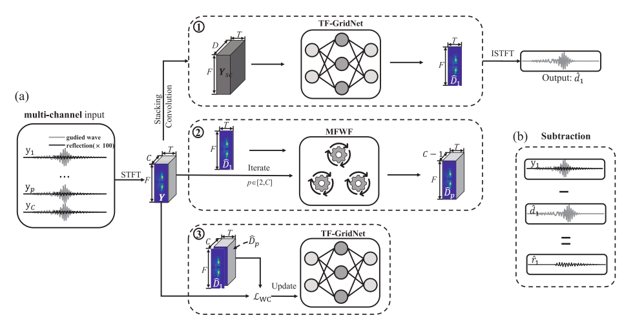
In a recent research paper published in Mechanical Systems and Signal Processing, Dr. Qiang Wang, Professor Hua Wang, Professor Zhilong Fang, and Mr. Qizhi Bi from the University of Electronic Science and Technology of China developed an unsupervised deep learning method to extract weak acoustic reflections from strong interfere of guided waves without requiring labeled training data. Their method combines a time–frequency neural network, TF-GridNet, with a multi-frame Wiener filter. The network first estimates the strong guided waves at one reference channel. The filter then uses information from neighboring time frames and other channels to estimate these waves across the sensor array. During training, differences in amplitude and phase between the estimated waves and the recorded signals are used to improve the network’s predictions. The estimated guided waves are then subtracted from the original recordings, leaving the weak reflections needed for geological imaging. The overall workflow is illustrated in Figure 1.
To evaluate the method, the researchers first used simulated borehole measurements in which the actual reflected signals were known. They examined three geological models: an inclined reflecting interface, two fractures dipping in opposite directions, and a small cavity. In the inclined-interface model, the method recovered weak reflections with less residual error than frequency–wavenumber filtering and multichannel singular-spectrum analysis. In the two-fracture model, the residual error was 0.0083, compared with 0.0206 and 0.0378 for the two conventional methods, respectively. These findings demonstrate that the new method is effective in removing unwanted guided-wave energy and recovering weak reflections with less distortion.
The cavity model provided a different test because its reflections followed curved patterns across the recorded data. All three methods recovered these reflections, but the unsupervised method produced the lowest residual error. Separation was more difficult where the reflection patterns resembled those of the guided waves. Further analysis of the simulated recordings showed that the method suppressed much of the guided-wave interference and preserved reflected energy associated with the surrounding geological structures.
The researchers then examined field measurements from sandstone and carbonate formations to see whether better signal separation could produce clearer geological images. To do this, they compared the reflections recovered by their method with those obtained using conventional filtering and used the signals to image structures around the borehole. This helped them assess whether removing more unwanted wave energy also improved the visibility of geological features.
In sandstone, the method produced clearer images of high-angle fractures, with better continuity and fewer artifacts near the borehole. In another sandstone interval, it revealed a fracture network that was difficult to distinguish using conventional filtering. The improved visibility was associated with more effective removal of guided-wave interference, which had obscured parts of the geological reflections in the other methods.
The carbonate measurements provided a further test involving cave structures. Conventional filtering left considerable guided-wave energy in the extracted signals, making the cavities more difficult to image. The unsupervised method recovered clearer reflections and produced images with fewer misleading features near the borehole. Similar improvements were observed across the examined carbonate intervals, indicating that the method could recover useful geological information from recordings collected in different rock formations.
The researchers at the University of Electronic Science and Technology of China developed a new approach to train a neural network directly from acoustic recordings without requiring labeled examples of the signals they wanted to extract. By combining the network with a multi-frame Wiener filter, the researchers used the relationships between measurements at different channels to identify the dominant guided-wave component which makes it possible to separate signals that are difficult to distinguish from individual recordings.
The improvement is critical for geological imaging because residual guided waves can create misleading features near the borehole or interrupt the apparent continuity of fractures. Recovering cleaner reflections helps produce images that more clearly represent the surrounding structures. The field measurements also demonstrate the value of evaluating signal separation through the resulting geological images, in addition to examining the recorded waveforms.
The effectiveness of the method depends on how differently guided waves and reflections travel across the sensor array. When their patterns become similar, some reflected energy may be lost during separation. The method also requires repeated network training, which increases processing time. The research shows that multichannel acoustic measurements can help recover weak reflections without labeled training data. The method may also be useful in other guided-wave sensing applications, including structural health monitoring.

Reference
Qiang Wang, Hua Wang, Zhilong Fang, Qizhi Bi, An unsupervised deep learning method for extracting weak reflections from strong guided waves in array data, Mechanical Systems and Signal Processing, Volume 259, 2026, 114808, https://doi.org/10.1016/j.ymssp.2026.114808