 Advances in Engineering Advances in Engineering features breaking research judged by Advances in Engineering advisory team to be of key importance in the Engineering field. Papers are selected from over 10,000 published each week from most peer reviewed journals.

Significance
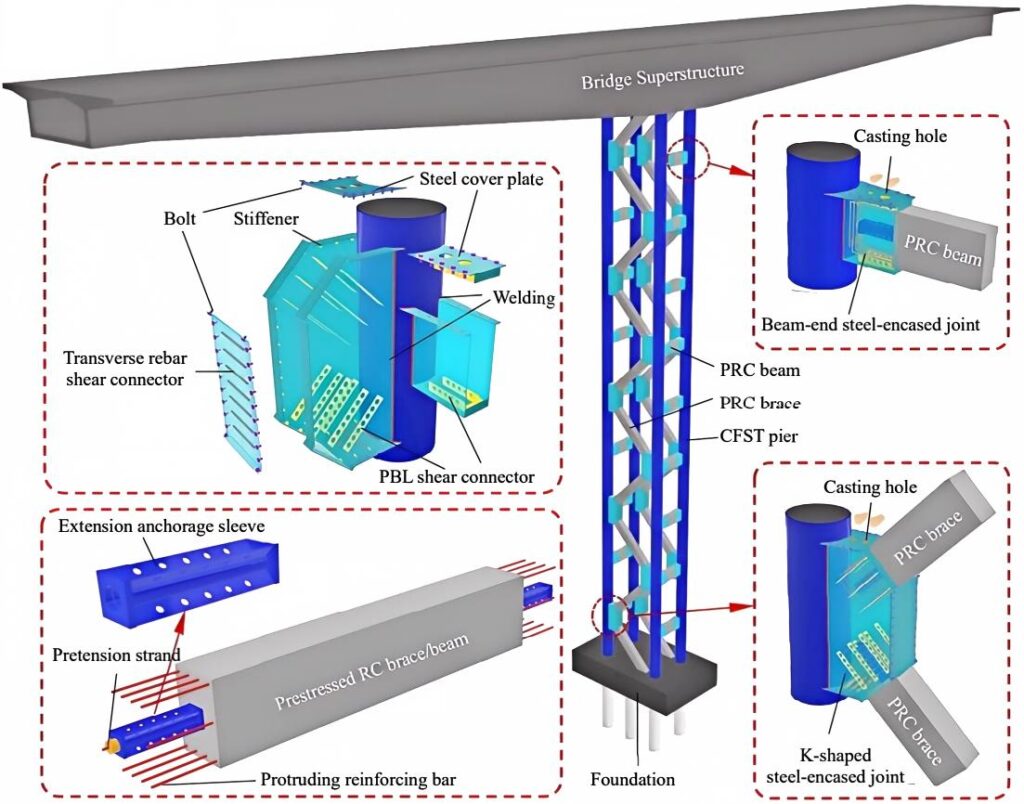
Tall bridge piers are commonly used in mountainous regions to cross deep valleys and uneven terrain. These structures must support heavy loads and withstand lateral forces, particularly during earthquakes. Concrete-filled steel tube (CFST) columns offer a combination of strength, stiffness, and ductility, and connecting them with braces can improve structural stability while reducing weight.
Conventional bracing systems usually use steel members or cast-in-place concrete but steel braces can require large amounts of steel and extensive welding, whereas cast-in-place concrete involves more work at the construction site. Prefabricated reinforced concrete braces can provide a good alternative because they can be manufactured in advance and assembled on-site. Prestressing also helps control cracking under tensile loading.
The challenge is connecting these prefabricated braces securely to the steel columns. During an earthquake, one diagonal brace may experience tension while another experiences compression. Compressive forces can be transferred through the concrete inside the joint, but resisting tension requires effective anchorage of the reinforcing bars and prestressing strands. The joint must also provide sufficient shear resistance and confinement to prevent the brace from pulling out.
In a recently published research paper in Engineering Structures, Professor Xuanding Wang, Mr. Shuai Zhang, and Professor Xuhong Zhou from Chongqing University, together with Professor Kwok-fai Chung from The Hong Kong Polytechnic University and Dr. Xiaohu Chen from T.Y. Lin International Engineering Consulting (China) Co., Ltd., developed a steel-encased beam-end (SEBE) K-shaped joint for connecting prefabricated prestressed reinforced concrete braces to CFST columns. The connection consists of a steel enclosure welded to the column, with reinforcing bars and prestressing strands from the brace extending into it. An extended anchorage sleeve secures the prestressing strands, and concrete and internal steel connectors help transfer forces to the surrounding steel structure. The researchers tested the connection under tensile loading to understand its failure mechanisms and identify ways to improve its performance.
To investigate the connection’s behavior, the team fabricated and tested ten half-joint specimens with different reinforcement ratios, numbers of prestressing strands, anchorage sleeve lengths, joint filling materials, and steel plate connections. Most specimens were subjected to repeated tensile loading to study how damage developed. The tests showed two main failure modes: in some specimens, the concrete brace pulled out of the steel enclosure, causing a rapid loss of strength and stiffness. In others, failure occurred in the brace itself, with the connection remaining intact and maintaining stable resistance and energy dissipation.
The reference specimen reached a peak tensile load of 638 kN before pull-out failure occurred. Cracks initially formed in the concrete brace as the load increased. Further loading caused damage within the joint, followed by buckling of the steel cover plate and separation of the brace.
A similar specimen tested under continuous tensile loading, rather than repeated loading and unloading, failed in the concrete brace without significant pull-out damage. This indicated that repeated loading caused damage to accumulate in the joint concrete, reducing its resistance to shear forces. Increasing the number of prestressing strands from one to two also had little effect on the peak load when failure occurred inside the joint. Both configurations reached similar loads because the surrounding concrete failed before the additional tensile strength of the strands could be fully used.
The anchorage sleeve length also influenced the failure mechanism. Shortening the sleeve reduced its anchorage capacity, causing more pronounced damage in the surrounding concrete and greater deformation of the steel cover plates. This showed why sufficient anchorage length is needed to maintain reliable force transfer.
The researchers then investigated two modifications with the intention to improve the connection. The first involved replacing conventional concrete inside the steel enclosure with steel fiber-reinforced grout. The modified specimen did not experience pull-out failure and reached a peak load of 906 kN. According to the authors, this improvement was due to the higher shear resistance of the grout and the ability of steel fibers to restrict crack development.
The second modification strengthened the connection between the steel cover plates and flange plates using additional plug welds. This reduced excessive deformation of the steel enclosure and helped it maintain confinement of the concrete. The strengthened specimens reached tensile loads of 924–926 kN, with failure occurring in the concrete brace rather than through separation at the joint.
A different result was observed in a specimen without the internal perforated steel plate connectors. Although some slip occurred between the steel and concrete, the specimen avoided the severe pull-out failure seen in the reference configuration. The researchers explained that the connectors had created a vulnerable region in the concrete of the scaled specimen. They also noted that this failure mechanism would be less likely in full-scale connections, where a larger volume of concrete would surround the connectors and reinforcement.
Measurements of cracking and deformation provided further information about the role of prestressing. The initial compression delayed cracking in the concrete braces and helped cracks close when the tensile load was removed. In specimens where the joint remained intact, this behavior continued even at relatively high loads. One specimen with steel fiber-reinforced grout retained about 80% crack closure after unloading from 880 kN. These specimens also developed smaller permanent displacements than those experiencing severe pull-out failure.
The research of Professor Xuanding Wang and colleagues can teach us how the different components of a steel-encased connection work together to resist tensile forces. The load passes from the reinforcing bars and prestressing strands into the surrounding concrete through anchorage and bearing, and then into the steel enclosure through internal shear connectors and flange plates. The enclosure also confines the concrete, and improved its resistance to shear damage. If the steel cover plates deform too much, they provide less support to the concrete, increasing the risk of the brace pulling out of the joint.
The findings demonstrated that increasing the strength of the concrete brace does not necessarily improve the performance of the entire connection. The anchorage system, filling material, and steel enclosure must also be strong enough to transfer the forces developed by the reinforcement. Sufficient anchorage length, suitable concrete or grout, and stiff steel cover plates are therefore needed to maintain reliable performance under repeated loading.
The research team also developed a theoretical expression for estimating tensile capacity based on the strength of the reinforcing bars and prestressing strands. The predictions agreed well with the experimental results for specimens that failed in the concrete brace. However, when the brace pulled out before the reinforcement reached its full strength, the joint itself limited the load-bearing capacity. This showed that accurate predictions depend on having a connection strong enough to prevent premature pull-out.
Professor Xuanding Wang told Advances in Engineering: “From an engineering application perspective, the proposed SEBE K-shaped joint provides an excellent solution for connecting prefabricated prestressed concrete members to steel or CFST columns. As the prestressed RC braces are fully prefabricated, they eliminate the need for on-site post-tensioning and large amounts of cast-in-place concrete, significantly improving construction efficiency and quality control. The connection is particularly suitable for high bridge piers in mountainous valleys and latticed CFST pier systems in seismic regions. It also has potential applications in other prefabricated steel–concrete composite structures.”
Reference
Xuanding Wang, Shuai Zhang, Kwok-fai Chung, Xiaohu Chen, Xuhong Zhou, Behavior of novel steel-encased beam-end (SEBE) joints for prefabricated prestressed RC braces under cyclic tension, Engineering Structures, Volume 362, 2026, 122990,