 Advances in Engineering Advances in Engineering features breaking research judged by Advances in Engineering advisory team to be of key importance in the Engineering field. Papers are selected from over 10,000 published each week from most peer reviewed journals.

Significance
Ductility—the ability to sustain substantial deformation before failure—is essential for concrete structures to dissipate energy and avoid brittle collapse under earthquakes, extreme winds, and impact loads. As primary load-bearing components, concrete columns must maintain their load-carrying capacity while deforming, making their ductility crucial to overall structural safety and resilience. However, concrete is inherently brittle, which limits its deformation capacity. Wrapping concrete columns with fiber-reinforced polymer (FRP) materials helps overcome this limitation by restraining lateral expansion during compression, enabling the concrete to sustain greater deformation before failure.
Conventional FRP materials, such as carbon and glass fiber composites, generally have relatively low rupture strains, limiting the deformation they can accommodate before failure. Large rupture strain FRP (LRS-FRP), including polyethylene terephthalate (PET) composites, can achieve tensile rupture strains approaching 10%, offering considerable potential to enhance the deformation capacity of concrete structures. However, their relatively low tensile stiffness means that substantial lateral expansion of the concrete is needed to mobilize effective confinement. Consequently, the compressive stress may initially decrease after reaching its first peak, then rise again as further expansion activates stronger confinement, producing a distinctive postpeak softening–recovery response.
Cross-sectional geometry also influences confinement efficiency and the resulting postpeak stress–strain behavior. Square columns experience nonuniform confinement and stress concentrations around their corners, whereas circular columns generally develop more uniform lateral restraint. Rounding the corners of square columns improves confinement efficiency and changes the extent of postpeak stress recovery. Together, the properties of the FRP jacket and the cross-sectional geometry govern the shape of the confined concrete’s stress–strain curve, particularly the extent of postpeak softening and subsequent stress recovery.
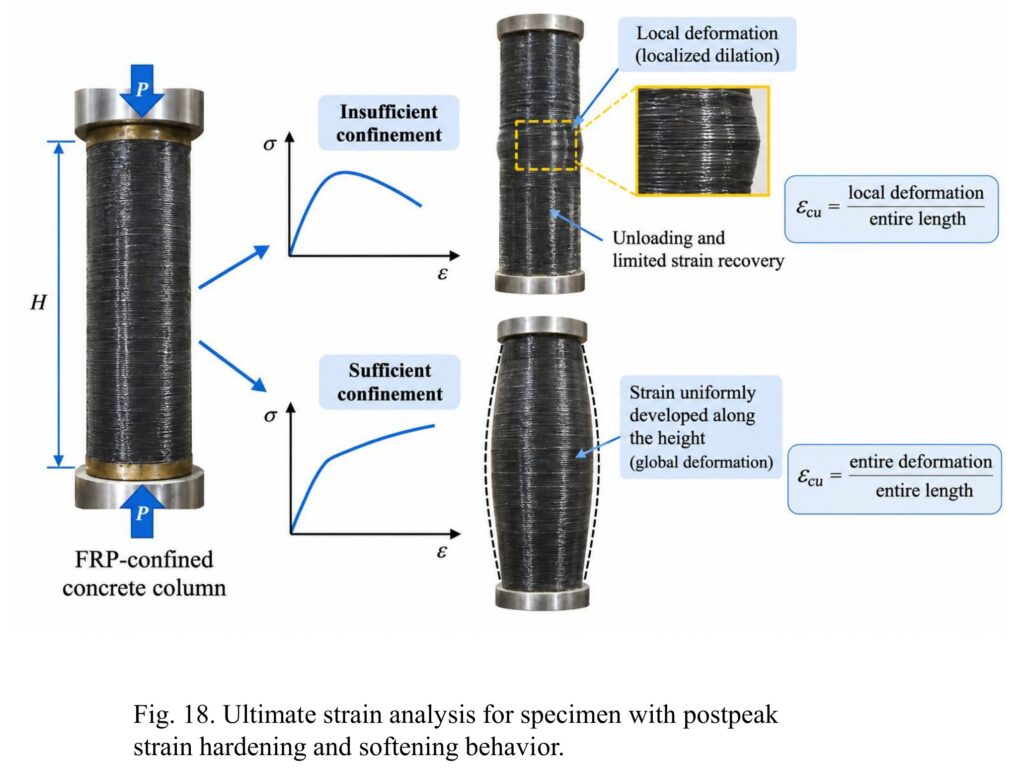
Predicting overall deformation capacity therefore requires understanding how these local stress–strain responses govern deformation along the column. When confinement is insufficient to restrain damage localization, deformation concentrates within a limited region, while other regions may unload. The deformation of this localized zone then dominates the overall shortening of the column. When confinement is sufficient to limit localization and restore load-bearing capacity, deformation can spread to additional regions and develop more uniformly along the column. These contrasting mechanisms require different treatments when calculating overall deformation from local stress–strain responses. Existing prediction models do not always adequately account for this distinction, particularly in longer columns.
In a recent research paper published in Journal of Composites for Construction, Associate Professor Peng-Da Li and postgraduate student Peng-Cheng Huang from Shenzhen University in China investigated how local stress–strain behavior govern the overall deformation of LRS-FRP-confined concrete columns. Their work combined axial compression tests with detailed strain measurements to identify distinct deformation mechanisms and develop an ultimate axial strain prediction model.
Experiments and Findings
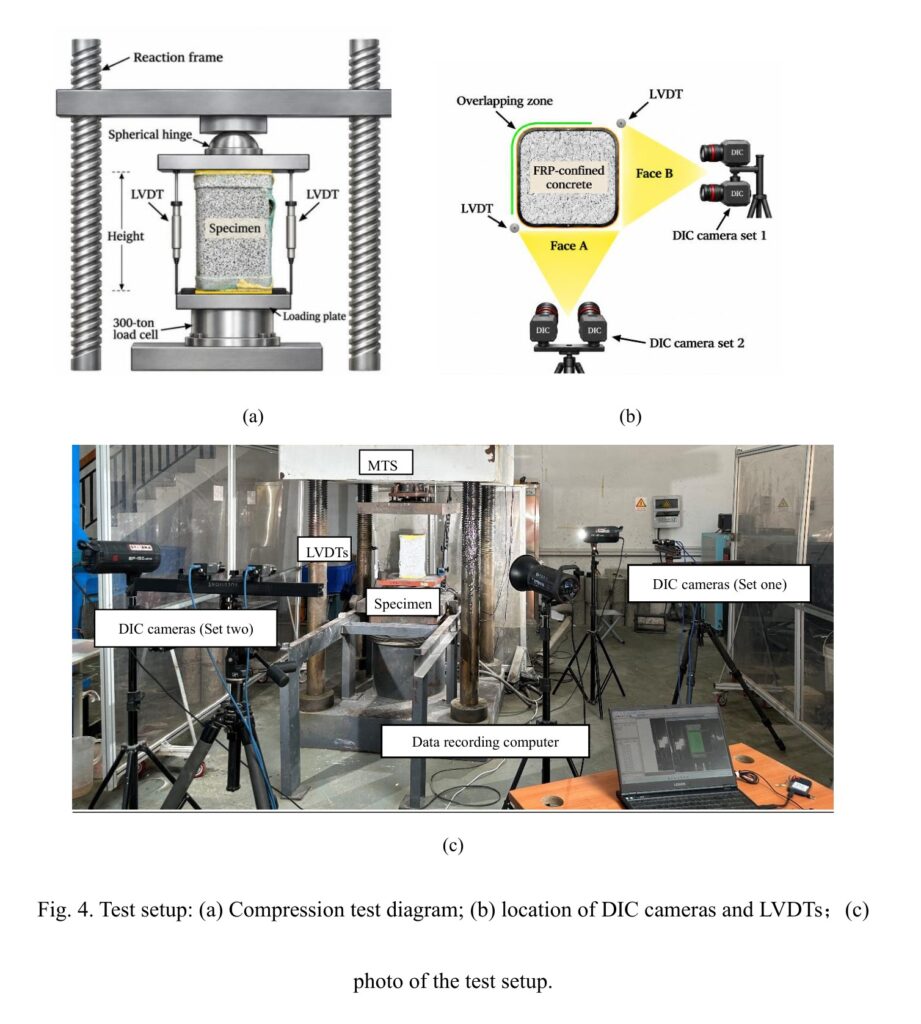
The researchers prepared 20 concrete specimens, including 18 confined with three layers of PET-FRP and two unconfined reference specimens. The confined specimens had a constant cross-sectional width or diameter of 150 mm, with corner radii ranging from 0 to 75 mm and heights of 300, 500, or 700 mm. These variations allowed the team to investigate how confinement efficiency and column height interact during compression. Digital image correlation was used to measure strain distributions across the specimen surfaces, providing information about both localized damage and overall deformation.
Under axial compression, Li and Huang found that the PET-FRP-confined specimens generally showed three stages of stress–strain behavior. After the initial increase in stress, the concrete entered a softening stage as internal damage reduced its load-bearing capacity. Continued compression caused further lateral expansion, increasing the confining pressure from the PET-FRP jacket. The concrete then began to recover its compressive strength, with the amount of recovery varying considerably among specimens.
The stress–strain curves showed two different responses. In Type I behavior, the recovered strength remained below the initial peak, indicating that the confinement was insufficient to fully compensate for the effects of concrete damage. In Type II behavior, the recovered strength exceeded the initial peak, reflecting stronger confinement during the later stages of deformation.
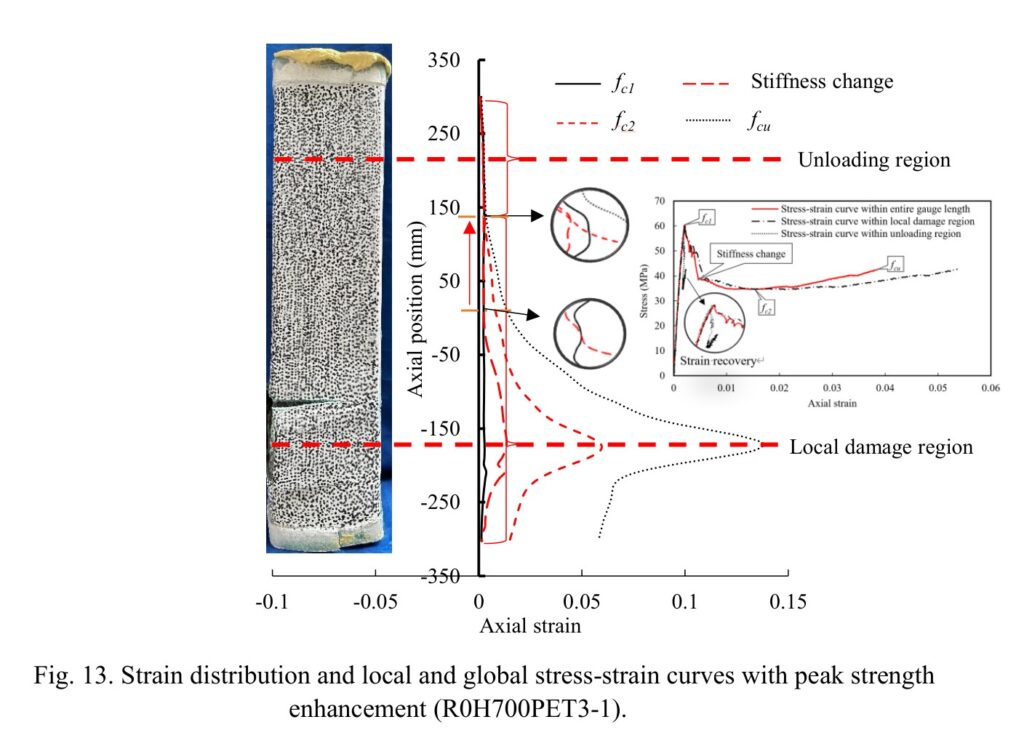
Strain measurements along the columns helped explain this difference. In Type I columns, deformation initially concentrated in weaker concrete regions. As these regions deteriorated, the surrounding portions experienced partial unloading, while additional compression continued to accumulate within the damaged area. Because confinement was limited, deformation remained concentrated in this region, and the measured local strain became substantially greater than the average strain across the column.
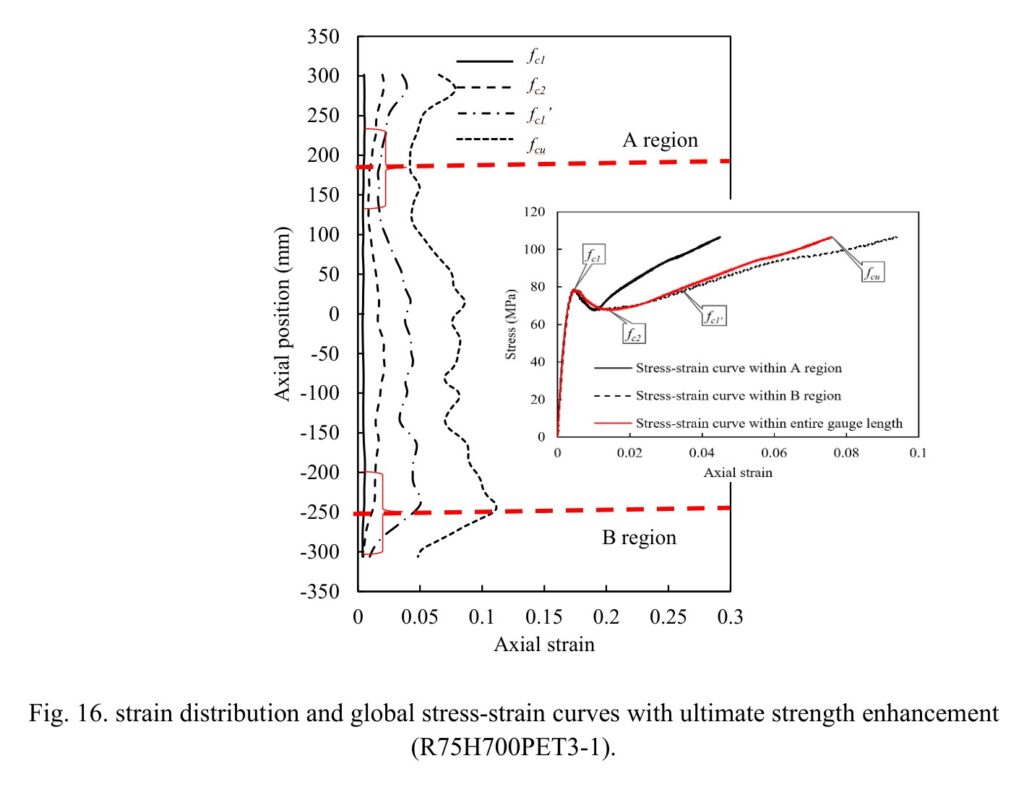
In Type II specimens, stronger confinement allowed deformation to spread along the column, either through expansion of the initially damaged region or the development of additional deformation zones. This produced a more uniform axial strain distribution and allowed a greater proportion of the column to contribute to its overall deformation.
Using their experimental findings and data from previous investigations of LRS-FRP-confined concrete, Li and Huang developed a model for predicting ultimate axial strain. Rather than applying the same geometric relationships to all specimens, the model distinguishes between Type I and Type II stress–strain behavior. It incorporates parameters associated with confinement, FRP rupture strain, cross-sectional geometry, and column height.
Column height had a substantial influence on predicted ultimate strain for Type I behavior but only a minor influence for Type II behavior. When Li and Huang compared their approach with four existing models they showed that the proposed approach provided more accurate predictions across circular and noncircular specimens, with a particular improvement for longer columns.
How Local Stress–Strain Behavior Governs Overall Deformation
The central contribution of the study is a mechanical explanation of how different local stress–strain responses lead to different ways of calculating overall column deformation. Although total axial shortening always represents the accumulated deformation along the column, the regions contributing to that shortening—and their loading histories—differ substantially between response types.
Figure 18 establishes the underlying distinction between postpeak softening and hardening. When deformation localizes during softening, a damaged region continues to shorten while other regions unload and recover part of their strain. The large strain measured in the damaged region therefore cannot be applied uniformly over the full column height. Under sustained hardening, deformation can develop more broadly, allowing a greater proportion of the column to contribute to axial shortening.
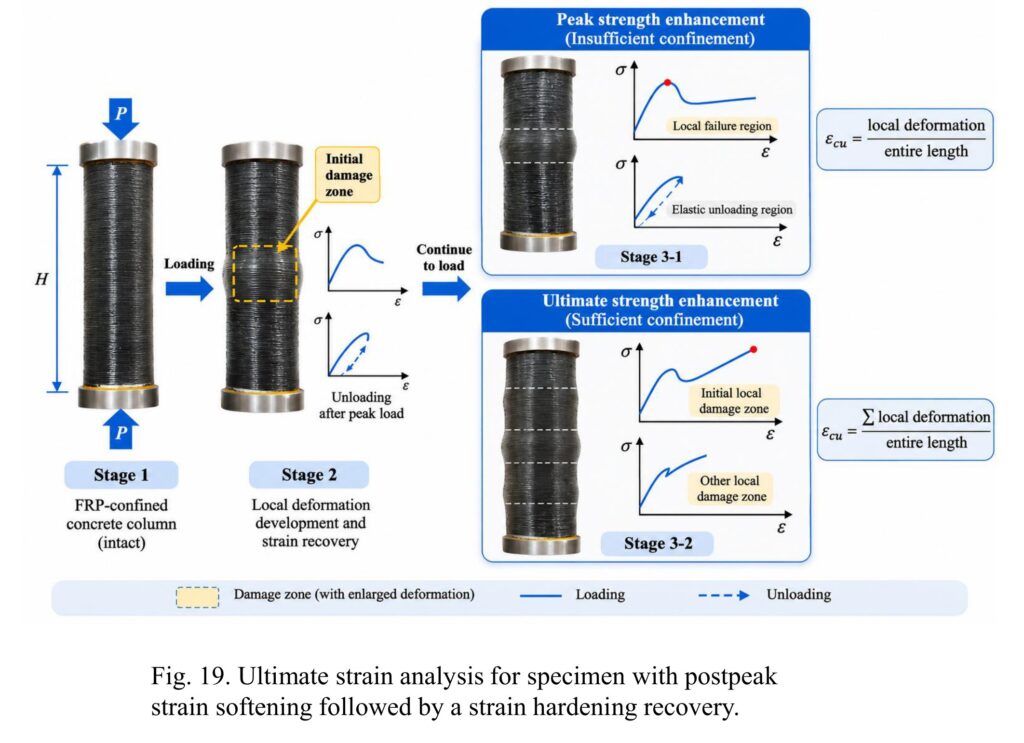
Figure 19 extends this explanation to the softening–recovery response characteristic of LRS-FRP-confined concrete. Initially, a relatively weak region reaches its load-bearing capacity and begins to soften. The resulting reduction in column load causes other, relatively stronger regions to unload. Continued lateral expansion in the damaged region then mobilizes additional FRP confinement, allowing its compressive stress to recover.
What happens next depends on whether that recovery exceeds the initial peak stress.
For Type I behavior, recovery remains insufficient to exceed the initial peak. Additional compression continues to accumulate mainly within the original damage region, while the remaining regions contribute comparatively little additional shortening. Overall deformation must therefore be calculated by distinguishing the localized deformation zone from the unloading or reloading regions outside it. Using the local ultimate strain as though it occurred throughout the column would overestimate the overall deformation capacity. As column height increases, localized shortening is averaged over a greater length, helping explain the pronounced reduction in average ultimate strain.
For Type II behavior, confinement enables the recovered stress to exceed the initial peak. Other regions can then progress beyond their earlier loading states and contribute further deformation. The initial deformation zone may expand, or additional deformation zones may develop elsewhere. Calculating overall shortening must therefore include the contributions of these participating regions, rather than assuming that deformation remains restricted to the first damaged zone. As deformation becomes more widely distributed, local strain becomes more representative of the overall response, and column height has a much smaller influence on average ultimate strain.
The distinction is therefore more significant than a difference in curve shape. Even an ascending recovery branch does not, by itself, establish that deformation has spread along the column. Its recovery relative to the initial peak is crucial to understanding which regions participate in subsequent deformation.
The measurements in Figures 13–16 support this interpretation: Type I responses showed persistent strain concentration and unloading outside the damaged region, whereas Type II responses showed broader participation in deformation. Together with Figures 18 and 19, these observations connect local material response with the calculation of structural deformation.
Engineering Significance
The research by Li and Huang improves the prediction of ultimate deformation capacity in LRS-FRP-confined concrete columns. It shows why models based mainly on material properties and cross-sectional geometry may not adequately represent the behavior of longer columns. Accounting for the relationship between local damage and overall deformation is particularly important when confinement is insufficient to prevent strain localization.
By distinguishing between two types of postpeak stress–strain behavior, the proposed model can represent differences in the effects of column height and corner geometry. It also helps explain why previous investigations reported conflicting relationships between corner radius and ultimate strain.
For structural engineers, the new model can provide a more reliable way to estimate ultimate axial strain across different column geometries and its predictive accuracy was evaluated using experimental data from specimens with different cross-sectional shapes and heights, supporting its use in assessing the deformation capacity of LRS-FRP-confined concrete columns under axial compression.
Reference
Li, Peng-Da & Huang, Peng-Cheng. (2026). Deformation Capacity Analysis of Large Rupture Strain FRP-Confined Concrete with Local Stress–Strain Effects. Journal of Composites for Construction. 30. 10.1061/JCCOF2.CCENG-5409.