Advances in Engineering Advances in Engineering features breaking research judged by Advances in Engineering advisory team to be of key importance in the Engineering field. Papers are selected from over 10,000 published each week from most peer reviewed journals.

Significance
Hydraulic fracturing in layered geological formations remains difficult to model because their interaction becomes once dimensionality, directionality, and scale separation are taken seriously at the same time. In tight reservoirs, fracture growth does not proceed in a single plane but instead, fractures extend laterally while also evolving vertically, all the while responding to elastic anisotropy, locally varying fracture resistance, and fluid flow constrained within a thin, deforming aperture. Capturing these effects simultaneously is challenging, and it is perhaps unsurprising that many established models avoid doing so. Much of the classical literature still relies on two-dimensional assumptions that quietly enforce homogeneity or isotropy, often for reasons of analytical or numerical convenience. While such models can be informative, they tend to smooth out behaviors that become important once fractures begin to curve or deviate from idealized geometries. The anisotropic character of layered rock further complicates the picture. Sedimentary deposition produces directional contrasts in stiffness and toughness that directly influence how a fracture front advances. Rather than propagating uniformly, different segments of the front may accelerate, slow down, or deflect, depending on orientation. Analytical solutions offer useful benchmarks, but they are inevitably tied to restrictive assumptions on fracture geometry and material response. As a result, they struggle to accommodate fracture fronts that evolve in a non-self-similar manner while remaining coupled to fluid flow. These limitations have pushed the field toward fully three-dimensional numerical methods. XFEM, in particular, is appealing because it allows fractures to propagate independently of the background mesh. However, extending XFEM to fluid-driven fracturing in anisotropic media introduces its own set of problems. Crack-tip asymptotic fields no longer remain constant along the front, stress intensity factors become strongly direction-dependent, and standard propagation criteria begin to lose coherence. Many existing formulations address these issues only partially, often falling back on isotropic enrichment functions or simplified growth laws that are difficult to justify once material anisotropy and toughness variation are no longer negligible.
To this end, new research paper published in Computer Methods in Applied Mechanics and Engineering and conducted by Dr. XiuYuan Chen, Professor Hao Yu, Dr. YiLun Zhong, Dr. Quan Wang, and Professor HengAn Wu from the CAS Key Laboratory of Mechanical Behavior and Design of Materials, Department of Modern Mechanics at University of Science and Technology of China, the researchers developed a fully coupled three-dimensional XFEM framework for hydraulic fracturing in layered anisotropic rock that incorporates direction-dependent crack-tip enrichment functions and an anisotropy-aware fracture propagation law. A hybrid explicit–implicit fracture representation enables efficient geometry updates while maintaining accurate enrichment identification. By regularizing Irwin’s criterion through inversion of anisotropic crack-tip asymptotes, the model captures non-uniform fracture growth along curved fronts.
The research team implements the proposed methodology within a fully coupled three-dimensional XFEM framework that simultaneously resolves elastic deformation in transversely isotropic rock and two-dimensional fluid flow along the evolving fracture surface. Fracture geometry is described explicitly through triangulated surface elements, while level set functions are introduced in an implicit manner to identify enriched nodes and construct local crack-tip coordinate systems. By combining these two descriptions, the team adopts a hybrid explicit–implicit strategy that circumvents the numerical overhead associated with advection-based level set evolution, yet retains sufficient geometric flexibility to accommodate complex fracture growth. A defining feature of the formulation is the construction of anisotropic crack-tip enrichment functions. At each quadrature point along the fracture front, a local coordinate system is established based on the normal direction of the evolving front. The global elastic stiffness matrix is transformed accordingly, and plane-strain compliance components are extracted to solve a characteristic equation governing crack-tip asymptotes. As a result, the enrichment functions vary smoothly along the fracture front, reflecting local variations in material stiffness and orientation. This contrasts sharply with conventional XFEM implementations that assume uniform asymptotic behavior.
The authors modeled fluid flow within the fracture as laminar Poiseuille flow, coupled to rock deformation through fracture opening. The resulting nonlinear system is solved using a Newton–Raphson scheme, with convergence verified across both toughness-dominated and viscosity-dominated regimes. Benchmark simulations of penny-shaped fractures demonstrate close agreement with analytical solutions for fracture width, radius, and stress intensity factors, confirming the accuracy of the coupled formulation. Fracture propagation is governed by a regularized Irwin-type criterion that has been modified to account explicitly for anisotropy. Instead of prescribing a uniform advance when the critical stress intensity is reached, the model inverts the local crack-tip asymptote to determine direction-dependent growth distances along the fracture front. An apparent Young’s modulus, dependent on propagation angle, is introduced to capture directional stiffness effects. This leads to fracture fronts that advance unevenly, even under nominally uniform loading conditions. The authors found that in transversely isotropic media with isotropic fracture toughness, initially circular fractures evolve toward non-elliptical equilibrium shapes that compensate for stiffness anisotropy. When fracture toughness is itself anisotropic, the model captures transition stages in which fracture geometry adapts before reaching a self-similar growth regime. Importantly, the simulations demonstrate that assuming strictly elliptical fracture shapes can significantly overestimate fracture aspect ratios, particularly when stiffness anisotropy is strong.
In conclusion, the research work of Professor Hao Yu, Professor HengAn Wu and their colleagues developed a new computationally robust method capable of resolving complex three-dimensional fracture evolution beyond isotropic assumptions. Indeed, this work represents a significant advancement in three-dimensional XFEM by, for the first time, introducing a new comprehensive crack-tip enrichment function construction method and a regularized Irwin’s criterion for layered anisotropic rock. By allowing crack-tip asymptotic fields to vary continuously along the fracture front, the authors resolve a long-standing inconsistency between XFEM theory and the physical reality of layered rock formations. This alone has significant implications for fracture mechanics modeling beyond hydraulic fracturing, including geological faulting and fracture propagation in engineered composites.
Additionally, the introduction of a regularized, anisotropy-aware fracture propagation criterion is especially impactful. Traditional propagation laws implicitly assume that fracture growth is governed solely by local stress intensity reaching a critical threshold. The present formulation demonstrates that growth distance is equally controlled by directional Young’s modulus and fracture toughness, both of which vary along a curved front in anisotropic media. As a result, fracture evolution is shown to be inherently non-uniform, even under symmetric loading conditions and this finding challenges the widespread use of simplified growth assumptions in reservoir-scale simulations. Moreover, the authors’ hybrid explicit–implicit fracture description offers a pragmatic balance between accuracy and efficiency. The new method achieves scalability without sacrificing geometric fidelity by avoiding advection-based level set evolution while retaining implicit enrichment identification. This makes it particularly suitable for large-scale three-dimensional simulations relevant to field-scale hydraulic fracturing design. The study also has important implications and the predictions of fracture height growth, aspect ratio, and width distribution are directly linked to reservoir connectivity and production efficiency. Overestimating fracture extent in stiff directions or underestimating confinement effects can lead to flawed operational decisions. The present model provides a more physically grounded basis for such predictions, especially in formations where anisotropy is pronounced rather than incidental. More broadly, the framework establishes a foundation for future extensions. Incorporating heterogeneity, poroelastic coupling, or fracture network interactions becomes more tractable when the underlying crack-tip mechanics are treated consistently. The methodology therefore opens new avenues for predictive modeling of subsurface fracture processes under realistic geological conditions. In sum, the reported study provides an efficient, powerful and robust tool for understanding and predicting complex 3D fluid-driven fracture propagation, revealing the non-self-similar propagation behavior in anisotropic rock.
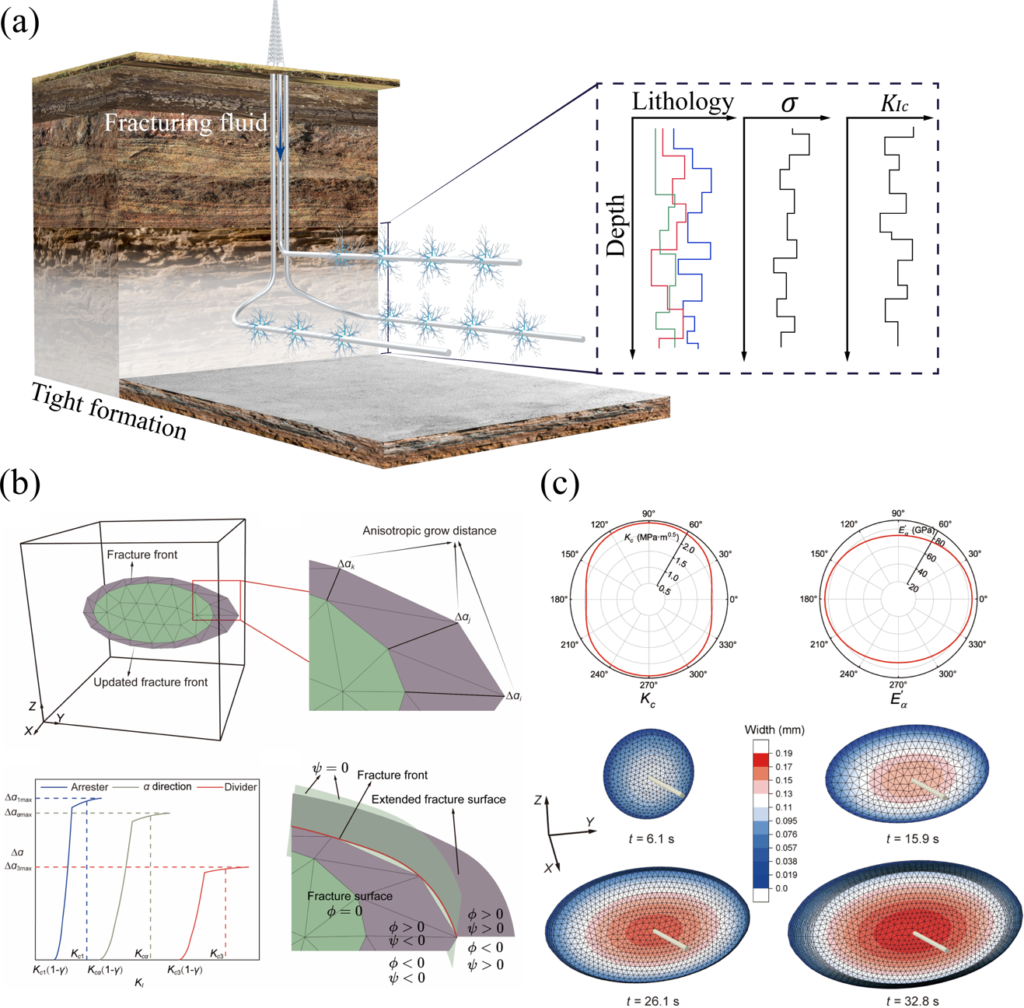
Figure: (a) Schematic of three-dimensional hydraulic fracturing model; (b) The hybrid explicit-implicit method for fracture propagation and geometric description with rock anisotropy; (c) The hydraulic fracture propagation process under anisotropic material and fracture toughness.
Note: This figure is remade by ourself and no need for permission.



Reference
XiuYuan Chen, Hao Yu, YiLun Zhong, Quan Wang, HengAn Wu, 3D XFEM for fluid-driven fracturing of layered anisotropic rock, Computer Methods in Applied Mechanics and Engineering, Volume 441, 2025, 117963,
Go to Journal of Computer Methods in Applied Mechanics and Engineering.