 Advances in Engineering Advances in Engineering features breaking research judged by Advances in Engineering advisory team to be of key importance in the Engineering field. Papers are selected from over 10,000 published each week from most peer reviewed journals.

Significance Statement
A crack embedded in elastic homogeneous systems is observed to propagate in the direction of maximum energy release rate that is experienced by incipient kink cracks at the tip of the crack. For instance, under mode I crack surface opening conditions, including incipient kink crack directly ahead of the tip of the crack, experiencing maximum energy release rate, therefore, it is the one initiated in the course of crack growth initiation and confines the macro-crack path to the plane of the crack.
Under pure mode II loading conditions, i.e. under relative crack surface sliding conditions, local maximum in the energy release rate is normally experienced by a kink crack at about 70.3° clockwise from the crack plane for a positive mode II stress intensity factor. In an interesting manner, the kink crack path direction estimated implementing a maximum energy release rate criterion is observed to coincide with a path perpendicular to the maximum principal stress near the crack tip.
It has been observed from previous studies that it can be challenging to envision the conditions, under which mode II crack occur, for instance, horizontal crack embedded in a cantilever beam subjected to an end force loading, will initiate and propagate in plane. University of Maryland researchers Dr. Xiaomin Fang and Professor Panos Charalambides employed a J-integral approach for developing estimates of the available elastic energy release rate at crack tips on the right and left. For this reason, they used moment resultants, beam deflections and cross sectional force. Their work is now published in Engineering Fracture Mechanics.
Path independent J-integral equals to the elastic energy release rate which is available to the crack-tip contained within the domain bounded by the integral contour as well as traction free crack surfaces. This is based on linear and elastic isotropic system. Considering the independence of the J-integral, the authors used contours for left and right crack tips. Every contour initiated at the bottom crack surface relative to a system that was positioned at the crack tip, and followed the specimen contour in an anti-clockwise direction and ended at the top surface.
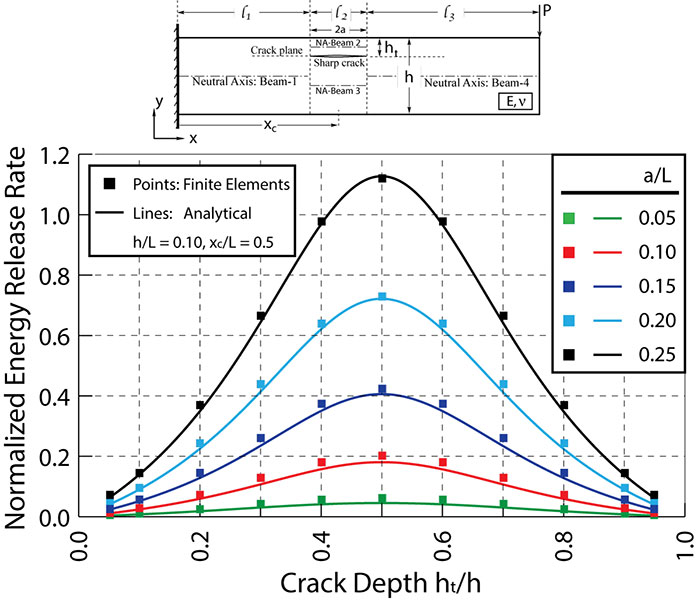
The authors also carried out finite element studies of a cantilever beam with an embedded sharp crack and subjected to an end traverse loading. They systematically placed cracks of different lengths as well as orientation on geometrically admissible locations within the selected beam. They extracted and reported the near-tip energy release rate and mode I and mode II stress intensity factors that dominated the crack tip regions.
Both analytical and numerical results yielded identical energy release rate predictions where the right and left tips experienced identical levels of energy release rate. 2-D finite element models were adopted for parallel studies to extract the energy release rates for a wide range of beam and crack systems. Comparison results indicated significant agreement between finite element and analytical predictions. However, there were slight deviations between two predictions for cracks deeply embedded close to the neutral axis of the beam.
Energy release rates for all systems at the left and right crack tips were observed to be symmetric with respect to the neutral axis of the beam. This suggested that horizontal cracks situated at equal distances below and above the neutral axis of the beam experienced identical energy release rates.


Reference
Xiaomin Fang, Panos G. Charalambides. A J-integral approach in characterizing the mechanics of a horizontal crack embedded in a cantilever beam under an end transverse force. Engineering Fracture Mechanics 169 (2017) 35–53.
Go To Engineering Fracture Mechanics