Advances in Engineering Advances in Engineering features breaking research judged by Advances in Engineering advisory team to be of key importance in the Engineering field. Papers are selected from over 10,000 published each week from most peer reviewed journals.

Significance
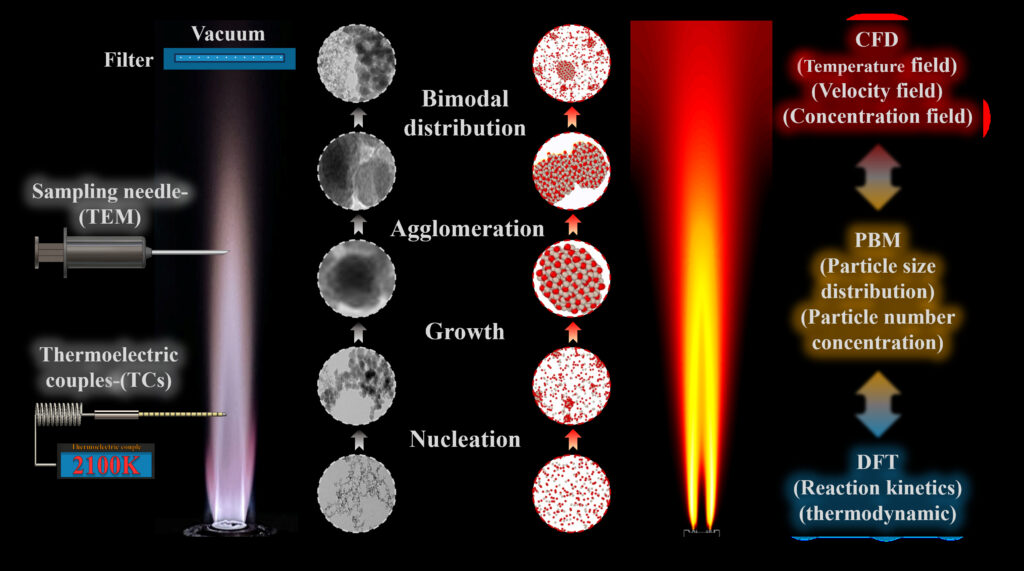
Flame-based routes for synthesizing silica nanoparticles have long been valued for their scalability and their ability to convert volatile silicon precursors into materials with tightly controlled morphology. However, despite their industrial maturity, the underlying physics and chemistry remain frustratingly intricate. The fate of each particle is set by a sequence of events that begins at the molecular level with rapid hydrolysis and pyrolysis reactions and ends at the macroscopic scale with agglomeration in a vigorously mixing flame. Traditional models tend to isolate one part of this sequence—often the reaction chemistry or the turbulent flow—while relegating the remainder to simplified assumptions. This separation has made it difficult to gain a consolidated understanding of how local reaction pathways, temperature fields, and particle-level processes reinforce one another as silica evolves from SiCl₄ in a hydrogen–oxygen flame. To this end new research paper published in AIChE Journal and conducted by Dr. Jie Ju, Dr. Lingli Luo, Dr. Yingjie Wu, Dr. Qiling Cheng, Dr. Hao Jiang, Professor Yanjie Hu, and Professor Chunzhong Li from the East China University of Science & Technology, the researchers developed a multiscale numerical platform that unifies first-principles reaction kinetics with macroscopic combustion modeling and population balance descriptions of particle evolution. Their DFT-derived mechanism provides chemically realistic rate parameters that drive nucleation and growth predictions. The CFD–PBM framework then links these microscopic rates to the evolving temperature and flow fields of the flame.
The research team first established accurate molecular-level kinetics for the SiCl₄ system. They optimized the reactants, intermediates, and transition states associated with hydrolysis and pyrolysis pathways using density functional theory. Their calculations supplied activation energies, pre-exponential factors, and temperature-dependent reaction rates for an 18-step mechanism that reflects the hierarchy of processes occurring in the early stages of silica formation. One noteworthy outcome was the identification of a high-barrier pyrolytic step whose rate ultimately governs how quickly reactive intermediates decompose and feed the formation of Si-oxy species. The authors established a kinetic foundation that could be embedded directly into a combustion simulation without relying on empirically tuned corrections by clarifying these microscopic bottlenecks. They also incorporated the kinetic mechanism into a CFD framework designed to reproduce the conditions inside the flame reactor. The model resolved mass, momentum, and energy transport while allowing concentration fields to adapt dynamically to the reaction rates supplied by the DFT calculations. The research team selected the reactor geometry, gas injection configuration, and flow regime to mimic experimental conditions under which SiCl₄, hydrogen, and air mix and ignite and through the simulation, the model reproduced key features of the flame: the emergence of a high-temperature combustion zone, the presence of a rapid upward jet, and the transition from unmixed reactants near the nozzle to well-mixed gases farther downstream.
They then used these flow and temperature fields as the evolving environment for the population balance model. Nucleation was triggered once local supersaturation crossed the threshold determined by the kinetic scheme. Growth proceeded through both mass-transfer-limited and reaction-limited pathways, depending on position within the flame. Aggregation was represented using a fractal description that accounts for the open, chain-like structures typically observed in silica nanoparticle clusters. By tuning the nucleation and growth constants within physically justified ranges, the authors arrived at a model that generated self-consistent particle size distributions across the length of the reactor. The authors also compared simulation outputs against measurements taken at various flame heights to test the reliability of their predictions and the thermocouple readings confirmed that the CFD simulation and reproduced the thermal structure of the flame with only small deviations at locations where measurement artifacts are expected. The team performed transmission electron microscopy which showed that primary particle sizes increased steadily with height, a trend reproduced by the model. Moreover, optical particle sizing corroborated the predicted formation of larger agglomerates near the reactor exit.
In conclusion, the East China University of Science & Technology scientists developed new models that can offer a predictive, experimentally validated tool for understanding and controlling silica nanoparticle formation in high-temperature reactors. The significance of the new work lies in its demonstration that nanoparticle synthesis in flames can be understood with far greater nuance when chemical and physical processes are not artificially separated. Indeed, the authors produced a framework that captures the intertwined phenomena governing silica evolution by constructing a kinetic mechanism from first principles and embedding it directly into a CFD–PBM model. The new approach moves beyond the usual practice of inserting generic reaction schemes into combustion models and hoping the resulting particle predictions align with experiment. Instead, it shows that the microscopic details matter—and that they can be incorporated without sacrificing computational tractability.
A key implication is that reactor optimization may now be approached with a deeper level of insight. Because the model clarifies how hydrolysis pathways, pyrolytic barriers, and supersaturation fields interact, it allows one to reason more precisely about how modifications to precursor flow, flame stoichiometry, or thermal gradients will influence nucleation intensity and growth trajectories. This is important in industry where particle size distributions must be tightly controlled. By identifying where in the reactor growth accelerates, where aggregation becomes dominant, and where chemical bottlenecks hold the process back, the framework provides guidance on how to manipulate conditions to achieve a desired outcome. Another important contribution is the treatment of aggregation and rather than assuming spheres or adopting overly simplified kernels, the authors used a fractal description that reflects the open, ramified structures common in flame-synthesized silica. This allowed the model to predict both primary and aggregate size distributions in a manner consistent with experimental observations. For applications in optics, catalysis, or surface engineering—where aggregate morphology directly affects performance—such realism is essential. The study also demonstrates how multiscale modeling can reduce dependence on extensive trial-and-error experimentation. Because the model accurately reproduces both the thermal field and the evolution of particle sizes, it can serve as a predictive tool for exploring conditions not yet tested experimentally. This ability to screen operating regimes computationally can shorten development cycles and help identify promising parameter windows before committing resources to full-scale testing. Ultimately, the new framework by Professor Yanjie Hu and colleagues is considered a significant methodological advancement for flame aerosol science and it shows that when molecular kinetics, fluid dynamics, and particle evolution are woven together, they form a more coherent picture than any single-scale model could offer. This integrated perspective equips researchers and industry with a practical tool for designing more efficient reactors and producing nanomaterials with tailored characteristics.


Reference
Ju, Jie & Luo, Lingli & Wu, Yingjie & Cheng, Qiling & Jiang, Hao & Hu, Yanjie & Li, Chunzhong. (2025). Multiscale numerical simulation of the evolution of SiO2 nanoparticles in high‐temperature rapid reaction processes neglecting sintering. AIChE Journal. 71. 10.1002/aic.18760.
Go to Journal of AIChE.