Advances in Engineering Advances in Engineering features breaking research judged by Advances in Engineering advisory team to be of key importance in the Engineering field. Papers are selected from over 10,000 published each week from most peer reviewed journals.

Significance Statement
The Purpose
The proposed method helps you to manage the quality risk of your ongoing software project.
The Objective
Your ultimate objective is to deliver the software product on time achieving the quality goal.
Your Project Assumptions
- Your ongoing software project is within Acceptance Test.
- The testing project is on schedule at the present, i.e. end of Week (i).
- The test is planned to finish in Week (j) inclusive, where j > i.
- The planned delivery date is the week after end of testing, i.e. Week (j + 1).
- Your Software Quality goal is: The last week of testing Week (j) should be defect free, i.e. zero defects.
The Problem
The problem is how to deliver the software product on time and achieve the quality goal.
The Resolution: Implement the Method
- Using the failure history data for Week (1)–Week (i), predict the quality at the planned end of testing Week (j); and measure the predicted quality versus your quality goal.
- If the prediction meets your goal, you will most likely deliver the product on time achieving the quality goal by continuing the testing as is. However, you should continue to use the method on regular basis (i.e. weekly in this hypothetical case) in order to monitor and control the performance of your tasting in order to achieve your objective.
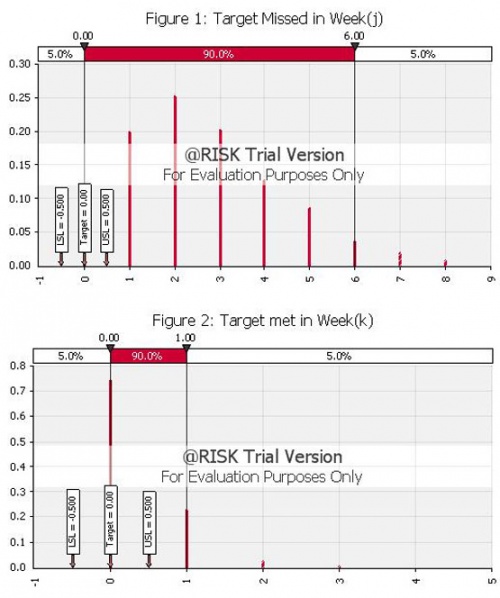
- If the prediction misses your goal, by continuing the testing as is, you will most likely fail to deliver the product on time and meet the quality goal. For example, Figure 1 shows that the Mean Number of Defects in Week (j) equals two, i.e. missing the zero defects goal.
- If the goal is missed, predict when your quality goal will be met if you continue the testing as is? For example, the goal will be met in Week (k) where k > j (Ref. Figure 2, where the Mean Number of Defects is zero). Now, you’ve got two options: 1) Continue the testing as is and either; deliver the product on time and miss the quality goal; or deliver the product later in Week (k) and meet the quality goal; or 2) Improve your testing process in order to deliver the product on time, i.e. in Week (j + 1) and achieve the quality goal.
Please, reed the paper to find out how to accomplish your ultimate objective.
Software Testing, Verification and Reliability, Volume 24, Issue 2, pages 124–154, March 2014.
Vojo Bubevski.
Bubevski Systems & Consulting, Portslade, Brighton, United Kingdom.
Abstract
Software quality is very important in today’s competitive business environment. It is a critical constraint on software projects. Software organizations’ major objectives are delivering products on time and achieving quality goals. Quality is directly dependent on software processes, which are inherently variable and uncertain, involving substantial risk. Managing quality risk is an important challenge. The conventional approach to quality risk management for ongoing software processes has two major deficiencies: static analytic models are used, and structured methodologies to enhance processes and improve quality are not systematically applied. This new practical method uses Six Sigma and Monte Carlo Simulation for ongoing quality risk management. DMAIC (Define, Measure, Analyse, Improve, Control) is systematically applied as a tactical framework to enhance the process and improve quality. Simulation predicts quality (reliability) at the expected process end and identifies and quantifies risk. DMAIC is a verified structured methodology for systematic process and quality improvements. Monte Carlo Simulation is superior to conventional risk models. These synergetic enhancements eliminate observed deficiencies. The method has been successfully proven and applied practically on real in-house projects. Substantial savings, quality and customer satisfaction have been achieved. An application on an internal project and obtained results are presented. The method is simplistically elaborated on a published third-party project answering key research questions from practical perspectives. This CMMI® compliant method offers important benefits including savings, quality and customer satisfaction. Copyright © 2013 John Wiley & Sons, Ltd.
Copyright © 2013 John Wiley & Sons, Ltd.