Advances in Engineering Advances in Engineering features breaking research judged by Advances in Engineering advisory team to be of key importance in the Engineering field. Papers are selected from over 10,000 published each week from most peer reviewed journals.

Significance
To this account, new research paper published in Optics Letters and conducted by Dr. Yiluo Jiang and Professor Yonghang Shen from the College of Optical Science and Engineering at Zhejiang University, alongside Dr. Wenping He from the SoundFiber Photonics Inc., the researchers developed a dual-pulse phase-OTDR fiber sensor integrated with an active laser-frequency compensation loop. By using the interferometric output of an in-balanced Mach–Zehnder interferometer as a feedback signal, the system directly stabilized the combined parameter f(t) • tp, compensating simultaneously for laser drift and arm-length jitter. The authors’ experimental configuration focused on an IMZI-based dual-pulse ϕ-OTDR, fed by a single-frequency semiconductor laser operating near 1550 nm with a narrow 3 kHz linewidth. They first gated continuous-wave output by an acousto-optic modulator to form single pulses and then divided within the interferometer into dual pulses separated by a 20 m optical path difference. These pulses, amplified by an erbium-doped fiber amplifier, were launched into a 967 m G.652 telecommunications fiber acting as the sensing medium. A 37.5 m segment located 545 m from the input end was wound on a piezoelectric transducer (PZT), which introduced controlled vibrations driven by an arbitrary waveform generator. To realize active compensation, a fraction of the laser light was sent backward through the IMZI. The returning interferometric intensity, captured by a photodetector, served as a live indicator of any fluctuation in the composite term f(t) • tp. Deviations from a predefined reference value were processed through a custom feedback circuit that modulated the laser injection current, thereby tuning its frequency with a sensitivity of 80 MHz per volt. This simple optical-electronic loop simultaneously countered frequency drift and arm-length jitter. When operated without compensation, the authors observed interferometric signal displayed slow drift and large intensity oscillations—up to 1.6 V over 8.5 s—revealing pronounced instability. Upon activating the feedback, the same signal remained nearly constant, with instantaneous noise falling from 20 mV to 8 mV, corresponding to a 60 % reduction in short-term fluctuation. The improvement propagated directly into the distributed sensing response. Rayleigh-backscattered flow maps recorded under 200 Hz sinusoidal and triangular excitations revealed that, in the uncompensated mode, vibration edges appeared blurred and distorted, whereas under frequency control the features sharpened and waveform shapes were faithfully preserved. Moreover, the recovered time-domain traces left little doubt about the system’s improvement. Whether the piezoelectric transducer applied a sinusoidal or triangular vibration, the actively compensated sensor reproduced the driving waveform with striking accuracy—its peaks, troughs, and transitions clearly preserved. Quantitatively, the residual noise dropped by about half for the sinusoid and by roughly forty percent for the triangular input. These observations were not incidental; they followed closely the expectations from the phase-stability model, confirming that the feedback loop successfully maintained the constancy of f(t) • tp. The gain extended beyond cleaner traces: the signal-to-noise ratio nearly doubled, an outcome that hints at partial suppression of intrinsic laser phase noise in addition to mechanical jitter. What emerged was a sensor that seemed to regulate its own coherence—a distributed acoustic system that stayed steady for long measurements while relying on relatively simple optical and electronic components.
In conclusion, the innovation of Professor Yonghang Shen and colleagues yielded substantial reductions in noise and waveform distortion, effectively doubling the sensor’s signal-to-noise ratio. The approach establishes a compact, self-stabilizing architecture for high-fidelity distributed acoustic sensing. Indeed, their idea of letting the Mach–Zehnder interferometer monitor and correct its own frequency drift turns a once troublesome element into a built-in reference. This approach moves away from the heavy machinery of temperature-controlled modules and external frequency discriminators. Instead, stability is woven into the sensor’s optical fabric itself—the network becomes the instrument’s own reference frame. Such elegance, achieved through feedback rather than added complexity, points toward a new generation of self-aware, resilient fiber-optic sensing systems. Additionally, the demonstrated 60 % reduction in short-term noise and 50 % suppression of waveform distortion indicate that phase fluctuations from both mechanical and electronic origins can be concurrently neutralized. The implications extend beyond laboratory validation. In field applications such as perimeter monitoring, underwater acoustic mapping, and seismic event detection—where environmental noise and temperature gradients continuously challenge coherence—this approach promises sustained high-fidelity signal recovery without the overhead of complex calibration. The method effectively broadens the usable dynamic range of dual-pulse ϕ-OTDR, allowing it to capture both low-frequency drift and rapid high-frequency vibrations with equal reliability. Moreover, the design achieves these gains through minimal modification of standard components: an optical coupler, a photodiode, and a simple analog feedback circuit. Such accessibility lowers barriers to integration into existing sensor infrastructures. The principle can, in principle, be generalized to other interferometric or frequency-sensitive platforms—Brillouin and Raman distributed sensors, coherent optical communications, or even frequency-modulated continuous-wave LIDAR—where joint control of frequency and timing is essential. By demonstrating that a simple feedback path can achieve precision comparable to sophisticated electronic controllers, the study underscores an elegant principle: in optics, stability can be engineered not by isolation from noise but by active engagement with it. In a nutshell, the new findings in the study thus open a route toward next-generation distributed acoustic sensors that are lighter, smarter, and inherently more resilient to the fluctuations that once constrained their reach.
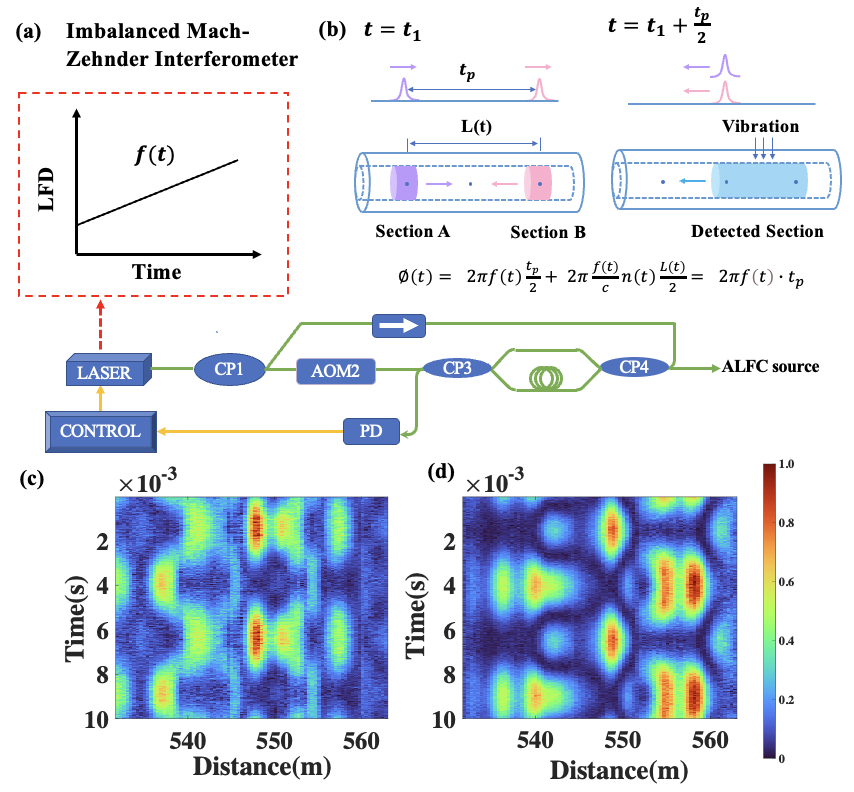
Figure 1 (a) Schematic diagram of stabilizing the Imbalanced Mach-Zehnder Interferometer through active laser frequency control (b) dual-pulse resulted interference within the sensing fiber (c) flow chart of the dual-pulse ϕ-OTDR with(right) and without (left) feedback control